


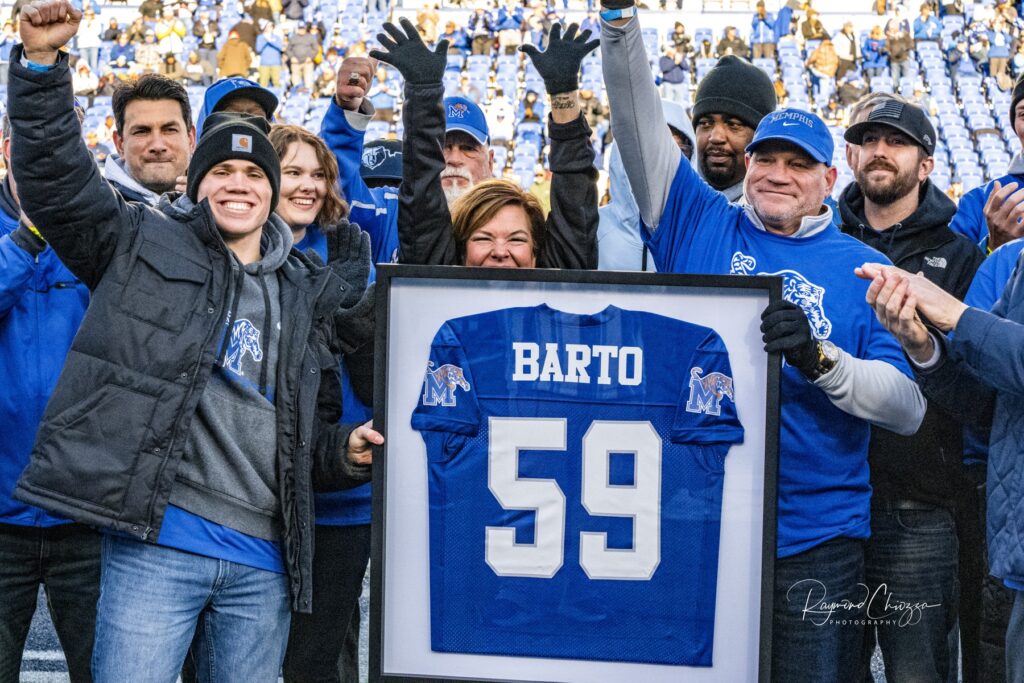
The final jersey in this series is also the one that brings Memphis football’s retired-number story closest to the present.
No. 59: Danton Barto and the Modern Measure of Defensive Greatness
Danton Barto’s No. 59 was added to the retired group in 2022, joining John Bramlett, Isaac Bruce, Dave Casinelli, Charles Greenhill, Harry Schuh, and DeAngelo Williams in one of the most exclusive circles in program history. That timing matters. Barto is not a distant name from black-and-white photos or half-remembered radio stories. He is close enough to modern Memphis football that his legacy still feels active, still feels lived-in, still feels personal to people who watched him and worked with him.
And once you look at the résumé, the honor feels unavoidable.
The Production Alone Was Enough
To this day, Barto remains the school record holder for career solo tackles with 273 and total tackles with 473, while ranking second all-time with 200 assisted tackles. He was a first-team All-South Independent selection in 1991, 1992, and 1993, earned Defensive Player of the Year honors in 1992 and 1993 across the South Independent and Independent Football Alliance recognition listed by the school, and was named a Football News All-American from 1991 through 1993.
That is not a good career. That is a program-defining one.
Barto’s greatness was built on the kind of consistency defensive coaches dream about. Tackling is one of the purest measures of defensive reliability. It means finding the ball, getting there on time, and finishing the play over and over again. To own Memphis’ career records in that category is to say that for years, no one on that side of the ball was more dependable, more active, or more central to the outcome of games than Danton Barto.
And yet the records only explain part of why his jersey retirement hit so hard.
More Than a Tackling Record
Barto passed away in 2021 at the age of 50, and his jersey retirement announcement the following year carried the emotional force that comes when a school publicly gathers memory and honor into one act. It was not merely a statistical recognition, though the statistics were overwhelming. It was also an acknowledgment that Barto’s relationship with football and with Memphis extended beyond his playing days.
After his college career, Barto played professionally in the CFL and AFL, coached the Memphis Xplorers to their first league championship while earning Coach of the Year honors, later served as head coach of the Las Vegas Gladiators, and worked as an NFL scout for the St. Louis Rams. That matters because retired jerseys at Memphis are not awarded on talent alone. The school’s own criteria include character, leadership, post-collegiate impact, prior Hall of Fame induction, and high-level honors during or after a player’s career.
In other words, No. 59 was retired because Barto checked every box a program could reasonably ask for. He was elite on the field, decorated nationally, connected to Memphis after college, and important to the sport well beyond his own playing window.
That makes him the ideal closing figure for this series. If Isaac Bruce pointed Memphis toward possibility and DeAngelo Williams expanded the program’s reach, Barto represents institutional memory at full maturity. His jersey retirement tells fans what Memphis now understands about its own history: greatness must be preserved while the people who felt it are still here to tell the stories.
No. 59 also creates a fitting final link back to Bramlett. Barto twice won the John Bramlett Defensive Player of the Year award before eventually joining Bramlett in the retired-number fraternity. One legendary defender became the name on the award. Another became the player worthy of winning it and, later, hanging beside him.
That is the kind of symmetry good program history gives you.
So when fans look up and see No. 59 retired, they should see more than a tackle total. They should see the modern defensive standard. They should see a life in football that extended from college dominance to coaching, scouting, and long-term influence. Most of all, they should see proof that Memphis still knows how to honor the people who built it.
In that sense, Danton Barto is the perfect final chapter. The jersey is retired. The standard remains.