
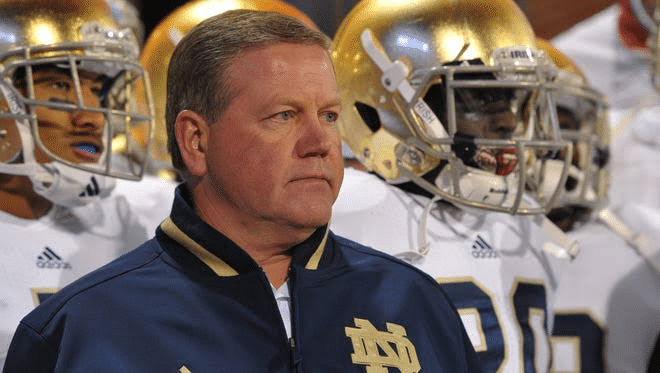
College football knows how to examine a coach’s record. It is considerably less comfortable examining what should matter more. Put Brian Kelly’s name in a coaching search and the familiar calculations begin. How much does he have left? Can he recruit? Can he win enough to justify the investment?
Before Brian Kelly Coaches Again, College Football Owes Declan Sullivan a Serious Conversation
Before another university answers any of those questions, it should answer a harder one. Why should it trust him with the responsibility again? That question begins with Declan Sullivan, the 20-year-old Notre Dame student employee who died on October 27, 2010, when high winds toppled the elevated scissor lift from which he was filming football practice. Kelly was Notre Dame’s head coach. He later acknowledged that the decision to practice outdoors was his.
Sullivan’s death should not be reduced to a weapon in an argument about a football coach. He was a young man whose life mattered independently of the program he worked for. But respecting that distinction does not require separating his death from an honest examination of the people responsible for that program. It requires getting the facts right.
A Safety Failure, Not Just Dangerous Weather
Indiana’s workplace-safety investigation identified six violations. Regulators said Notre Dame directed untrained student videographers to use scissor lifts during an active wind advisory, with sustained winds and gusts exceeding the manufacturer’s specifications and warnings. They also identified failures involving training, inspections, preventive maintenance, access to an operator’s manual and warning labels.
That is not simply a description of bad weather. It is a description of protections that were supposed to exist before the weather became an emergency. The state initially assessed $77,500 in penalties, including a “knowing” violation, its most serious classification. A subsequent settlement reduced that violation to “serious” and the total fine to $42,000. Both parts belong in the story. Anyone demanding accountability cannot selectively omit the facts that complicate his argument.
The same standard applies to Kelly. The findings cited here do not establish that he personally ordered Sullivan onto the lift or knowingly disregarded its operating limits. Suggesting otherwise would replace a legitimate leadership question with an accusation the record does not support.
But Kelly did identify himself as the person who decided the team could practice outside. “On Wednesday I made the decision that we could have a productive and safe practice outdoors,” he said afterward. Choosing the practice location is not the same as approving a piece of equipment. A head coach is not an occupational-safety inspector. He is, however, a leader whose decisions affect people far beyond the players on his depth chart.
Accountability Requires the Whole Record
If a coach cannot personally know every technical risk, his program needs people who do—and procedures that give those people the authority to stop something unsafe. Delegation should establish responsibility, not dissolve it. Notre Dame’s own investigation found the university “collectively responsible.” It identified four primary factors: a sudden 53-mph wind burst, staff members’ lack of knowledge about on-field wind speeds, the particular lift’s susceptibility to tipping and its elevation. University president John Jenkins said the investigation concluded that “no one acted in disregard for safety,” while accepting ultimate institutional responsibility himself.
Those conclusions deserve space, too. They do not support turning Sullivan’s death into a claim that Kelly alone caused it. Nor should Sullivan’s family be drafted into that argument. On the first anniversary of his death, Notre Dame’s student newspaper reported that the family had publicly said it did not blame the university. Their position deserves respect, not reinterpretation to suit a column.
A family’s response to an unimaginable loss, though, is not a substitute for a university’s hiring judgment. These are separate responsibilities. Sullivan’s family owes the public nothing. A university choosing the next person to lead its football program owes its students and employees a serious examination of that person’s judgment.
That examination should neither manufacture culpability nor retreat into the convenient argument that institutional responsibility means no individual leader has anything left to explain.
Another Opportunity Must Require More Than Wins
The question of whether Kelly should coach again cannot be answered responsibly with either a reflexive lifetime ban or a recitation of his victories. Another school should have to explain what it knows about his accountability, what he learned and how those lessons changed the way he leads.
Notre Dame agreed to institutional changes following Sullivan’s death, including a national scissor-lift safety education campaign, additional training and a liaison between athletics and risk management. Its football program also replaced the lifts with an operational remote-camera system.
Those changes matter. So does asking what changed in the head coach. Not whether he can produce the appropriate expression of regret at an introductory news conference. Whether he can explain, specifically, how he now ensures that the people doing essential, largely invisible work around his program have protection—and permission to raise concerns.
Is Kelly Back?
A university considering him should ask that before negotiating his salary. It should be prepared to explain its answer publicly. Without that explanation, my answer is no. That is not a finding of criminal guilt. It is a judgment about the burden that should accompany another opportunity to lead.
The passage of time does not, by itself, answer a question about accountability. Neither does professional success. If a school believes Kelly has met that burden, it should make the case rather than treating the subject as an uncomfortable interruption.
A football program’s responsibility extends to the student holding a camera, not just the quarterback standing in front of it. Before another university introduces Brian Kelly as its next head coach, it should be able to explain why it trusts him with both.