

Some players become stars. Some players become eras. DeAngelo Williams was the second kind.
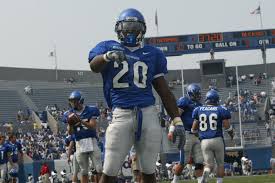
When Memphis retired No. 20, it was not just honoring the best running back in school history. It was honoring the player who, more than anyone else, dragged the program into the national conversation and made Tiger football feel bigger than it had ever felt before. He did not just produce highlights. In fact, Williams changed the scale of belief around Memphis football.
That is what separates him.
By the time Williams finished his career, his numbers had moved beyond school-great and into sport-wide absurd. He rushed for more than 6,000 yards in a Memphis uniform, becoming only the fourth player at the highest level of college football at the time to cross that threshold. He piled up 34 career 100-yard games, more than any player in NCAA history, and finished with an NCAA-record 7,573 career all-purpose yards. Those totals tell you he was productive. They do not fully explain what it felt like to watch him.
The Entire Stadium Knew
The simplest way to understand DeAngelo Williams is this: everybody in the building knew the ball was going to him, and it often did not matter.
That kind of certainty is reserved for very few college players. It is one thing to thrive in a system built to manufacture space. It is another to become the system itself. Williams was not a luxury for Memphis. He was the offense, the identity, the tension, and the release. If the Tigers needed life, he provided it. If they needed a drive rescued, he took over. If they needed a moment that made the whole crowd rise before the play was even over, he delivered that too.
That was the genius of his college career. He made his dominance feel routine while still making it feel unbelievable.
For fans, that meant Saturdays changed shape. A handoff that should have gone for four might turn into 44. A crease that barely existed suddenly felt like an invitation. Memphis supporters did not watch Williams the way fans watch ordinary great players. They watched him with that rare mixture of comfort and suspense, knowing he could erase a bad quarter or elevate an average afternoon into something worth remembering for years.
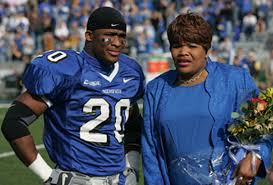
And context matters here. Memphis was not operating from the center of the college football universe. It did not have the infrastructure, branding power, or built-in national pull of the sport’s traditional giants. Williams found a way around that. He forced people to talk about Memphis because ignoring him was impossible. That is one of the rarest things a college star can do for a program: make the helmet relevant by the force of his own talent.
Why No. 20 Is Untouchable
Every retired jersey carries symbolism, but No. 20 may be the clearest case of a number becoming sacred through production and transformation at the same time.
Yes, Williams earned it statistically. That is beyond dispute. But the deeper reason his jersey matters is that he gave Memphis football a new public identity. He made it possible for the Tigers to be discussed as more than a regional curiosity or a program trying to scratch its way into legitimacy. With DeAngelo, Memphis had a player who belonged in any conversation, on any network, against any opponent.
He also helped define a lineage. Memphis fans now talk naturally about offensive skill talent coming through the program, about backs and receivers who can threaten defenses in space and move on to the NFL. That identity did not begin from nothing. Williams is one of the strongest roots it has. Long before later Tigers built on that reputation, he made it real and visible.
There is also a certain emotional clarity to his retired jersey. Unlike some honors that invite debate over era, role, or interpretation, No. 20 feels obvious. It feels inevitable. He gave Memphis not only records but moments, not only accolades but stature. Younger fans may know the numbers first, but older fans remember the sensation: the slight shift in a stadium when he touched the ball, the expectation that anything could happen, and the confidence that Memphis always had a chance because he was still in the backfield.
That is why DeAngelo Williams belongs in a different category from most stars. He was not only one of the greatest Tigers ever. He was one of the clearest answers to the question every ambitious program asks itself: what does it look like when one player changes everything?
For Memphis, it looked like No. 20.