
Not every retired jersey is about records. Not every honored number belongs to a player who had years to build a résumé, stack accomplishments, and leave behind a long trail of highlights. Sometimes a jersey is retired because a program suffers a loss so deep that forgetting becomes impossible. That is where the story of Charles Greenhill begins, and why No. 8 may be the most emotional number in Memphis football history.
No. 8: Charles Greenhill and the Number Memphis Retired for Grief
Greenhill’s place in the program is different from everyone else in this series. Isaac Bruce changed the way Memphis fans thought about wide receiver play. Dave Casinelli helped define the power and identity of an earlier era. DeAngelo Williams turned the program into a nationally recognized Saturday show. But Charles Greenhill’s name lives in Memphis memory because it became tied to one of the darkest moments the school has ever endured.
And that matters just as much.
A Future Interrupted
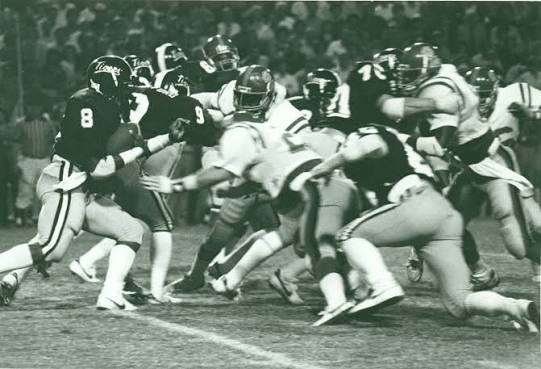
Greenhill was a graduate of Frayser High School, a local player whose path to Memphis carried a natural sense of hometown investment. Those players always mean a little more in college towns and city programs. Fans do not just see talent. They see one of their own. Greenhill played one season for the Tigers in 1983, and while that brief career did not provide time to compile the kind of statistics that usually anchor a legacy, it did place him inside the heartbeat of the program at a critical time.
That season should have been the beginning of his story.
Instead, it became nearly the whole public record of it.
In December 1983, Greenhill was killed in the plane crash that also took the life of Memphis head coach Rex Dockery. It is the kind of sentence that still lands with force decades later because it reaches beyond football immediately. Once tragedy enters the story at that level, wins and losses become secondary. Depth charts no longer matter. You are no longer talking about a promising player or a rebuilding program. You are talking about grief, shock, and the kind of event that leaves a permanent scar on everyone connected to it.
For Memphis football, that crash became one of those before-and-after moments that every older fan remembers in emotional terms rather than chronological ones. They remember where they were when they heard. They remember how it sounded when the news started moving. They remember the feeling more than the details, because some losses become atmospheric. They settle into the program itself.
That is what happened with Greenhill.
Why No. 8 Still Matters
When Memphis retired No. 8, it was doing something more than honoring a player. It was creating a permanent act of memory. Greenhill’s jersey was not retired because he had time to finish his career or because he had accumulated records that could be measured neatly against those of other great Tigers. It was retired because the program understood that his absence had become part of its history.
That distinction gives No. 8 a different emotional weight than the rest of the retired jerseys.
In most cases, a retired number points backward to achievement. With Greenhill, it points backward to loss, but also to belonging. Memphis chose to say that even one season was enough for him to remain part of the program forever. There is something powerful in that. It says the bond between a school and a player is not always defined by longevity. Sometimes it is defined by what that player represented, where he came from, and what the program owed his memory after everything changed.
It also reminds younger fans that football history is not just built through highlight tapes and stat graphics. Programs are shaped by the pain they survive as much as the victories they celebrate. There are seasons you remember because they ended in a bowl win. There are names you remember because they led the nation in something. And then there are names you remember because the act of remembering them becomes part of the responsibility of loving the team in the first place.
That is Charles Greenhill’s place in Memphis history.
His No. 8 endures not because fans got years to watch him become a star, but because they did not. The jersey hangs there as a quiet interruption in the lineage of Memphis football, a reminder that not every legacy reaches its full visible form. Some are carried instead through ceremony, story, and the refusal to let time wash someone away.
That is why a series like this has to include him with the same seriousness as any record holder or NFL name. If retired jerseys tell the story of a program, then No. 8 tells one of the most important truths Memphis football has ever had to learn: that remembrance is part of identity too.
The great players show you what a program can become. The painful stories show you what it has survived. Charles Greenhill’s number remains because Memphis decided his story would never be left behind.