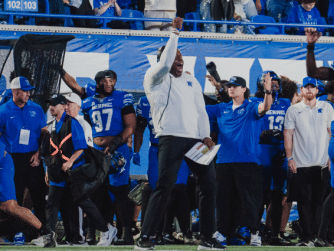

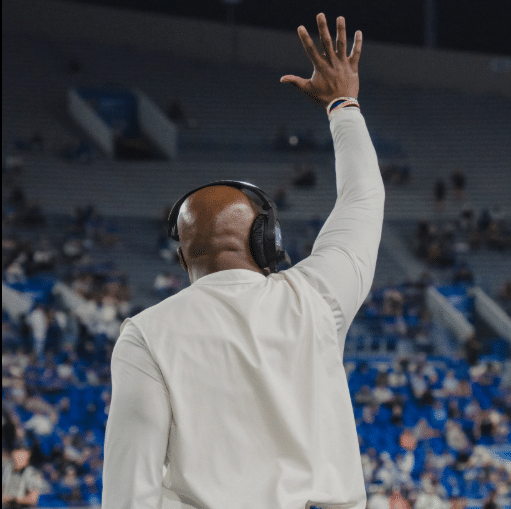
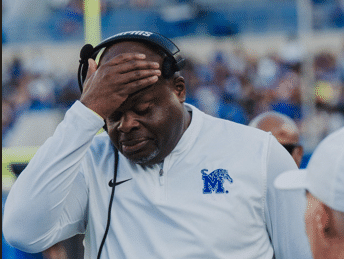
Charles Huff knew how to explain the recruiting advantages of being linked to another job. Explaining a loss at Navy proved considerably less revealing. After Memphis surrendered a 10-point fourth-quarter lead Saturday, Huff’s postgame news conference lasted two minutes and 24 seconds. His answers were restrained, repetitive and largely confined to familiar territory: tackle better, execute better, coach better.
Who Turned Down the Volume on Charles Huff?
The contrast invites a question: Did someone at Memphis ask him to dial it back? There is no verified reporting that athletic director Ed Scott gave such an instruction. A subdued coach after a damaging loss is not evidence of an administrative intervention. But the contrast itself is real—and Memphis should understand why people noticed.
The Coach Who Could Explain The Upside
Earlier this month, Huff offered a detailed explanation of how another school’s interest could help his recruiting. “Every time a coach says, ‘Coach Huff ain’t going to be there,’ it actually works in my favor,” he said. “Because if I’m leaving Memphis, I ain’t going to high school. I’m going to something bigger.” His message to recruits followed: “You’re going with me.” That was not an announcement that he planned to leave. It was an explanation of how he countered negative recruiting.
Still, it showed a coach comfortable discussing a complicated subject when he believed he could explain its advantages. After Navy, that expansive version of Huff was absent. “Not good enough today by the entire organization,” he said. “Got to be better.” True enough. Also, not nearly enough to explain how Memphis lost control of an afternoon it had positioned itself to finish.
Caution Is Reasonable. Brevity Has Consequences.
Huff had a legitimate reason not to offer instant technical conclusions. Asked about offensive problems, he said he needed to review the film. “I don’t want to make some stuff up without looking at the film,” he said. That is a responsible answer. Coaches should not invent explanations to satisfy a microphone, and immediate postgame interviews cannot replace detailed review.
He also accepted some coaching responsibility while discussing the tackling failures. “We’ve got to put them in better positions,” he said. Those statements deserve acknowledgment. Huff did not simply blame his players or pretend Memphis had played well.
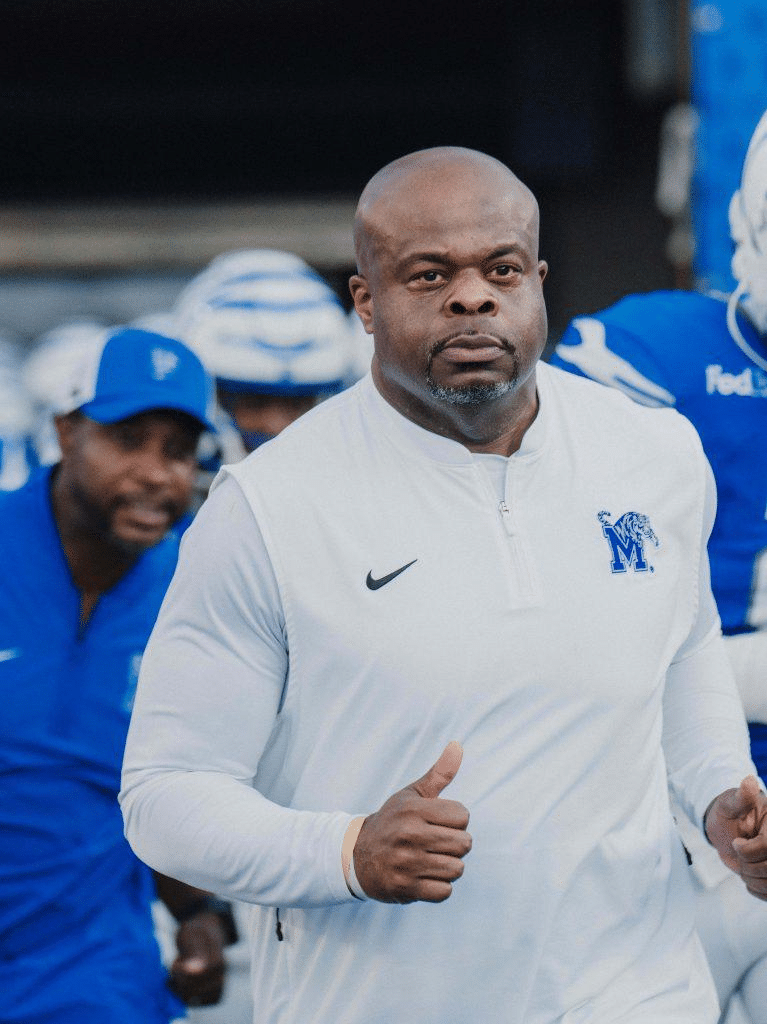
But an availability lasting 144 seconds leaves little room to establish what the coach knows, what he needs to examine and what deserves a follow-up. Reporting described a Memphis communications official ending the session. The reason for doing so has not been established here. Neither has any connection between that decision and Scott. That distinction matters. An unexplained decision is a reporting question, not permission to invent a backroom conversation.
Memphis Needs An Explanation, Not A Conspiracy
The appropriate questions are straightforward. Why did the availability end so quickly? Was there a logistical constraint? Had anyone discussed changing Huff’s public approach Scott and the university can address those questions. Until they do, nobody should claim to know their answers.
The same restraint belongs in coverage of Huff’s future. Reports that Maryland has spoken with him establish reported contact—not an agreement to leave, and certainly not an explanation for Saturday’s missed tackles. But Memphis cannot expect those subjects to vanish because the microphone does.
The university has a coach whose candid remarks about advancement attracted attention. It now has a damaging loss followed by an unusually short explanation. There may be an ordinary reason for all of it. Providing that reason would accomplish more than leaving everyone to guess. Huff did not owe Memphis a performance after Navy. He owed it to an accountant. Two minutes and 24 seconds left plenty still to discuss.