
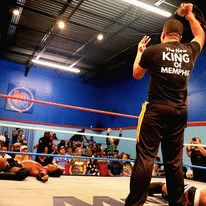
With a television studio, two training locations, and a growing regional footprint, the promotion is trying to turn a famous wrestling identity into a sustainable modern business. The address is 3296 Winbrook Drive. The work extends well beyond what happens inside the ropes.
At the Memphis Wrestling WrestleCenter, the company produces television and trains the people who might eventually appear on it. Its instruction reaches beyond aspiring wrestlers to referees, announcers, managers, broadcasters, and production personnel. The building is both a stage and a place to learn how that stage operates.
More Than a Throwback: Inside the Company Dustin and Maria Starr Are Building With Memphis Wrestling
That combination helps explain what Dustin and Maria Starr are building. Memphis Wrestling is not simply an occasional wrestling card trading on a recognizable name. It is a locally owned company organized around recurring television, live events and talent development, with the WrestleCenter serving as its operational home.
Its identity is unmistakably regional. Its challenge is contemporary: How does an independent wrestling company attract attention, create recognizable performers, and give people enough reasons to keep coming back?
The Starrs’ answer brings together an old presentation style and a broader production system. The studio supplies the setting. Training supplies potential performers. Television and digital distribution introduce them to an audience. Live events give that audience somewhere to participate. The pieces are in place. Making them reinforce one another is the business.
Before The Promotion, There Was A Television Opportunity
The company’s development did not begin with a fully formed wrestling operation. As Dustin Starr recounted in a profile, he and Maria appeared in short CW30 commercials introducing upcoming programs. Recognition from those spots demonstrated something important: Television could make them familiar to people who did not necessarily know Dustin from wrestling.
A conversation with the station’s general manager eventually led to a syndicated wrestling show hosted by the couple. They recorded local introductions and endings while working toward producing their own wrestling programming. Dustin said the pandemic interrupted launch plans following an announcement in February 2020.
That sequence matters because it reveals the company’s foundation. The Starrs were not only trying to find somewhere to hold matches. They were developing an audience relationship through a recurring media product. The locally produced program debuted in February 2021. By August 2023, when the company announced its move to Action News 5 Plus, it reported having produced 132 original one-hour episodes. Its announcement scheduled a Friday-night premiere and a Saturday-noon replay.
Dustin’s Job Reaches Beyond The Microphone
Dustin is the most immediately recognizable face of the operation, but the work described in recent reporting extends well beyond hosting. For the company’s Mid-South Fair appearance, he outlined a process involving dates, performer availability, television story development and coordinated promotion. The event required deciding which ongoing stories would reach an important point in front of that audience.
That is a different task from assembling an attractive list of matches. A recurring promotion needs an event to satisfy the people who bought tickets while also contributing to the next broadcast and the next show. A visiting star can attract attention, but the company still needs to give that attention somewhere to go. Dustin identified Matt Hardy and Joe Hendry among the recognizable performers Memphis Wrestling has featured. His explanation drew the distinction clearly: Those appearances help bring people in; continuing stories help keep them watching.

The balance is important. A promotion built entirely around guests risks making its own roster feel secondary. A promotion that never creates an entry point for unfamiliar viewers can struggle to expand beyond its existing audience. Memphis Wrestling’s opportunity is to use recognizable names as introductions rather than substitutes for its own identity.
Maria’s work is part of the infrastructure
A company profile that treats Maria primarily as the host’s wife would misunderstand the operation. The company identifies Dustin and Maria as its owners and hosts. In an earlier interview, Dustin credited Maria with responsibilities including graphics, web design, and accounting, describing her as a driving force behind the business.

Those duties connect the public-facing product to the machinery required to sustain it. Graphics establish presentation. A website helps turn interest into attendance or viewership. Accounting tracks the obligations that remain after a show ends. They are different disciplines, but an independent company cannot assume that someone else will handle them.
The Starrs’ partnership therefore belongs at the center of the company’s story—not as a sentimental detail, but as an explanation of how creative and operational responsibilities have been assembled.
The Wrestlecenter Is More Than A Wrestling School
The company’s training program is designed around participation in a television product. Its enrollment page advertises instruction for in-ring and non-wrestling roles, with an opportunity—not a guarantee—to be cast on Memphis Wrestling television. It also describes opportunities to participate on television dates and at special events.
That distinction separates the concept from simply learning moves in a ring. A wrestler must communicate with the audience in the building. A television performer must also understand what viewers can see, what the camera needs, and how a character carries from one segment to another. Dustin specifically emphasized the difference between live and television performance in his interview.
The current training page lists Coach Justin leading Memphis classes, Coach Dalton leading classes in Pontotoc, Mississippi, and Memphis veteran King Cobra as the program’s team captain. Dustin also works with students before their television debuts. The structure connects several kinds of experience: instruction, live performance, television preparation, and a link to the city’s earlier wrestling generation. It also acknowledges that wrestling needs more than wrestlers. A trained referee, broadcaster or production worker can be essential to making a developing performer look ready for television.
Expansion Now Includes A Second Training Location
Memphis Wrestling currently advertises training at two locations: the WrestleCenter in Memphis and the Slaughterhouse Gym in Pontotoc. The published schedule places Memphis classes on Mondays and Wednesdays and Pontotoc classes on Tuesdays and Thursdays.
That gives the company a training presence beyond its home city. The posted full-camp tuition is $3,500, with a nonrefundable $500 deposit and the remaining $3,000 payable in $250 monthly installments. Private instruction is available for an additional fee.
Those figures establish what the company charges, not how much it earns. Enrollment, completion rates, operating expenses, and the number of students who secure paid opportunities are not established by the public enrollment page.
Still, training is clearly more than a side note. It is a formal service, a potential revenue source, and a way to develop people familiar with the company’s presentation. The second location also makes regional development part of the operation rather than merely a slogan.
Studio Wrestling Is A Production Choice, Not Just A Visual Reference
The WrestleCenter’s dual purpose is central to the model: It is both a television studio and a training facility. That arrangement creates an opportunity to connect learning with performance. Students can prepare for the kind of environment in which the company actually produces its show, rather than train in one setting and encounter television as an entirely separate world.
The studio format also gives Memphis Wrestling a clear creative proposition. It does not have to compete with national promotions on the size of the entrance stage. It can compete for attention through clarity: an identifiable personality, an understandable conflict, and an audience response that viewers can feel. That is not an automatic advantage. Close quarters can expose weak interviews and unclear characters just as readily as they can amplify strong ones. The format demands that the company make its people matter.
Distribution Has Grown, But Awareness Remains A Hurdle
A November 2025 company announcement listed distribution through WMC Action News 5 Plus, WBBJ in Jackson, THV11+ in Little Rock, TrillerTV and YouTube. At that point, the company reported 246 original one-hour episodes. That announcement documents the distribution footprint at the time; it should not be mistaken for independently verified audience size or a guarantee that every arrangement remains unchanged.
More recently, Starr described the company reaching viewers through television, Facebook and YouTube, using short clips as introductions and longer videos for matches and complete programs. The approach offers different entry points. Someone can encounter a brief confrontation without committing to an entire episode, then follow the performer into longer programming.
Yet access alone does not create awareness. Dustin stated in an interview that he still encounters people who do not know Memphis Wrestling is active. He described the fair as an opportunity to reach people who had not arrived intending to watch wrestling. That may be one of the company’s most revealing challenges. Its name is familiar. Its current operation is not necessarily familiar to everyone who recognizes it.
The Ambition Is Developmental—But The Distinction Matters
Additionally, Dustin has said he hopes Memphis Wrestling can establish an official developmental partnership with a larger company, comparing the concept to the NBA’s relationship with its G League. That is an ambition, not an announced agreement.
Likewise, individual performers receiving opportunities elsewhere is not the same as Memphis Wrestling holding an official developmental designation. The distinction matters when evaluating what the company has built and what it still hopes to become.
Its present value can be assessed without overstating that future. It offers a place to train, a recurring production to work toward, and a public setting in which performers can demonstrate improvement. Whether that eventually becomes a formal pipeline will depend on relationships and results that have not yet been established publicly.
The Next Chapter Has To Be Measured In Returning Fans
For all the attention paid to wrestling’s creative decisions, Dustin’s description of the business included customer service and cleanliness. He connected the experience of attending a show with the likelihood that someone returns.
That is an appropriately practical place to judge the company. A recognizable guest might help sell a ticket. A dramatic clip might earn a view. Neither guarantees an enduring audience. Memphis Wrestling’s long-term test is whether those introductions become habits—and whether developing performers become attractions people seek out by name.
The company has built more than a tribute to an influential era. It has assembled a studio, a training operation, regional activity, and a recurring media product around the Starrs’ leadership. The heritage gives that work context. The operation gives it substance. What happens next will depend on whether Memphis Wrestling can turn the people discovering it today into the audience that expects it to be there tomorrow.