

Colorado did not hire Deion Sanders to remain interesting while losing football games. It hired him to make the program matter again, and for a while, attention and improvement traveled together. Now they are moving in different directions. Saturday’s 57–24 loss at Oklahoma State was not simply another disappointing afternoon. It was a halftime lead turned into a second-half surrender, another conference defeat and another reason to ask whether Colorado is evaluating a football program or protecting an investment in its coach’s name.
It Is Prime Time to End the Deion Sanders Experience at Colorado
The Buffaloes are 2–5 overall, 0–4 in the Big 12 and riding a five-game losing streak. Those are not public-relations problems. They are football results. In Year 4, Sanders should be judged by them. My judgment is that Colorado should move on. That does not require denying what Sanders accomplished. It requires acknowledging that past accomplishments cannot become a permanent exemption from present accountability.
The Collapse Was Bigger Than One Bad Half
Colorado led Oklahoma State, 24–23, at halftime. Thirty minutes later, the Buffaloes had lost by 33. The Cowboys outscored them 34–0 after the break, turning a competitive game into a rout. That distinction matters. This was not a team buried immediately by an opponent it could never challenge. Colorado demonstrated enough offensive ability to lead at intermission. Then it failed to score again while Oklahoma State took control.
The final statistical picture was equally uncomfortable. Oklahoma State finished with 598 yards to Colorado’s 399. The Buffaloes gained only 122 yards in the second half. Penalties and turnovers contributed to the collapse. A halftime advantage does not entitle a team to victory. It gives the coaching staff something tangible to protect and build upon.
Colorado did neither. One poor half cannot establish every reason a coach should be dismissed. But a fifth consecutive loss demands a different evaluation than an isolated stumble. The question is no longer whether the Buffaloes occasionally struggle. It is whether this staff can stop the struggles from becoming the defining pattern.
Colorado opened 2–0. It has not won since. At some point, “we have to execute” stops functioning as an explanation and starts sounding like an admission that the coaching has not translated.
Give Sanders Credit Without Giving Him Immunity
Sanders inherited a program that went 1–11 in 2022. Colorado improved to 4–8 in his first season, then went 9–4 in 2024. That progress was real. So was the achievement of returning the Buffaloes to a bowl game.
Any honest assessment should acknowledge it. But Colorado followed that season with a 3–9 record in 2025 after Shedeur Sanders and Travis Hunter departed for the NFL. This season’s 2–5 start means the Buffaloes have won five of their past 19 games. That is the trend the administration must evaluate.
Exceptional players can elevate any program. The head coach’s responsibility is to build something that can survive their departures. Nobody should expect replacing a high-level quarterback and a Heisman Trophy winner to be easy. Nobody paying major-conference coaching money should accept rebuilding as an explanation without demanding evidence that the rebuilding is working.
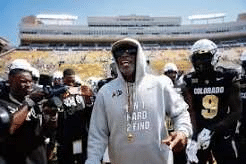
The argument for patience must contain more than reminders of how bad Colorado was before Sanders arrived. Otherwise, the original turnaround becomes a standard against which no subsequent failure can be measured. That is not accountability. Colorado can appreciate the nine-win season and conclude the operation is moving backward. A program’s ceiling matters. Its ability to sustain a credible floor matters, too.
The Contract Makes the Decision Harder, Not Less Necessary
There is a substantial financial complication. Colorado gave Sanders a five-year, $54 million extension running through 2029. The agreement pays him $10 million in 2026, followed by $11 million in both 2027 and 2028 and $12 million in 2029.
Those commitments cannot be dismissed with a slogan. A coaching change would require careful review of contractual obligations, transition costs and available resources. But an expensive decision already made is not proof that continuing it is wise.
The administration should compare the cost of changing direction with the cost of retaining a coach whose recent results no longer support the investment. Neither side of that calculation should be reduced to emotion. This is a judgment about performance, not personality. Sanders deserves credit for making Colorado relevant. He does not deserve indefinite patience because relevance remains easier to market than sustained success.
The Buffaloes led at halftime Saturday. They lost by 33. That is the current football reality. Colorado should stop asking whether the Deion Sanders experience still attracts attention and start asking whether it remains the right way to build a winning program. The evidence says it is time to end it.