
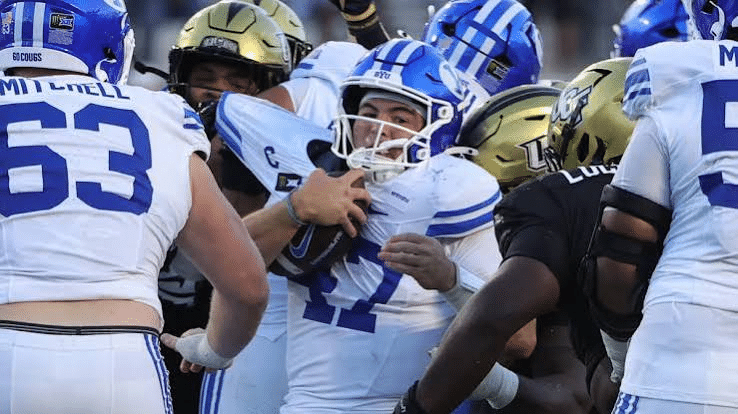
BYU has every right to examine the overtime penalty. It does not have the luxury of pretending the game began there. Before the controversial whistle, before the final fourth-down incompletion and before an undefeated season became a 39–31 double-overtime loss, the Cougars spent the afternoon giving UCF reasons to believe. Explosive plays. Empty possessions. A turnover before halftime. A running game struggling without its top back. The flag became the argument. It cannot become the entire diagnosis.
Monday Hangover: BYU Cannot Let One Flag Hide an Entire Afternoon
That distinction matters because BYU still has a season worth protecting. The Cougars left Orlando 6–1 overall and 3–1 in the Big 12. One defeat does not erase the evidence of a capable team. It creates an obligation to identify what failed without allowing frustration to make the review less honest.
The Defense Turned Advantages Into Problems
Start with the number that should command attention: 463. That was UCF’s total yardage against a defense that entered allowing an average of 275 yards per game. Backup quarterback Keyone Jenkins threw for 293 yards and three touchdowns. He added a rushing score, while the Knights finished with 170 rushing yards. The breadth matters.
BYU was not beaten by one isolated mismatch while controlling everything else. UCF found enough production through the air and on the ground to keep the Cougars from forcing the offense into a narrow set of options.
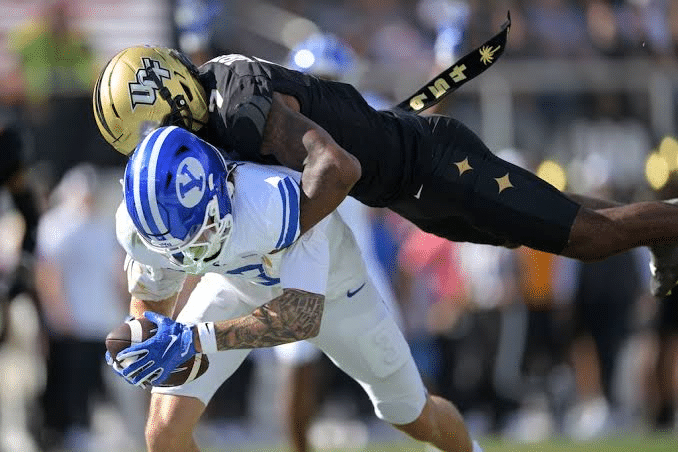
The explosive plays were particularly damaging. In the end, UCF produced 233 yards on 10 explosive plays. One was a 56-yard reception on third-and-17. Another was a 25-yard touchdown on the Knights’ first overtime snap. Third-and-17 should be a position of defensive leverage. Allowing 56 yards does more than extend a possession. It reverses the situation.
That is where the review must become specific. Was the problem assignment execution, coverage spacing, tackling or some combination? Public numbers cannot identify every responsibility. They can establish that favorable situations repeatedly became costly failures.
“Play harder” is not a sufficiently precise response. The staff must identify what broke and give players a correction they can execute. Otherwise, the lesson becomes little more than an expression of disappointment.
The Offense Made the Defensive Problems More Expensive
A struggling defense needs help through points, possession or both. BYU did not provide enough consistent assistance. The Cougars scored on five of 12 possessions and finished with four three-and-outs. Bear Bachmeier completed 16 of 32 passes, and his interception before halftime helped UCF produce a go-ahead touchdown.
Those failures affected the game differently. The interception removed an offensive opportunity while creating one for the opponent. The short possessions limited rhythm and returned the ball without requiring UCF to defend an extended series.
This was not an offense performing efficiently while the other side wasted its work. The problems fed each other. Defensive breakdowns increased the demand for points. Empty possessions reduced the margin available to survive the next defensive mistake.
LJ Martin’s absence also belongs in the discussion. Without the injured running back, BYU struggled to establish consistent production on the ground. Remove Preston Rex’s 27-yard gain, and the Cougars averaged 2.4 yards per carry.
That is relevant context, not a complete explanation. Every staff would prefer access to its best players. The job becomes harder when one is unavailable. It does not become optional. BYU needs an approach that reflects the personnel it can actually put on the field. Explaining who is missing cannot replace preparing the players who remain.
The Response Must Outlast the Frustration
Kalani Sitake’s staff does not need to deny that the roughing-the-kicker penalty mattered. It extended a consequential opportunity in the second overtime. It also does not need to make that moment responsible for every earlier failure. The useful review starts before the extra periods: the third-and-17 breakdown, the interception before halftime, the empty possessions and the difficulty containing Jenkins.
Those are areas in which BYU can do something more productive than express disagreement. The answer should not be an emotional overhaul, either. This team had just beaten Notre Dame. One poor performance does not establish that the entire operation is broken.
It establishes that success did not carry itself from one week to the next. The corrections should be measurable: fewer explosive concessions, more sustained offense and a workable running-game response when the preferred personnel are unavailable. That is how a loss becomes information rather than an identity.
BYU can spend the week winning arguments about the whistle. Or it can spend the week improving the football that placed the whistle in such a powerful position. Only one approach gives the Cougars a better chance the next time a game gets tight.