
The worst part of losing a close game is not the loss itself. It is what happens after the second one. Then the third. Then the fifth.
That is when a football problem becomes something heavier. A team stops treating the fourth quarter like an opportunity and starts treating it like a warning sign. A fan base no longer watches a tie game with excitement, but with dread. A coach’s late-game decisions stop being judged one at a time and start being folded into a larger case against him. That is the moment when close losses stop feeling random and start feeling like identity.
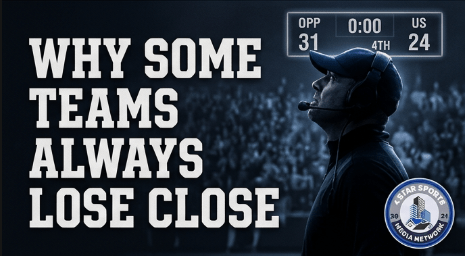
Why Some Teams Always Lose the Close Ones
Every fan base knows the sensation. The game is tight with six minutes left and the room changes. Nobody says it out loud, but everybody knows the old script is back on the screen. The false start feels inevitable. The soft coverage on 3rd-and-long feels inevitable. Even the postgame explanation feels prewritten. That is what repeated close losses do. They create a program-wide memory that begins shaping the next game before it even unfolds.
How A Trend Becomes A Label
One-score records are not listed on a coach’s business card, but they may as well be. Once enough of those losses stack up, the number follows him into every conversation about job security.
A coach who wins close gets credit for poise, leadership, and finishing ability. A coach who loses close gets hit with a different vocabulary: passive, rattled, conservative, not built for the moment. It does not matter that the difference between winning 28-24 and losing 24-21 can be microscopic. The public reads one as proof of progress and the other as proof of failure.
That is why hot-seat conversations turn so quickly toward close-game history. Analysts and fans may not always say it directly, but one-score records become a proxy for trust. Can this coach finish? Can he manage the final four minutes? Does the team tighten up under pressure? Those questions start shaping the way a season is discussed long before the standings are final.
And the pressure does not stop with the staff.
Players carry this too. Locker rooms develop emotional instincts just like fans do. Teams that repeatedly win close games start expecting calm endings. Teams that repeatedly lose them begin to carry a different kind of memory into tight situations. The body language changes. Sidelines feel noisier. Mistakes arrive faster. Even when no one says it, the thought is there: here we go again.
The Moment Belief Starts To Crack
This is where the issue goes beyond cliché. People love to say teams just need confidence. That sounds nice, but it misses the real point. Confidence in close games is not abstract. It is built from memory.
Teams that finish well usually have proof stored up. Their quarterback has done it before. Their staff has practiced the moment well. Their defense has closed drives in similar spots. Their special teams unit has held up under pressure. All of that creates a belief that feels sturdy.
Teams that keep losing close often have the opposite. They have too much proof of failure. Too many drives ending in panic. Too many calls are made out of fear. Too many snaps where the moment seemed to get louder than the execution.
That is why repeated close losses are so damaging. They not only hurt the record. They damage trust. Coaches stop trusting players. Players stop trusting the calls. Fans stop trusting the program’s ability to survive a tied game late. Once that happens, the pressure of the moment gets heavier than it should be.
And no, the portal does not erase that automatically. Roster turnover is faster now, but emotional culture can still linger. A program can bring in new bodies and still carry old scars. A new edge rusher or slot receiver can help. They cannot instantly remove the feeling hanging in the building when a game gets tight.
That is why some teams seem to “always” lose the close ones. It is not always bad luck. It is often accumulated damage. Enough painful endings create an environment where everyone starts bracing instead of attacking.
And in college football, that hesitation is fatal.
That is also why fans often tolerate blowouts longer than repeated one-score heartbreak. Blowouts tell you a team was not good enough that day. Close losses tell you something more painful: the answer was sitting right there, and the program still could not grab it. One kind of loss feels honest. The other feels personal.
In this sport, close losses do more than wreck a season. If they pile up long enough, they change the mirror. A team stops seeing the possibility in the fourth quarter and starts seeing judgment. Once that becomes your identity, every tight game begins with you already carrying the weight of the last one.