

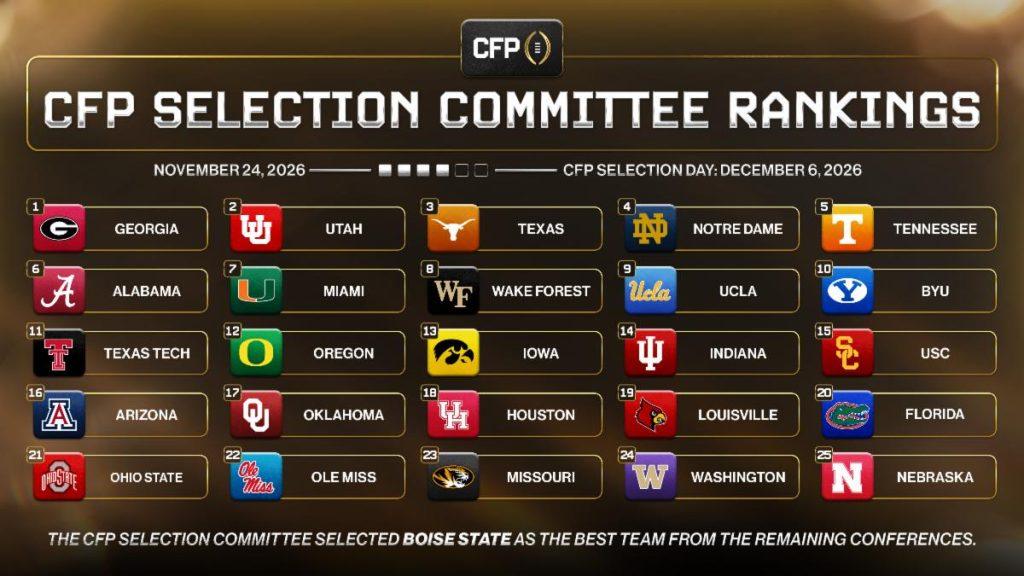
Boise State’s disappearance from the top 25 exposes the difference between a protected entry and a broader opportunity to be considered. The most revealing team in Tuesday’s College Football Playoff release was not in the rankings. Boise State disappeared from the top 25 after losing 22–20 to San Diego State. Yet the official announcement separately identified the Broncos as the committee’s preferred team from the six-conference access group.
The CFP Has a Place for the G6. Does the Committee See Anything Beyond It?
The committee could not find a place for Boise among its 25 best teams. The playoff format still required it to identify a place for somebody from that group. That distinction does not prove the rankings are wrong. It does expose a question the sport too often answers with a slogan. When college football says everybody has access, what kind of access does it mean?
The Structure Is Unequal by Design
Four named major conferences each have a championship route into the field. Six other conferences share a designated position. Additional G6 teams can qualify through the remaining selections. There is no written one-team ceiling. That is important, and any honest criticism needs to acknowledge it.
But a theoretical route and a demonstrated opportunity are not the same thing. This week, none of those six conferences has a team in the published top 25. Seven four-loss teams do. The committee is entitled to conclude that each of those seven has a better full profile than every G6 candidate. It should also be prepared to show why.
Schedule Strength Cannot End the Conversation
The obvious defense is that schedules differ. They do. A team can lose four times against substantially stronger opposition and still be better, or more accomplished, than a team with fewer defeats. The mistake would be pretending schedule difficulty settles the comparison without examining what happened against that schedule.

Which quality opponents were beaten? Which performances demonstrate the claimed strength? How damaging were the defeats? What evidence distinguishes the ranked team from the outsider? A difficult schedule is an important component of a résumé. It is not an achievement by itself. The committee should not be asked to ignore differences in competition. It should be asked to explain how those differences are weighed against results.
Boise’s Loss Deserves Evaluation, Not Protection
Boise is not entitled to remain ranked because removing it leaves the G6 without representation. The Broncos’ loss matters. Their complete season should be assessed against the same principles applied elsewhere. But the same scrutiny should work in both directions.
If a close defeat can preserve a major-conference team’s standing because the broader performance remains strong, examine whether that reasoning applies to Boise. If it does not, identify the difference. That is not a demand for equal outcomes. It is a demand for comparable examination. The strongest exclusion argument is not that every outsider deserves the benefit of every doubt. It is that outsiders should not have to prove an exceptional case while familiar programs receive an ordinary explanation.
What This Week Actually Proves
The rankings establish that the committee currently recognizes no G6 team among its top 25. The format establishes that those six conferences collectively retain one designated entry. They do not establish intentional discrimination. They do not prove a particular unranked team belongs above Oklahoma, Florida, or Ohio State.
Those claims require complete comparisons. But the absence itself is significant. It makes the distinction between access and standing impossible to ignore. Boise can remain central to selection while disappearing from the committee’s public hierarchy. That is a peculiar kind of inclusion.
Ask More Than Whether Somebody Gets In
The wrong response is to portray Boise as taking a place that belongs to a ranked team. The access position is part of the format, not an exception invented for the Broncos. The better question is whether the committee’s evaluation offers realistic consideration beyond that one protected route. An invitation can satisfy a rule without settling a fairness debate.
The committee does not have to manufacture a second G6 contender. It does have to demonstrate that its comparisons would recognize one if the evidence warranted it. This week, the field has room for an outsider. The rankings suggest the committee sees none worth placing among the first 25. That gap deserves an explanation more substantial than “they have a path.”