

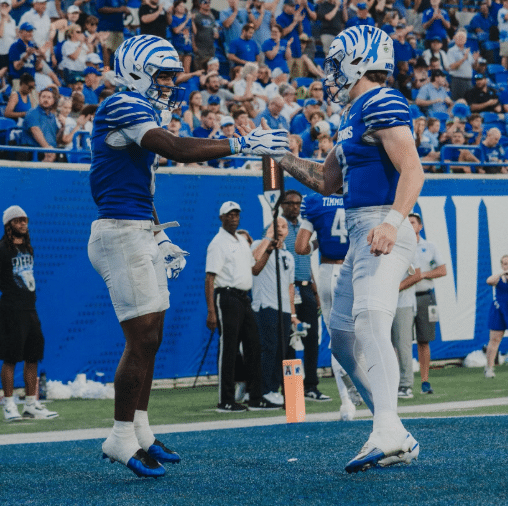
Marcus Stokes’ most valuable contribution against Army was not simply accounting for 5 touchdowns. It was keeping Memphis from becoming dependent on one way to produce them. He threw accurately, spread the ball across the receiving group and added a rushing score when the Tigers needed to strengthen their fourth-quarter advantage.
Marcus Stokes Made Memphis’ Offense Bigger Than One Answer
His 371 passing yards supplied the headline. The complete performance explained why Memphis finished with a 49–22 victory instead of another uncomfortable closing assignment.
Accuracy Made the Production Sustainable
Stokes completed 29 of 36 passes without an interception. That is more revealing than a touchdown total by itself. A quarterback can produce a few explosive moments while leaving the offense inconsistent between them. Stokes’ completion volume gave Memphis a steadier foundation against Army. He averaged more than 10 yards per passing attempt, and the offense finished with 27 first downs. Those numbers describe an operation repeatedly creating another opportunity to continue.
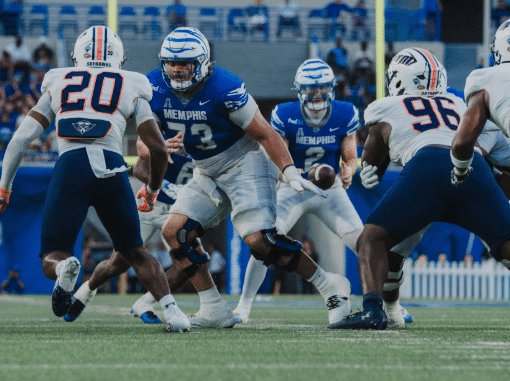
There is no need to attach an invented leadership speech to the performance. The available evidence is on the field. Stokes delivered the ball often enough, accurately enough, and productively enough for Memphis to keep building possessions. His night was not defined by avoiding every difficult situation. It was defined by how often the offense found a usable answer.
The Distribution Kept the Offense From Shrinking
Hayes and Davis caught 2 touchdowns apiece, but the passing game extended beyond the scoring targets. Hayes and Tipton each finished with 86 receiving yards. Davis added 75. Burnside supplied 51, and O’Callaghan gained 46 on his only reception. Seven Memphis players caught a pass. That distribution matters because it kept the performance from becoming a story about repeatedly finding one favorable matchup.
Different receivers contributed different pieces. Hayes supplied volume. Tipton’s longest reception covered 51 yards. Davis combined scoring production with an average of 18.8 yards per catch. The box score cannot establish every read or protection adjustment Stokes made. It can establish that the ball reached multiple productive options. That is a meaningful part of a quarterback’s profile: not an assumed personality trait, but an observable way his offense functioned.
His Legs Helped Complete the Assignment
Stokes rushed 7 times for 30 yards and a touchdown. The rushing total was modest beside his passing production. The timing was not. With Memphis leading 35–22 in the 4th quarter, Stokes finished a 12-play, 92-yard drive with a touchdown run. The score extended the advantage with 5:37 remaining.
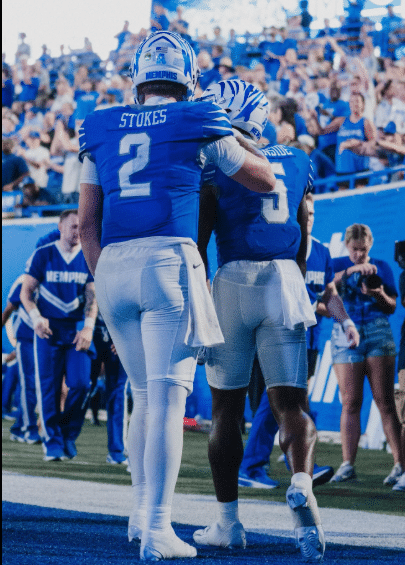
It gave Army another possession with a larger deficit and less time. That is where his full contribution becomes clearer. He did not need to dominate the rushing statistics to provide a consequential running play. Carter and Covey supplied their own ground production. Stokes added another available answer.
One performance does not settle a quarterback’s development or define his entire season. It does provide a standard worth carrying forward. Against Army, Stokes did not have to make every possession spectacular. He made enough of them productive that Memphis could finish the night without asking for something extraordinary.