
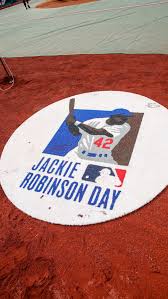
Jackie Robinson Day does not arrive quietly. It hums under every highlight package, sits on every lineup card, and hangs on every jersey as the game pauses, just for a night, to remember the moment baseball finally decided to live up to the myth it had been selling for decades. One day a year, the sport that is always racing toward the next series, the next callup, the next contender, forces itself to look backward and ask a hard, simple question: Where would any of this be without 42?
Breaking Barriers, Keeping Score
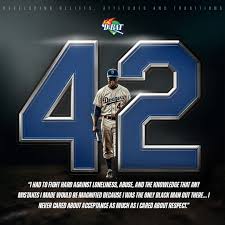
United in 42
Every player wears the same number, every back reads the same name. For a sport built on individuality, on batting titles and ERA leaders and back‑of‑the‑card stats, Jackie Robinson Day is intentionally disorienting. Umpires signal to a sea of forty twos, broadcasters work overtime trying to help viewers sort out who is who, and scorekeepers double-check every entry. That confusion is the point. For one night, the person who shattered the color line stands alone by making everyone look the same.
The story, of course, begins on April 15, 1947. Jackie Robinson walked onto the field at Ebbets Field as a Brooklyn Dodger and into a game that had spent decades insisting it was the national pastime while keeping part of the nation out. He took the field knowing every at‑bat would be judged twice, once as a player, once as a symbol. Teammates watched. Opponents tested him. Fans and writers divided into those who saw a ballplayer and those who saw a threat.
That Major League Baseball now pauses to honor him is, in itself, a measure of distance traveled. In 1947, Robinson’s presence was treated as a provocation. In 2026, his number is retired across the sport, his name is invoked as a shorthand for courage, and his legacy is baked into the way baseball talks about itself. But Jackie Robinson Day matters because it refuses to let that journey get smoothed over into an easy, feel-good story.
The pregame ceremonies are polished. Video boards roll through stolen bases and double plays, kids in Little League uniforms line up on the warning track, legends and current stars share the field. Underneath the pageantry, though, lies an uncomfortable truth the day is designed to surface, not hide. If Jackie broke the barrier, who built it, and how long did the game spend pretending it was not there? If he opened a door, how many doors did baseball quietly keep half shut in the years that followed?
For Black players, the weight of that history is not theoretical. They walk into a ballpark that celebrates their presence but still reminds them, by sheer numbers, how rare that presence remains. Representation among Black American players has declined in recent decades, and Jackie Robinson Day lands like both a tribute and a challenge. When they stand shoulder to shoulder with every other player wearing 42, the gesture is not just symbolic; it is a reminder that their careers exist because someone absorbed a level of hostility and pressure that they may never fully have to.
Keeping History Honest, Pushing the Game Forward
Baseball prides itself on memory. It can tell you what a star hit in 1954 and how many strikeouts a pitcher had in a night game in 1968. That devotion to history is part of its charm, but it has also been a shield. For a long time, team histories glossed over the Negro Leagues, old photographs were displayed without context, and the story of the sport was told as if it naturally evolved from Cobb to Ruth to DiMaggio without asking who was missing along the way.
Jackie Robinson Day forces a different kind of remembering. It puts Robinson’s debut in the center of the narrative and, if the sport is honest, pulls the rest of the truth in with it. You cannot tell his story without telling the story of the Negro Leagues, of Satchel Paige and Josh Gibson, of barnstorming teams that played with Major League-caliber talent before Major League baseball would acknowledge it. You cannot celebrate his courage without acknowledging that the game, for decades, needed that courage because it chose exclusion.
That honesty does not tear down tradition; it deepens it. When a kid in the stands hears Jackie’s name mentioned alongside Ruth and Mays, and hears the names of Negro League legends in the same breath, they are not being asked to abandon the old heroes. They are being invited to see the whole picture. The game becomes richer, not thinner, because it admits where it failed and who helped drag it forward.
From that fuller story comes the chance to actually change the present. Jackie Robinson Day is not just about highlight packages and commemorative caps; it is a yearly reminder to ask, what are we doing with what he gave us. Are teams investing in urban youth academies and access for kids who do not live near pristine suburban complexes? Are front offices and dugouts becoming more representative of the communities that fill the stands and watch at home? Are broadcasters and writers telling the stories of Black and Brown pioneers with the same energy they devote to familiar myths?
If the answer, slowly, becomes yes, the day becomes something more than ritual. It becomes a checkpoint. Each April 15, baseball can look at itself in the mirror of 42 and measure whether it has taken even a small step closer to the inclusive game it pretends to be in its best commercials. Progress does not mean erasing the past; it means refusing to let the past repeat itself in quieter, more polite ways.
The beauty of Jackie Robinson Day is that it shows those two ideas can coexist. You can fiercely protect the game’s history, the stats, the stories, the lore, while still admitting that some of that history is painful and incomplete. You can wrap a number in reverence without turning it into a museum piece. On the field, the rules do not change on April 15. The frame does.
In the end, that is what makes the day powerful. For a few hours, the sport that has so often struggled with change leans directly into it, not by abandoning what it was, but by acknowledging who forced it to become something better. If a new generation of fans and players looks up at 42 and sees not just a retired number, but an open door, then Jackie Robinson Day will have done more than honor a legend. It will have proved that baseball’s greatest tradition is not standing still, it is learning, slowly and stubbornly, how to live up to the courage of the man who stepped onto the field first.