
Preseason rankings create expectations, but college football rarely follows the script. Every season brings teams that enter the year ranked only to face a brutal schedule, difficult conference transition, roster concerns, or simply an inability to meet the pressure attached to a national ranking.
At the same time, teams outside the initial Top 25 often have the talent, experience, and favorable schedule needed to emerge by November.
4 Star Sports Media asked its contributors a simple question: Name two ranked teams that could end the season unranked, and two currently unranked teams that could finish the year in the polls.
The answers covered the SEC, Big Ten, Big 12 and ACC, showing just how much movement could be ahead across the country.
Teams That Could Slide
Wes Pruett identified LSU and SMU as ranked programs that could struggle to remain in the national conversation through the entire season.
LSU always possesses the talent to compete in the SEC, but the margin for error in that league remains extremely thin. A couple of losses against ranked conference opponents can quickly turn a team from a College Football Playoff contender into one fighting just to stay in the polls. LSU will have to prove it can handle the weekly physicality and depth required to survive a demanding SEC slate.
SMU faces a different challenge. The Mustangs have earned increased respect nationally, but expectations can change quickly when a team moves into a more difficult conference environment. Their ability to compete consistently against stronger opponents will determine whether their ranking holds up over a full season.
Jon Sturdivant selected Tennessee and Washington as teams that could fall outside the Top 25 by year’s end.
“Tennessee, because I think they finish the year with seven wins without a possible bowl win, is one because of their bowl history,” Sturdivant said.
A seven-win regular season could put Tennessee in a difficult position when it comes to finishing ranked. The Volunteers have one of the sport’s most demanding schedules year after year, and an uneven conference record can erase early momentum fast.
Sturdivant also questioned Washington’s chances in the Big Ten.
“Washington is another. I just don’t believe in them to do well in the Big Ten this year,” he said.
Madison Penke agreed on Washington, pointing to the difficulty of the new conference landscape and a lack of room for error. She also listed Missouri as a team that could fall out because of its schedule.
“Missouri, the schedule is just really tough,” Penke said. “There’s no room for error.”
The Tigers have the talent to challenge those predictions, but their path will test them almost every week. A difficult schedule can make even a strong team vulnerable if it cannot win tight games in hostile environments.
Teams That Could Rise
Arizona appeared twice among the staff’s picks as an unranked team with a realistic path into the final rankings. Pruett named the Wildcats as one of his two breakout candidates, while Penke noted that Arizona already has support in the AP voting.
“If they perform how they should, being ranked should be an easy thing for them,” Penke said.
The Wildcats have the opportunity to prove themselves in a changing conference landscape. If they take care of business in key games and avoid the upset losses that often sink fringe contenders, Arizona could be one of the country’s most improved teams.
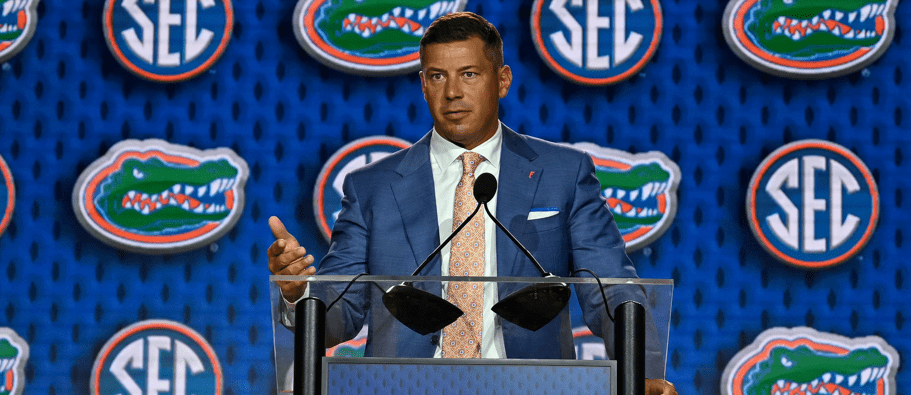
Pruett’s other pick was Florida. The Gators carry major upside if they can translate talent into victories against a difficult SEC schedule. Florida’s ceiling remains high, and a few statement wins could quickly place the program back in the Top 25.
Sturdivant chose TCU, citing a Big 12 schedule that provides significant opportunity at home. The Horned Frogs’ biggest conference matchups being in Fort Worth could give them a major advantage in their pursuit of a ranked finish.
He also named Georgia Tech as a possible riser, pointing to home contests against Colorado, Tennessee, Duke, Boston College, Louisville and Wake Forest.
Those toss-up opportunities could define Georgia Tech’s season. If the Yellow Jackets protect their home field, they may have enough quality wins to force their way into the national rankings.
Penke’s final pick was Virginia, a program she believes has the experience and continuity necessary for a breakthrough year.
“Virginia has a very experienced roster and is coming off an 11-win season with very low roster turnover,” Penke said. “If they perform how they did last season, I could see this being a huge season for them.”
By season’s end, today’s rankings may look drastically different. That is the nature of college football: preseason respect matters, but the results from September through November decide who truly belongs in the Top 25.