
The preseason AP Top 25 creates excitement, debate and plenty of misplaced certainty every August. Missouri, Houston and BYU have the thinnest margins inside the rankings, while Clemson, Florida and Boise State have the clearest paths from outside the poll to a ranked finish.
The preseason AP Top 25 is college football’s annual reminder that projecting the sport can be as dangerous as playing it.
Three Ranked Teams Ready To Fall, Three Unranked Teams Ready To Rise In College Football’s 2026 Poll
Voters are asked to rank teams before the first kickoff, before the first injury report, before the portal additions have faced live competition and before a new quarterback has been forced to make a third-and-eight throw with 90,000 people yelling at him. It is part forecast, part reputation contest and part bet on which teams are best built to survive a season that now feels longer, deeper and less forgiving than ever.
Some teams enter the rankings with a clear national profile. Ohio State, Oregon, Georgia, Notre Dame and Texas sit near the top because their talent, infrastructure and recent success make them easy to trust. But the bottom half of the poll is where the real tension lives. That is where one September loss can turn a preseason ranking into a distant memory.
Missouri, Houston and BYU begin 2026 ranked, but each carries questions that could push them out of the poll. Clemson, Florida and Boise State open just outside the Top 25, yet each has a realistic path to ending the year with a number next to its name.
The preseason poll is not a prediction. It is an invitation to prove it.
Missouri, Houston And BYU Have Little Room For Error
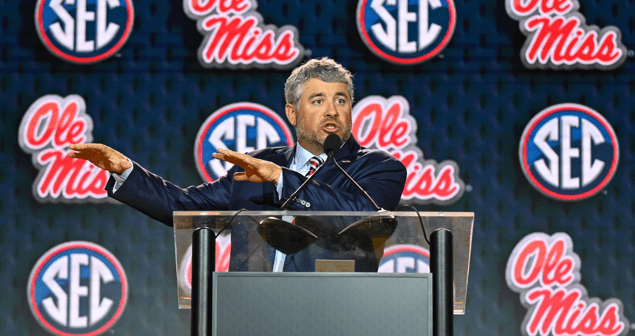
Missouri begins the season at No. 25, which is one of the most uncomfortable places a team can sit in August. The Tigers earned the recognition because the program has become more credible under Eli Drinkwitz, but No. 25 does not provide much safety. Lose early and Missouri is out. Lose twice before October and the conversation shifts from national relevance to survival in the SEC.
That is the problem with starting at the edge of the rankings in the country’s deepest conference. Missouri can be a solid football team and still fall out of the poll quickly. The Tigers will face a schedule that offers few opportunities to catch their breath, and every game against an SEC opponent becomes a test of roster depth, quarterback consistency and the ability to win when the game is ugly.
Missouri has shown it can rise above expectations before. But 2026 asks a different question. Can the Tigers handle being expected to matter?
Houston faces a similar challenge, even if its path is different. The Cougars enter the year at No. 23 after rebuilding confidence and creating more optimism around the program. But Houston is still trying to establish itself as a consistent Big 12 threat, and the conference does not give teams an easy route through the middle.
The Big 12 has become a weekly street fight. There may not be a single opponent with the recruiting power of Georgia or Ohio State, but there are plenty of capable teams that can beat a ranked opponent on any Saturday. Houston will need to win close games, protect its home field and prove it can perform away from Texas.
The Cougars have enough talent to justify the ranking. They also have enough uncertainty to lose it before the leaves begin changing.
BYU is the most interesting case. The Cougars enter tied for No. 14, a ranking that signals national belief in their experience, toughness and ability to compete near the top of the Big 12. That is also a heavy burden for a program that now has to play every week with a target on its back.
BYU is not a fluke program. Its culture travels, its physicality is real and its fan base creates a major home-field advantage in Provo. But the No. 14 ranking carries a different kind of pressure. The Cougars are no longer being evaluated as a dangerous spoiler. They are being evaluated as a team expected to contend.
A couple of close conference losses can change that quickly. The Big 12 will not forgive slow starts, turnover issues or offensive inconsistency. BYU may be good enough to finish ranked, but it also has one of the furthest falls available in the preseason field.
Clemson And Florida Are Built For A Rebound
Clemson opens as the first team outside the AP Top 25, a familiar but uncomfortable place for a program that spent much of the previous decade as the standard in the ACC.
The Tigers are not far removed from national championship contention. They still recruit at a high level. They still have the defensive talent to create problems for anyone on the schedule. They still have a national brand strong enough to move quickly in the rankings once they begin winning.
But Clemson’s rise will depend on whether it can rediscover the offensive consistency that once made it nearly impossible to beat. Dabo Swinney has built enough equity to avoid panic, but the national standard has changed. Clemson cannot live on recruiting rankings, program history and narrow wins over overmatched opponents.
The Tigers need an offense that can finish drives, a quarterback who can make winning plays late and a defense that turns pressure into game-changing moments. If those pieces align, Clemson will not just crack the Top 25. It could become one of the ACC’s most dangerous teams by November.
Florida is another unranked program with the resources to make a major leap. The Gators have spent years trapped between recruiting potential and on-field results, and that gap has become one of the sport’s most frustrating stories.
Florida has athletes. Florida has NFL-level recruiting access. Florida has a fan base that expects the program to stand beside Georgia, LSU and the SEC’s other heavyweight brands. What it has not had is enough stability to turn flashes into sustained success.
That can change quickly in modern college football. A veteran quarterback, a more settled offensive system and a defense capable of holding up in SEC games could move Florida from unranked to dangerous. The Gators do not need to win the conference to finish ranked. They need to prove they can beat quality teams, survive the league’s physical schedule and stop wasting opportunities in games that swing on one possession.
A ranked finish would not solve every long-term issue in Gainesville. It would, however, give Florida evidence that its rebuild is finally moving somewhere meaningful.
Boise State Can Carry The Group Of Six Flag
Boise State may be the cleanest answer outside the preseason Top 25.
The Broncos begin just outside the rankings, but they remain one of the few Group of Six programs with the name recognition and history to turn a strong start into immediate national attention. Boise State has long understood how to win in a way that resonates nationally. It plays with confidence, it carries a distinctive identity and it has the type of fan base that makes a late-night home game feel bigger than its conference label.
The path is clear. Boise State must win the games it is supposed to win, avoid a bad conference loss and make the most of any nonconference spotlight. That formula sounds simple, but it is the formula that has repeatedly placed the Broncos in national conversations.
The playoff era has made the Group of Six race more valuable. Boise State does not have to be perfect to matter, but it needs to be the program voters trust when the debate shifts toward the best team outside the power conferences.
That is why the Broncos are worth watching. They have been here before. They know how to turn a ranking into momentum and momentum into a season that matters.
By December, the preseason poll will look foolish in several places. It always does. Missouri, Houston and BYU could all prove their doubters wrong and hold their places. Clemson, Florida and Boise State could all stumble before they ever find the number beside their name.
But that uncertainty is the point.
August rankings are built on confidence. November rankings are built on scars.