

College softball has never felt bigger, and it has never felt more uneven. Ratings are climbing, stadiums are packed, and star players are finally seeing real value for their name and image, yet many programs and athletes are quietly slipping further behind. At 4 Star Sports Media, that gap matters as much as the highlights. That is why we sat down with ESPN softball analyst and former mid-major standout Haley Meinen to hear how this new era really feels to someone who has lived it on both sides of the fence.
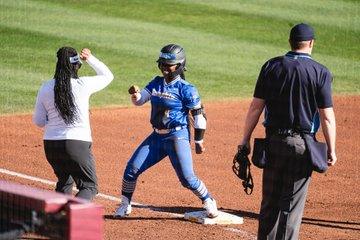
College Softball Is Booming, But Is It Fair
She did not give us a polished sales pitch for the sport. She gave us the hard truth. Her words carried the weight of long bus rides, late nights in the bullpen, and the kind of love for softball that makes it hurt when the game is not fair.
NIL Gains at the Top, Losses in the Middle
When we asked Haley about the game in 2026 and the new NIL era, she did not hesitate. “NIL is a great opportunity,” she said, “but I think it caters to Power Five schools, and mid-majors will suffer.” You could hear the conflict in her voice. She is happy for athletes who can finally help their families. She is also painfully aware that the system is not built for everyone.
For Haley, this is not a theory that lives on social media. It is grounded in what she has lived and what she sees now. Some programs are still trying to catch up to new limits and new realities. They may not be in a position to fully fund the maximum number of scholarships that are now allowed, or to pair those scholarships with the level of NIL support that the biggest brands can offer. In a recruiting world where every dollar and every resource matters, that gap becomes impossible to ignore.
She put it simply, and it stings because it feels honest. Some schools are stepping onto the field knowing they are already behind before the first pitch is thrown. It is not about effort or culture or belief. It is about math. When one program can stack more aid, more NIL backing, and more resources around its athletes, while another is still stretching every scholarship and every budget line, the playing field tilts.
Imagine sitting in a living room with a recruit you believe in with your whole heart. You talk about culture, about growth, about family. Then that same player goes on a visit to a Power Five program with deeper financial support and more visibility. You are not just up against a school. You are up against an entire system that rewards the places with the most to give. At some point, no amount of heart can outweigh the practical truth that one offer can change a life in ways another simply cannot.
Haley sees the fallout now from the analyst chair. She watches rosters at the top grow deeper and more talented. She sees mid-major programs fight like crazy just to stay in the conversation. She knows that the sport looks healthier than ever on television. She also knows that a piece of its soul is at risk, as the distance between the giants and the rest quietly grows.
Yet even as she points out the imbalance, she will not say NIL is all bad. She calls it a great opportunity and means it. What breaks her heart is that the opportunity is not spread evenly. Some players are being lifted. Others are left wondering if there is still room for them in the game they love.
Youth Coaching, Culture, and the Cost to the Game
If NIL is changing the top of the sport, the coaching crisis is poisoning the roots. When we asked Haley how softball can get abusive coaches out of the profession, she did not frame the problem as a handful of bad actors who occasionally make headlines. “I honestly think these bad coaches are everywhere,” she said. “We are just hearing about it because we are in softball, but it starts at the youth level, really.”
She described a youth world that feels “sooo watered down,” where teams pop up overnight, and adults chase status more than development. She sees parents who want their child to be the star so badly that they forget what the game is supposed to give them, which is joy, resilience, and a safe place to grow. “Youth is sooo watered down with people wanting their kid to be the star instead of really learning,” she told us. That sentence hangs heavy because it is not abstract. It is about actual kids who step into the circle already burdened by someone else’s expectations.
The damage begins early. A young pitcher hears more screaming than teaching. A hitter learns that one bad weekend means less love. A travel coach benches a child as punishment instead of as a tool for learning. At first, it is just confusion and hurt. Over time, it becomes a story in the player’s head. I am only worth something when I produce. Adults cannot be trusted. Softball is the thing that gives me joy and the thing that takes it away.
Then those same players arrive in college. From the outside, it looks like their dreams have come true. They wear the gear. They play under the lights. On the inside, many are already exhausted. They feel pressure before they ever step on the field. They brace for the next cutting comment or the next moment when they feel small. When those athletes land with a coach who repeats the same patterns, the harm deepens. When they land with a healthy staff, that staff has to begin the slow work of undoing years of fear.
Haley does not pretend that the answers are simple. She believes that real change begins with the people who hold the whistles and lineup cards long before cameras arrive. Youth coaches need real training, meaningful standards, and true accountability. Parents need to remember that their child’s heart matters more than any trophy. College programs need to value character and care as much as they value velocity and exit speed.
A Game Worth Fighting For
For all the hard truths Haley shared, her love for softball never wavered. It rose to the surface every time she talked about the kids who are coming next. She sees little girls in the stands with faces painted and gloves that are too big. She sees them mimic their heroes in the driveway. She knows they are watching not just the home runs, but also how the adults in this sport treat each other.
She remembers her own journey, from a young player learning the craft, to a standout at a mid-major, to a voice on broadcasts who now helps tell the story of the game. She does not take that platform lightly. When she pushes for change, it is because she wants those girls to inherit something better than what many current players have endured.

Softball, at its best, is a place where a shy kid finds confidence, where teammates become family, and where failure teaches more than it takes. It is a bat in the hands of a player who once thought about quitting and instead finds herself in the biggest moment of her life. It is a circle where a pitcher stands alone, but never really alone, because an entire dugout breathes with her.
That is the game Haley is fighting for. A game where NIL lifts athletes without closing doors on entire conferences. A game where bad coaches are not simply moved around, but removed. A game where youth players are allowed to be kids, to learn, to make mistakes, and to love the sport without fear.
We walked away from our conversation with Haley feeling both heavy and hopeful. Heavy, because the problems she described are real and urgent. Hopeful, because voices like hers exist inside the game and are willing to speak honestly, even when it hurts. College softball is at a crossroads. It can chase ratings and revenue and ignore the cracks underneath, or it can take this moment of unprecedented attention and use it to build a healthier future. Haley Meinen believes that the future is still possible, and so do we. The question now is whether the sport will listen before another generation of athletes gets lost in the gap.