

Texas Tech linebacker Jacob Rodriguez did not just win another trophy. He walked into a lane that still measures the whole person, not only the player.
A Trophy Built Around Leadership
Rodriguez was named the Jason Witten Collegiate Man of the Year on Thursday night in Arlington, Texas. Jason Witten, the former Dallas Cowboys tight end who lends his name and presence to the award, handed him the honor in a room that cared as much about character as production.
The award, presented by Albertsons and Tom Thumb, goes to the Football Bowl Subdivision player who shows an outstanding record of leadership. It focuses on courage, integrity, and sportsmanship. In a sport overflowing with honors for arm strength, speed, and sack totals, this one starts by asking a different question. What do you mean to the people around you?
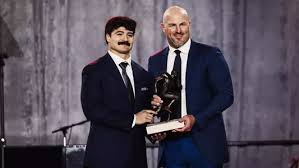
Rodriguez’s on-field résumé would satisfy almost any committee. He won the Bednarik Award as the top defensive player in college football. He drew the third most first-place votes in the Heisman race. He has earned All-Big 12 recognition in each of the last two seasons. He captained a Texas Tech team that won the Big 12 and reached the College Football Playoff. That is elite performance.
His path makes the leadership tag feel earned. Rodriguez began his college career as a quarterback at Virginia. He changed positions. He changed programs. He moved to linebacker in Lubbock and rebuilt himself as one of the most disruptive defensive players in the country. That process carries sacrifice and doubt. It also gives him a kind of credibility in the locker room that cannot be faked.
Texas Tech coaches leaned into that. Rodriguez is a two-time captain. Last offseason, he became a bridge between a strong group of returning players and a transfer portal class ranked at the top of the sport. Blending those two groups is not an academic exercise. It happens in weight rooms and position meetings and quiet conversations after practice. The Red Raiders turned that mix into a league title and a playoff berth. Inside the building, people will tell you that Rodriguez’s voice and habits were central to that jump.
Away from the field, he kept adding layers. He earned Academic All-Big 12 recognition. His wife, Emma, serves as an active duty helicopter pilot in Kansas. That reality shapes perspective and daily life in ways most teammates can only imagine. Around that, he has shown up for school visits and Habitat for Humanity projects. It is a steady service. It is not built for cameras. It fits the spirit of the award.
Why This Award Matters in 2026
When Jason Witten spoke about Rodriguez, he sounded less like a celebrity presenter and more like a former player who knows exactly what he is looking at.
“He has been a true example of a great leader in his time at Texas Tech,” Witten said. He pointed to Rodriguez’s standing as one of the best players in the nation. He also stressed something else. Rodriguez set the standard for his program in the community, in the locker room, and at home. His college career did not start smoothly. He stayed with it. He became an inspiration. Witten called him a perfect example of what a college student athlete can be.

That language fits the history of this particular honor. The Jason Witten Collegiate Man of the Year was the first major college football award built primarily around leadership on and off the field. Its roll call is a string of players whose impact reached beyond numbers. Shaquem Griffin at UCF. D’Cota Dixon at Wisconsin. Trey Smith at Tennessee. Sam Ehlinger at Texas. Josh Paschal at Kentucky. Deslin Alexandre at Pittsburgh. Mike Hollins at Virginia. J. J. Weaver at Kentucky. Each name comes with a story that involves injury, advocacy, service, or all three.
This year’s finalists fit the pattern. Indiana’s Aiden Fisher and Notre Dame’s Aamil Wagner joined Rodriguez on the short list. Witten said the vote was the closest in the award’s history. All three have taken active roles on campus and in their communities. All three carry reputations as tone setters in their programs. The difficulty of the choice is a good sign. It means there is still a deep bench of players who treat leadership as part of the job, even in an era that pushes movement and self-branding.
That is where the importance of this award sharpens. College football in 2026 is framed by realignment charts, media rights figures, and transfer graphics. The off-field conversation rarely leaves room for the quieter work that keeps a locker room aligned. The Jason Witten Collegiate Man of the Year cuts against that drift. It tells players and coaches that there is still a national platform for the person who picks up a teammate, who keeps a standard, who shows up for people who will never buy a jersey.
For Jacob Rodriguez, this honor tags his season with something more permanent than a stat line. It captures the way he has handled a position switch, a program change, and the weight of expectations. It recognizes the way he has used his voice in one of the most unstable periods the sport has ever seen.

For the sport, it serves as a reminder. The most valuable players in a program are often the ones who will never see their names on a mock draft board. They are the ones who keep people together when money and movement pull them apart. As long as awards like this exist, college football still has space on its main stage for that kind of name.
In a year that will be remembered for playoff debates and transfer news, the Jason Witten Collegiate Man of the Year offers a different headline. The game still knows how to honor the player who leads, who stays, and who lifts others with him.