


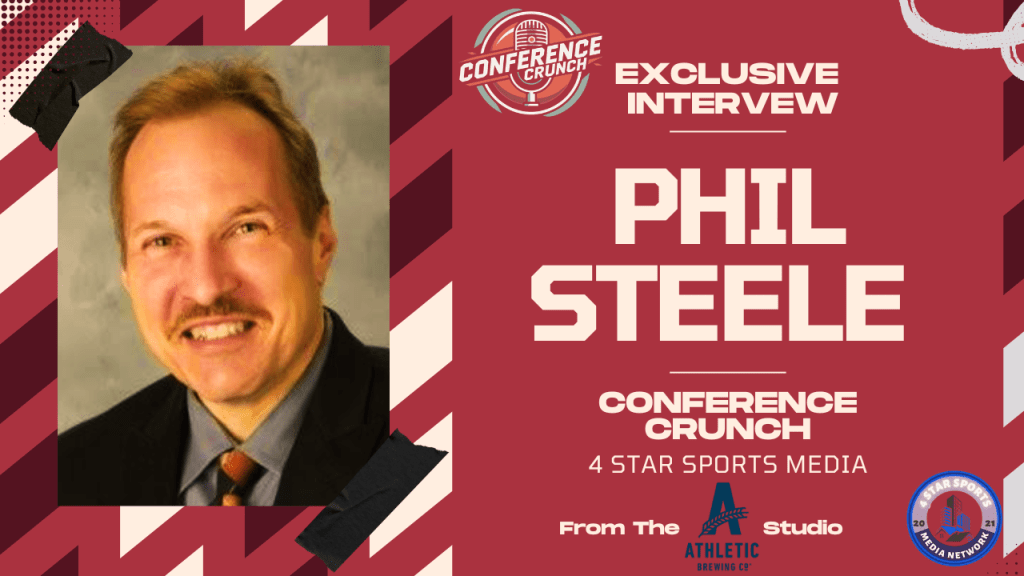
For more than three decades, Phil Steele has turned the sprawling, constantly changing world of college football into a yearly reference work that coaches, media members and devoted fans use well beyond kickoff weekend. The 2026 edition of Phil Steele’s College Football Preview is another product of that commitment: a 376-page, full-color publication covering all 138 FBS teams, built through a seven-month process that ends only when Steele believes every roster detail has been checked one more time.
Phil Steele’s Long Game: Building Toward Issue No. 50
The magazine’s reputation did not begin with a publishing plan. It began with a frustration.
Before launching his own publication in 1995, Steele ran a handicapping service and bought every available college football preview magazine he could find. There were roughly 30 on the market, but the combined information still was not enough to assemble complete starting lineups for many programs.
“I would write down every piece of information from every team,” Steele said during a recent appearance on Conference Crunch. “And guess what? I couldn’t even come up with a starting lineup for half the teams. There just wasn’t enough information out there.”
So Steele began building his own database. He collected rosters, player statistics and individual notes while watching games across the sport. A suggestion from someone in his office—turning those materials into a magazine—became the foundation for a college-football institution.
The first edition covered 88 teams in 188 black-and-white newsprint pages. Today, Steele’s preview devotes two full pages to every FBS program. The publication has grown into one of the sport’s most detailed annual resources, earning the “College Football Bible” label over the years. Steele’s 2026 digital edition remains available as part of a product line updated through September, reflecting the reality that rosters and college football news do not stop changing once a magazine reaches shelves.
A Process Built on Repetition
Steele’s work on the next season begins before the current one is fully out of mind. The process starts on the Sunday after Thanksgiving, launching what he described as a seven-month cycle of research, evaluation and rewrites.
He and his staff receive daily articles on every program during the season. Steele watches the games, reads the reporting, then returns to each team after the season to reconstruct the complete story. He studies the rise and fall of every position group, injuries, player development, coaching decisions and results that may have been missed in the weekly rush of a college football Saturday.
The goal of Steele’s first write-through is straightforward, even if the labor is anything but: What shape was each unit in entering the previous season? What happened during that season? And what should be expected next?
“The first two parts of that write-through aren’t going to change,” Steele said. “Last year’s not going to change over again. But the third part’s going to get changed numerous times in the seven-month process.”
That is where the modern game complicates the work. Transfer portal movement, freshman additions, spring development and eligibility questions can reshape an entire roster in a matter of days. The second write-through incorporates spring rosters, transfers and newcomers. The third—and most important—comes after Steele has spoken directly with the people leading the programs.
His established process has long included reviewing each team’s season, conducting multiple write-throughs and interviewing head coaches after spring practice.
The Coach Calls Matter Most
For Steele, the defining element of the magazine is not a preseason ranking, a statistical formula or even a Saturday spent monitoring 12 television screens. It is the conversations with head coaches.
This year, Steele said he spoke with 133 of 138 FBS head coaches, typically spending about an hour with each one. He sends the coach a detailed team page featuring every player on the roster, statistical information and his own player notes. Then he asks the coach to organize the players and identify who will make an impact.
“We go over the entire roster,” Steele said.
Those discussions serve as a final fact-checking and projection tool. They can reveal position battles that remain unsettled, identify players poised for larger roles and help clarify whether a newcomer is truly ready to contribute. Steele then completes his third write-through and updates nine sets of power ratings before the magazine goes to press in June.
That access is something Steele does not take lightly.
“For a head coach of any school to grant me an hour, hour and a half of their time going over the roster with me, I consider it an honor and a privilege,” he said. “There’s a level of respect there, and I can’t thank them enough.”
It is also a relationship built over time. Steele pointed to media-day appearances in the mid-2000s, first with the Mid-American Conference and then Conference USA, as important steps in developing those connections. Coaches shared information among themselves, and the interviews gradually became a staple of the magazine’s process.
Adapting to a Changing Sport
The 2026 cycle arrived at a moment when college football continues to wrestle with roster mobility, revenue-sharing questions, eligibility rules and a rapidly altered conference landscape. Steele sees reasons for optimism.
He said the absence of a second spring transfer portal window allowed coaches to hold their rosters together through spring and carry more continuity into fall camp. In his conversations with coaches, Steele repeatedly heard that they felt they had a more cohesive team and could coach players harder because the group was less likely to change immediately afterward.
“I think we’ll see a better brand of football this year,” he said.
Steele also welcomed a clearer five-year eligibility structure, particularly from the perspective of someone who must project 138 programs. Less uncertainty about whether a player will be available simplifies the evaluation process, but it also helps readers trust that the magazine reflects the best available snapshot of each roster when it goes to press.
The magazine’s growth has tracked the sport’s expansion. Steele noted that the first edition did not cover every team; now each FBS program receives the same two-page treatment. Recent editions have expanded as the FBS membership has grown, including a 360-page 2025 issue after Delaware and Missouri State joined the level.
The Road to No. 50
At age 61, Steele is not presenting a legacy speech. He is outlining an 18-year plan.
“I have announced when I’m officially going to step down from the magazine business,” Steele said. “And that’s issue 50.”
That target gives Steele a clear runway: 18 more editions, 18 more offseasons and 18 more opportunities to refine a process he has spent 32 years building. The long-range plan is not simply to keep the magazine alive until a milestone arrives. It is to continue writing every one of the 138 team previews himself, continue speaking with the coaches himself and eventually identify a successor capable of preserving the standard.
“We’re going to have to develop a successor at that point, 18 years from now,” Steele said. “But I do write each of the 138 teams myself, take a great deal of pride in that. I do talk to each of the coaches myself, which I take a great deal of pride in.”
That is the plan for the 50th edition: not a retirement tour, not a reduced role and not a handoff made before Steele is ready. It is a deliberate march toward a landmark issue while maintaining the hands-on work that made the magazine essential in the first place.
For Phil Steele, college football is not a seasonal interest. It is the center of his professional life, from the Sunday after Thanksgiving through the final pages sent to press in June, and then through every Saturday in the fall. Issue No. 50 may eventually mark a transition, but for now, it is simply the destination on a road Steele is still eager to travel.