
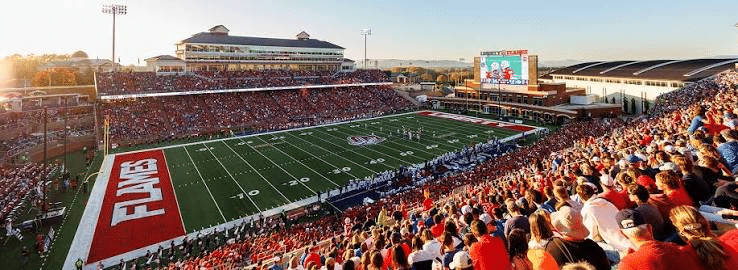
Ten consecutive victories, a balanced offense, and a defense that keeps answering the same question have put the Flames at the front of the Group of Six debate. The easiest way to dismiss Liberty is to identify its conference. The harder way is to explain its football team.
That requires accounting for 10 consecutive victories. For an offense that can change how it attacks without changing how effectively it moves the ball. For a defense that has spent most of the season preventing opponents from turning games into arguments.
Liberty Isn’t Asking for a Favor. It’s Making a Playoff Argument.
It also requires acknowledging the legitimate question attached to all of it: how much does the schedule tell us? Liberty does not get to escape that examination. But neither should the schedule become an excuse to avoid examining Liberty.
After Saturday’s 45–14 demolition of Western Kentucky, the Flames are 10–1 overall and unbeaten through seven Conference USA games. They led 21–0 after one quarter and 28–0 at halftime. Whatever uncertainty remains about their national ceiling, there was little uncertainty about which team controlled this game.
Sunday brought a more consequential development in the public conversation. Liberty climbed to No. 21 in the Associated Press poll, one position ahead of Boise State, becoming the highest-ranked Group of Six team in that survey. The coaches disagreed, placing Boise State 21st and Liberty 24th. That split is not a verdict. It is an invitation to have a better argument.
The Offense Has More Than One Answer
Start with what happened when Liberty put the ball in Deshawn Purdie’s hands. A week after the Flames rushed for a season-high 370 yards against Middle Tennessee, Purdie completed 19 of 25 passes for a season-high 344 yards against Western Kentucky. He threw two touchdown passes and added a rushing score. That is more revealing than another large number in a victory.
A productive running game can make an offense difficult to defend. A productive running game paired with a quarterback who can punish a defense through the air creates a different assignment. Western Kentucky did not merely have to withstand one preferred approach. Liberty demonstrated that it could produce in another way. The Flames still rushed for 216 yards and four touchdowns.. The passing performance supplemented the ground game rather than replacing it.
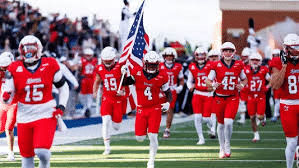
That distinction matters when evaluating a team for something beyond its next conference game. What happens if the preferred answer is unavailable? Can the offense find another one? Does the quarterback have to rescue the structure, or can he operate effectively within it? Saturday supplied encouraging evidence. Not proof that Liberty can beat anybody. Evidence that its offense deserves a more serious description than “good enough for Conference USA.”
The Most Important Names Might Be the Same Five
Quarterbacks make a playoff case easier to promote. Offensive linemen help make it sustainable. Liberty has started the same five offensive linemen in all 11 games. Its line ranks ninth nationally in PFF’s pass-block grading and 20th in run blocking. Against Western Kentucky, all five starters earned pass-block grades of at least 77.0 while allowing five total pressures.
Those are attributed grading measures, not an official national verdict. They still help explain how the offense functions. Liberty is averaging 221 rushing yards per game without asking one back to account for anything close to all of it. Its leading rusher averages 74.6 yards, and four running backs have at least 40 carries and 300 yards, according to the supplied figures.
The production is distributed. That does not make individual talent irrelevant. It suggests the offense has built something repeatable around more than one player. Fresh backs matter. Reliable blocking matters. So does a quarterback who receives enough protection to make the passing game a genuine threat. The Flames’ case is stronger when those pieces are considered together.
This Is Not Just a Team Winning Shootouts
There is another reason the argument deserves attention. Liberty is not asking its offense to compensate for a defense that disappears. The Flames are among the top 12 nationally in both rushing offense and rushing defense, among the top 20 in both red-zone offense and red-zone defense, and among the top 25 in both scoring offense and scoring defense. Liberty identifies itself as the only Group of Six team meeting each of those paired standards.
Those combinations matter more than an isolated ranking. An explosive offense can make a team dangerous. An offense supported by a defense that limits points, protects the red zone, and holds up against the run gives it additional ways to win. Liberty’s supplied figures also show 10 consecutive victories while holding opponents to 23 points or fewer.

Against Western Kentucky, the defense generated 19 pressures, including three sacks, and recorded 13 pass breakups. There is a difference between watching an opponent make mistakes and repeatedly creating difficult plays for it. Pressure and disrupted passes suggest Liberty was doing the latter.
The Schedule Question Is Fair
Now for the part that cannot be argued away. Western Kentucky left Lynchburg 4–7. A decisive victory over a losing team is not automatically a signature win, regardless of how cleanly the winner executes. And the concern about Liberty’s overall schedule is not something its supporters should dismiss as disrespect. ESPN’s weekend assessment identified schedule strength as a limitation on the Flames’ playoff case even while highlighting their improvement and 10-game winning streak.
That deserves an answer grounded in comparison. Who has the strongest collection of victories? Who has performed most convincingly against the opportunities available? How much separation should schedule strength create, and how much can consistent performance close it? Those questions should be applied across the Group of Six field.
Not selectively, depending on which program has the more familiar postseason history. There is evidence in Liberty’s favor beyond the raw record. ESPN’s updated SP+ rankings place the Flames 17th nationally, with the offense 22nd and the defense 19th. That provides another assessment supporting the idea that this is a balanced team, not merely a successful record attached to an unconvincing performance profile.
The Flames rank highly in two areas that stand out nationally, 18th in Team Success and 10th in Strength of Record, both the best among Group of Six programs. Those measures should inform the discussion, not end it. Different systems assess different things. But neither should they be ignored because they complicate a convenient dismissal.
Boise State’s Loss Opened the Door. Liberty Still Had to Move.
Boise State’s 22–20 loss to San Diego State changed the race. The Broncos took their second defeat and fell behind Liberty in the AP poll. They had been the only Group of Six team in the previous College Football Playoff rankings. That last distinction matters.
The AP poll does not award the playoff berth. The coaches poll does not award it, either. Liberty’s position in Sunday’s voting strengthens its public case. It does not establish how the selection committee will evaluate the Flames against Boise State or anybody else. Nor should Boise State disappear from the conversation because of one result. The Broncos’ entire season still belongs in the comparison.
But Liberty should not be described merely as the beneficiary of somebody else’s mistake. Ten consecutive wins represent work completed, not an opportunity inherited. Saturday’s performance gave the Flames something substantive to put beside the opening created elsewhere. They did not just remain available. They strengthened the argument.
Finish the Case
Liberty still has obligations before any playoff discussion becomes a selection decision. Analyzing their schedule, the Flames finish the regular season at Missouri State on November 28, then face Jacksonville State in the Conference USA championship game on December 4. Neither game should be treated as a formality. A November ranking is not permission to start preparing a December complaint.
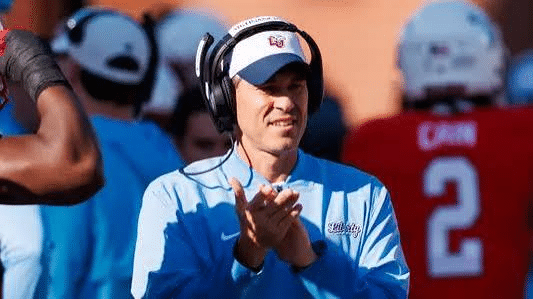
The assignment is to finish the regular season, win the conference and give the committee the strongest possible version of the case. But the national conversation can catch up now. Liberty has a legitimate argument to be the best Group of Six team. Its record supports it. Its balance supports it. An independent national rating system places it comfortably inside the top 20.
The schedule remains the strongest objection. It should be weighed—not wielded as a reason to stop looking. Liberty is not asking anybody to forget whom it has played. It is giving the sport increasingly good reasons to pay attention to how it plays.