
AJ McCarron did not come back to spring football to play a mascot. He walked into the United Football League’s toughest job: replacing a championship coach, taking over a flagship brand, and trying to prove that a first-time head coach can keep a dynasty alive inside a startup league still fighting for relevance. The question hanging over Birmingham is not whether fans know his name. It is whether the three‑time national champion from Alabama is actually in over his head now that the headset is his.
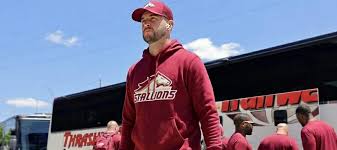
Is AJ McCarron Over His Head or Building a Beast?
The UFL did not hand McCarron a soft‑landing expansion project with low expectations. It dropped him into the hottest seat in spring football. Skip Holtz walked away with multiple spring titles and set a bar that feels closer to “championship or bust” than “let’s see how it goes.” McCarron has to match that standard while learning how to manage a staff, build a culture, and handle game management in real time, all without any prior head‑coaching résumé to lean on. Every mistake is magnified because it is happening in a pressure cooker that has never really cooled.
On paper, his qualifications make sense. He has lived almost every version of this ecosystem, from NFL backup and journeyman fighting for roster spots to spring‑league star quarterback who turned St. Louis into must‑watch TV and became one of the faces of the movement. That matters in a league where buy‑in is fragile and rosters churn quickly, because players know he has actually lived the grind they are in now. It is easier to demand professionalism when everyone in the room believes you understand the cost and the stakes.
But the sport is full of elite former players who discovered, painfully, that playing success does not automatically translate to managing fifty‑three egos, running a staff and owning every detail from the Tuesday install to the last timeout on Saturday. McCarron now has to install systems instead of just executing them, hire assistants instead of just working with them, and stand in front of a locker room after the kind of ugly losses that inevitably come with the job. The human side of coaching, from difficult conversations about jobs and roles to the discipline needed to keep a room together during a losing streak, will test him as much as any fourth‑quarter decision.
The context around him is just as unforgiving. The UFL is still young enough that every season feels existential, with markets being tested, television partners evaluating ratings and one bad year in a key city capable of swinging the narrative from growth story to “here we go again with spring football.” Birmingham is not just another team; it is a proof‑of‑concept for whether star‑power coaching hires and established brands can turn this league from curiosity into habit. If Birmingham stumbles, it is not only a local issue but a league‑wide storyline that feeds the spring‑league graveyard narrative.
McCarron’s temperament has already become part of that storyline. When he publicly vented about officiating standards and a missed delay‑of‑game call that helped swing a game, it did not sound like random complaining. It sounded like a coach who believes he is operating in a real, professional league and expects the infrastructure around him to match that standard. That kind of public edge can be valuable, because it signals accountability and a demand for professionalism the UFL genuinely needs. If players and coaches are held to a certain level, officials and the league office have to live there too.
The risk is that the narrative around that edge flips quickly if Birmingham struggles. The more a team loses, the less people hear “leader demanding better” and the more they hear “coach looking for excuses.” In a young league that still has to convince casual fans it is not a gimmick, a high‑profile coach constantly at odds with officiating can either underline how much these games matter or cheapen the product if it feels like chaos instead of accountability. McCarron has to be careful that his passion does not morph into the story itself.
The bigger picture question is how much room the UFL has for on‑the‑job learning at the very top. Established leagues can afford to let legendary players figure it out as coaches in real time, because the brand is bigger than any one person and the revenue streams are secure. The margin for error in a startup spring league is much thinner, especially in a cornerstone market. If McCarron mismanages games, whiffs on staff hires, or loses the locker room, Birmingham’s slide will show up in attendance, local sponsorships, and the tone of national coverage. That is a lot of risk bundled into one sideline.
So the debate over whether McCarron is overmatched or exactly what this league needs is really a referendum on the UFL’s own appetite for risk. The optimistic case says that his film‑room reputation, competitive edge, and modern quarterback experience will translate into creative game plans, sharp situational football and an authentic culture players trust. In that world, Birmingham stays near the top of the table, and the league gets the storyline it craves: a former NFL quarterback turned spring‑league star who is now winning as a head coach. That is the kind of arc that sells broadcast packages and digital shoulder content.
The darker case says the job proves too big, too fast. Birmingham drifts back toward the middle, McCarron’s public fire starts to feel like noise, and the UFL quietly shifts its hiring philosophy away from name value and back toward anonymous lifers with long coordinating résumés. The league can survive that outcome; spring football has always survived by moving on quickly. The question is whether a project still trying to earn trust can afford such a high‑profile experiment failing in full view.

The safer move for Birmingham would have been to replace Skip Holtz with another veteran coach who has spent decades grinding through position rooms and film cut‑ups. Instead, the franchise and the league gambled on the idea that a modern, recently retired quarterback with championship hardware and fresh spring‑ball credibility can be the blueprint for what this league wants to be. If McCarron hits, he will not only silence the “over his head” whispers; he will help legitimize the UFL’s entire talent pipeline from headset to huddle. If he misses, Birmingham will move on, but the bigger question is whether a league still building its identity can afford to watch one of its boldest bets come up short in real time.