
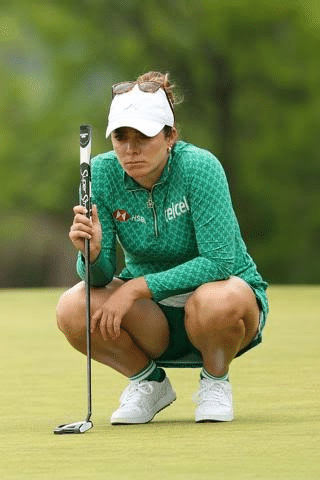
Gaby López’s 2026 season includes a result that gives fans an immediate understanding of her competitive potential. She tied for second at the U.S. Women’s Open, finishing one stroke behind Nelly Korda at Riviera. In a championship decided by the narrowest of margins, López remained close enough to be part of the outcome until the finish.
Gaby López: A Major Runner-Up With Another Story to Build at Pelican
She shared that position with Charley Hull at 7 under, while Korda won at 8 under. The result established a meaningful reference point for the season: López had produced one of the strongest performances in a major field, not simply a brief appearance near the top of a leaderboard.
Now she is among the prominent entrants highlighted for The ANNIKA. The tournament packet lists her at world No. 14 in its rankings snapshot, placing her within the group of highly ranked players preparing to compete at Pelican Golf Club. Her presence adds another substantive story to a week likely to attract considerable attention around Korda’s milestone pursuit.
The question is how her best golf takes shape. A finishing position tells fans where a player ended. It does not reveal whether the result was built on repeated close approaches, valuable putting, effective recovery or a combination that changed from round to round. Those differences are where an individual performance becomes a story.
López’s week offers an opportunity to follow that process. On a scoring hole, consider where the chance began. Did an approach leave a realistic birdie putt? Did a recovery save a par that could have become a dropped shot? Did one exceptional stroke disguise a more difficult sequence? None of those possibilities should be assumed from the score alone.
That makes “consistency” a useful question but an incomplete explanation. It is easy to say a player needs four good rounds. It is more informative to identify what can be repeated within them: sound position, quality approaches, manageable misses or dependable conversion. A complete tournament is built from those smaller outcomes.
For fans new to following López, the major runner-up finish provides the introduction. The next step is to watch how she responds to the different demands of another event. A strong result at Riviera does not predict a result at Pelican, but it establishes that she has already produced high-level contention during this season.

The distinction between expectation and evidence matters. A prominent player can have a difficult opening round without that erasing the quality of her year. A low first round can create an opportunity without proving that the rest of the tournament will follow. Watching the changes between rounds is part of understanding the competition.
López also gives readers a reason to look beyond a single dominant headline. The ANNIKA’s field includes defending champion Linn Grant, three-time winner Korda and a broader group with substantial achievements. López belongs within that competitive picture as a player with her own season and ambitions, not simply as another name included to describe field strength.
That is why player-led coverage can make a tournament more engaging. Instead of needing to know everyone immediately, a fan can choose one golfer and follow the sequence of her week. An opening round establishes a position. The second round shows a response. The weekend reveals whether the strengths remain useful as the competitive situation changes.
For López, the most interesting pattern may be the one that continues when the scoring slows. A successful recovery or an avoided mistake can have substantial value even when it does not produce a highlight. Those moments keep a player in position to benefit when the next genuine opportunity appears.
Her U.S. Women’s Open performance also demonstrates why the smaller margins deserve attention. One stroke separated the winner from the two runners-up. That does not mean a single missed chance should be selected afterward as the entire explanation. It means that many decisions and outcomes across the tournament contributed to a result decided closely.
Pelican presents another chance for those details to matter. López’s story will not be determined by a ranking snapshot or a pre-tournament label. It will emerge from the shots she produces, the opportunities she creates and the way she handles the rounds that do not unfold exactly as planned.
For fans, that is an inviting reason to follow: a player with a major result already on her season’s record, entering another strong field with a new performance to build. The interest is not only whether López finishes near the lead. It is how she gives herself the chance to get there.