
From a coach’s perspective, the new one-window transfer world is both a lifeline and a loaded gun. Every coach in America will tell you the truth over a quiet cup of coffee in January: they are coaching two seasons at once now. There is the one they just finished, the one everybody saw on Saturdays. There is also the one nobody really understands unless they live inside a facility, the 15-day sprint where a staff either saves a roster or watches it unravel in real time.
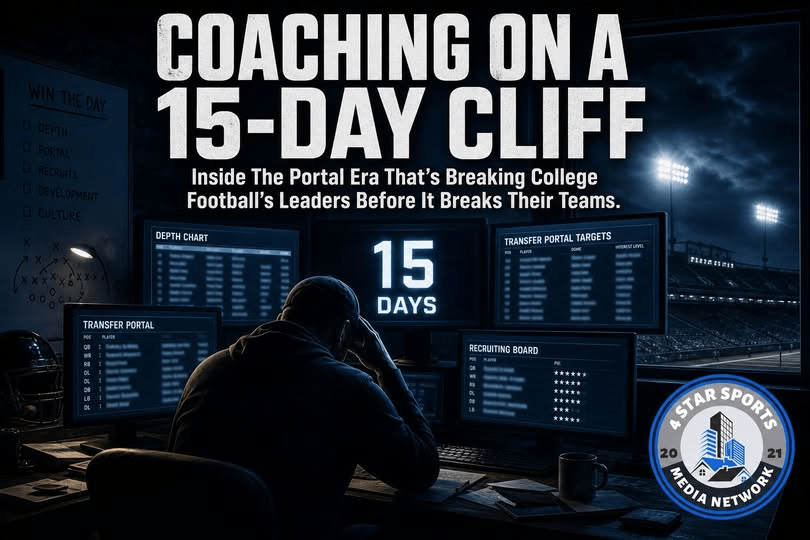
Coaching On A 15-Day Cliff: Inside The Portal Era That’s Breaking College Football’s Leaders Before It Breaks Their Teams
The board used to be simple, built around high school recruiting, development over years, and maybe a handful of transfers to plug obvious holes. Now every coach walks into the building on Jan. 2 knowing three things can happen in a hurry: the players they planned to build around can jump in the portal, the players they desperately need from the portal can suddenly cost more than they can afford, and the clock to fix all of it is ticking in the corner of the office like a bomb. There is nothing abstract about it. They are texting agents and intermediaries, they are on late-night calls with donors and collectives, and they are watching personnel staff refresh transfer trackers like day traders staring at a stock ticker, all while trying to look their current locker room in the eye and say they still believe in them.
The old line, “I am a ball coach, not a general manager,” does not exist anymore. A modern head coach is managing a recruiting calendar, a game-planning calendar, a portal calendar that has a 15-day panic window bolted to it, and a financial calendar tied to NIL and donor timing. You cannot hide from it, because staff meetings now sound like NFL free agency breakdowns. Assistants sit around a table and ask if a transfer’s price is worth the disruption, if he can play right now or if they are buying someone else’s problem, and how they will explain his value to the starters already in the room. They are still grinding tape until two in the morning, but half of that film is now other people’s players rather than their own.
The human side is what the outside world keeps underestimating. At some point in January, every head coach has to walk into a team meeting room full of players scrolling their phones, reading rumors about themselves, and seeing their market value debated online in real time. That coach has to stand there and talk about commitment and belief, even though everybody in the front row knows the staff just hosted a transfer at their position. You cannot bluff your way through that. Players are too smart and too plugged in. If they smell dishonesty, you do not just lose a body, you lose the trust that holds the room together.
That is where culture and chemistry become as fragile as depth charts. A staff might tell itself that bringing in two or three veterans from the portal will stabilize a position group, but if one or two glue guys feel disrespected and jump into the portal in response, the net effect can be negative. In a 15-day window, you do not have time to fix both personnel and culture, so you end up picking which fire to fight. Some coaches decide to live with a talent gap and protect the locker room. Others gamble on talent and hope they can repair the hurt feelings later. Either way, the margin for error is thinner than it has ever been.
Planning used to stretch three years into the future. A coach could look at a freshman class and talk honestly about what they would be as juniors. Now saying that out loud feels dangerous. A breakout freshman season is no longer just a cause for celebration; it is a trigger for anxiety. The minute a young player pops, the questions start. How do we keep him, what is his NIL situation, who is circling him behind the scenes, and will we have the resources to match what someone else can offer in the next window. Retention has become as important as acquisition. The staff that can keep its best players is every bit as dangerous as the staff that can poach stars from somewhere else.
At the same time, coaches are judged publicly as if nothing has changed. Fans see a depth chart hole in August and ask why it was not fixed in the portal. They do not see the transfer who assured the staff he was in, then bailed two days before classes. They do not see the high school signee the coaches backed off to create room for a veteran who never actually showed up. They only see the final roster and the final score. Inside the office, every one of those misses is attached to a name, a late-night call, and a choice that will be second-guessed for months.
The most honest feeling among coaches right now is that the pressure has gone up while the safety net has disappeared. When there was a spring window, you could convince yourself there would be a second chance to patch a mistake. Miss on a quarterback in January, and maybe a grad transfer would shake loose after spring practice. Now, if you misread the market or misjudge a player’s intentions, you are likely carrying that weakness all the way into the fall. That reality changes practice habits, risk tolerance, and even play calling. Coaches think about how many hits a thin position group can take in scrimmages. They think about whether a gadget play that exposes a star to contact is worth it when the portal has made replacing him harder than ever.
Yet for all of that, most coaches will not walk away. Underneath the spreadsheets, the late-night calls, and the fire drills, the thing that hooked them in the first place is still there. There is still the satisfaction of finding the right transfer who buys into the program and changes his life and your season at the same time. There is still the pride in seeing a position group that was a liability in October turn into a strength the next year because you blended a couple of portal additions with the right leader you already had in the room. There is still the rush of running out of the tunnel on a Saturday with a team you built in 15 frantic days and nine grinding months and watching them stand toe-to-toe with someone richer, louder, and more established.
From the outside, the new system looks like pure chaos. From the inside, it feels like a daily fight to build something lasting inside a machine that never stops spinning. Coaches complain, and they have every right to, but the moment the calendar flips and that window opens, they are right back at their desks, coffee going cold, eyes burning, chasing the next commitment. For all the extra titles that have been stapled onto their job description — recruiter, fundraiser, negotiator, crisis manager — there is still only one word they really want to earn when the lights come on in the fall.
Coach.