


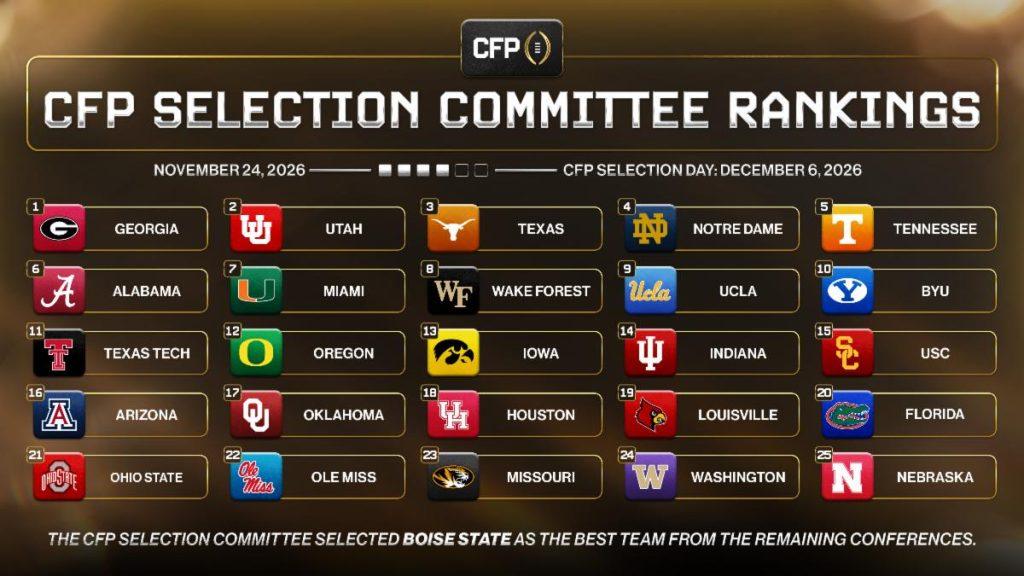
Alabama’s slide and Tennessee’s rise are defensible. The committee’s credibility depends on showing why those judgments are different from the ones it made before. The College Football Playoff committee’s most important move Tuesday was not dropping Alabama three places.
It was acknowledging that the argument for Alabama had changed. That should not be controversial. A committee reviewing an unfinished season ought to revise its conclusions. The alternative is a group more interested in defending its previous rankings than evaluating the next set.
The CFP Committee Changed Its Mind. Now Explain Why.
But revision carries a responsibility. When the committee changes the order, it needs to show whether new evidence changed the comparison or whether it reconsidered evidence that was already available. Those are different explanations. Both can be legitimate. Neither should be hidden behind a “full body of work.”
Alabama’s Supporting Evidence Changed
Alabama beat Chattanooga 47–0 and fell from third to sixth. Texas, Notre Dame and Tennessee passed it. That is not evidence the committee punished Alabama for winning. Rankings compare teams with one another, and a comfortable victory against Chattanooga does not necessarily strengthen a résumé as much as another contender’s result.
Committee chair Hunter Yurachek offered the more consequential explanation. “When we first ranked Alabama at No. 3 two weeks ago, their resume looked different than it did when we started the ranking process this week,” he said. That is the right place to begin.
Kentucky and South Carolina have left the rankings. LSU was already outside them. The quality of Alabama’s earlier victories cannot be evaluated independently of what those opponents subsequently reveal. But the committee must resist another shortcut. An opponent does not become worthless at No. 26 after being useful at No. 25.
The ranking label is not the evidence. The performances producing that label are. If Alabama’s previous opponents have demonstrated weaknesses, explain those weaknesses. If other contenders now have stronger collections of victories, make that comparison. That is more persuasive than counting how many ranked wins disappeared.
Tennessee’s Result Did Not Change
Tennessee beat Alabama before the first rankings were released. For three releases, the committee placed Alabama higher. Now Tennessee is fifth, Alabama sixth, and both are 9–2. The direct result has not changed. Its place within the committee’s larger judgment apparently has. That demands a precise explanation.
Did Tennessee’s new victories close a schedule gap? Did Alabama’s opponents weaken enough to narrow the overall comparison? Did the committee become more persuaded by Tennessee’s performance? The answer matters beyond these two teams because it establishes when head-to-head becomes decisive. The committee cannot make every winner rank above every loser. An entire season is more complicated than that. It can explain why the broader evidence overcomes a direct result—and what changes when it no longer does.
Indiana Reveals a Different Kind of Revision
Yurachek pointed to Indiana’s run of close games when explaining its decline. “Before Saturday, they found a way to win those games,” he said. “But on Saturday, they did not.” That is an understandable observation. It is not a complete analysis.
The committee must distinguish between learning something from a defeat and allowing the defeat to rewrite everything that preceded it. A close victory against a strong opponent can demonstrate quality. A narrow escape against a weak one can expose limitations. Treating both as entries in the same warning-sign column would sacrifice context for a convenient trend. The important question is not simply how often Indiana played close games. It is what those games consistently showed.
The Standard Should Be Visible
The committee deserves room to change its mind. It should not receive unlimited room to change the meaning of its explanations. This week’s order may be better than last week’s. Alabama’s decline may reflect appropriate reevaluation. Tennessee’s promotion may bring the rankings into better alignment with the complete evidence.
But a defensible conclusion is stronger when the reasoning can be followed. The committee’s job is not to prove it was right the first time. It is to demonstrate that it is asking the right questions now.