
WWE has the stars, the stadium, and the cage. Houston will reveal whether those pieces add up to something more than another expensive-looking wrestling show. A cage can contain a wrestling match. It cannot manufacture a reason to care. That is the challenge facing Survivor Series. WWE’s November 28 show at Houston’s Daikin Park features two WarGames matches, a traditional elimination match between Team USA and Team Mexico, and Liv Morgan defending the Women’s World Championship against Becky Lynch. On paper, the ingredients offer spectacle, recognizable names, and several different ways to tell a story.
Surviving The Series Pt. 1: Survivor Series Has WarGames. Does It Still Have Its Own Identity?
But a full lineup is not an identity. What should make Survivor Series different from any other major WWE event? The answer cannot simply be that this is the month when workers assemble two rings.
My answer is simpler: This should be the show where relationships face consequences. Who trusts whom? Who sacrifices for a teammate? Who discovers that a supposed ally is useful only when things are going well? Those questions make team wrestling compelling. Without them, a ten-person match risks becoming a crowded singles match with scheduled entrances.
Wargames Should Be The Consequence, Not The Assignment
There is nothing inherently wrong with an annual WarGames event. A recurring attraction gives an audience something to anticipate. The danger is reversing the creative process. Instead of a rivalry escalating until WarGames feels appropriate, the calendar can become the justification for assembling teams. Five people stand on one side, five stand on the other, and everyone behaves as though the cage itself explains their investment.
It does not. The strongest case for this year’s men’s match is that WWE has supplied an escalation substantial enough to justify confinement. Its official account of The Bloodline’s conflict with The 946 includes assaults, an abduction angle and both factions setting the other side’s vehicle on fire. Royce Keys’ grievance began with an injury inflicted by Jacob Fatu, and the conflict expanded into a confrontation involving Roman Reigns and his family
That is not a minor disagreement requiring a decorative stipulation. But once the story includes that level of hostility, the match inherits an obligation: It must resolve something meaningful. If everyone emerges from Houston ready to resume the same parking-lot attacks and interrupted interviews, the cage will have been an expensive pause button. WarGames does not have to end every relationship in the rivalry. It should end the version of the rivalry that required WarGames.
The Bloodline Cannot Be The Only Team Allowed To Become More Interesting
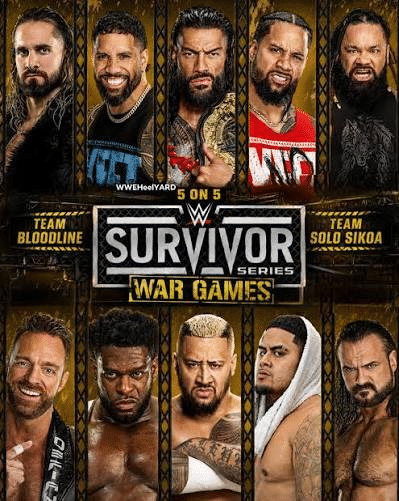
The Bloodline enters with Roman Reigns, The Usos, Solo Sikoa, and Jacob Fatu. The 946 counters with Royce Keys, Bronco Nima, Lucien Price, Carmelo Hayes and Cruz Montana. That pairing creates an obvious creative temptation: Use the newer faction to generate another dramatic chapter for the established attraction. That would be the safe version of the match. It would also be the least ambitious.
The 946 cannot function merely as opposition that allows The Bloodline to demonstrate its power again. The group needs identifiable value beyond being the people standing across from Roman. A viewer should leave knowing more than which faction won. What makes Keys the leader? What distinguishes Nima and Price? Where does Hayes’ ambition fit inside the group? What does Montana contribute beyond being another body?
The match does not need five separate origin stories. It needs choices that reveal character. A teammate who prevents an elimination-level mistake matters more than someone taking a weapon shot in the background. A calculated sacrifice says more than another synchronized pose. WWE should use the size of the match to broaden its cast, not narrow the spotlight.
The Women’s Match Needs Hierarchy Without Making Half The Field Irrelevant
Charlotte Flair, Stephanie Vaquer, Alexa Bliss, Tatum Paxley and Bayley face Jacy Jayne, Fallon Henley, Lainey Reid, Jade Cargill and Michin. WWE’s account connects the match to overlapping conflicts involving the women’s tag titles, Cargill’s attack on Flair and subsequent confrontations among the teams. The ingredients are there. The challenge is organizing them. A match with ten participants does not require ten equal shares of screen time. It does require everyone to have a recognizable function.
The established names can provide structure. They should not consume every consequential moment. Vaquer should feel like a central competitive force, not an impressive accessory. Paxley needs something to accomplish beyond being present alongside more established stars. Fatal Influence needs to operate like a faction with a plan rather than a convenient collection of opponents.
Most importantly, Cargill and Flair’s conflict should retain emotional priority when those two finally meet. If their confrontation feels no different from any other exchange, the match will have misplaced one of its clearest reasons to exist. WarGames works when the audience can follow several threads through the disorder. Chaos is the presentation, not an excuse to abandon clarity.
The Traditional Match Is Not A Museum Exhibit
The Team USA–Team Mexico elimination match gives this card a different storytelling tool. Following November 23’s Raw, the announced teams include Cody Rhodes, CM Punk, Je’Von Evans, LA Knight and Seth Rollins against Rey Mysterio, Penta, Rey Fenix, Dragon Lee and El Grande Americano. This match should not be treated as a respectful nod to an older format before the “real” attractions begin.
Elimination changes a match as it progresses. Every departure alters the balance. A wrestler who seemed comfortably protected can suddenly be isolated. Someone who entered as a supporting player can become the last remaining hope. That is an advantage no amount of cage construction can replicate.
My concern is the national branding. “USA versus Mexico” provides an immediately understandable label, but it should not substitute for personalities or invite the presentation to flatten a talented team into generic foreign opposition. Make the conflict about competition, leadership and the people involved. There is enough material without asking a flag to do all the storytelling.
Survivor Series Should Make Cooperation Expensive
The real identity available to this show is not “the event with lots of people in the ring.” It is the event where wrestlers discover what teaming with someone actually costs. That could mean surrendering personal glory. It could mean trusting someone you dislike. It could mean realizing that the strongest individual is not the most valuable teammate.
WWE does not need a surprise betrayal in every match. In fact, three matches built around anticipated betrayals would become exhausting. Sometimes the more revealing choice is loyalty when betrayal would be easier. Houston has the right match formats to explore all of that. What it needs is the discipline to make the relationships matter after the spectacle ends. The cage will be visible from the upper deck. The consequences should be visible on Monday.