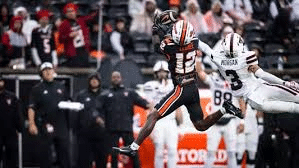

Outgained. Out-possessed. Still victorious. Memphis left Las Vegas with a 27–21 win that put the Group of 6 on notice.
Memphis Leaves UNLV “All Shook Up” in G6 Battle
Memphis did not leave Las Vegas with a perfect performance. It left with a powerful one. The Tigers rallied from a halftime deficit, answered every major UNLV punch, scored the game’s final 13 points, and left Allegiant Stadium with a 27–21 victory that immediately puts Charles Huff’s first Memphis team on the Group of 6 radar.
Memphis did not win because it controlled the stat sheet. It won because it owned the moments that decided the game. UNLV had more yards. The Rebels had more first downs. They had more plays. They held the ball for more than 35 minutes. They led at halftime. They reclaimed the lead in the third quarter. They had a chance to take control late. Memphis had more answers.
A Meaningful Group of 6 Win
The national value of the win starts with the opponent. UNLV entered the game after a 10–4 season, a Mountain West Championship Game appearance and a Frisco Bowl berth. The Rebels had been one of the more productive Group of 6 offenses in the country in 2025, ranking 20th nationally in total offense at 446.4 yards per game and 23rd in rushing at 195.5 yards per game.
Memphis knew exactly what it was walking into. The Tigers were playing their first Week Zero game in program history. They were playing their first game ever carried by the FOX broadcast network. They were opening the Charles Huff era on the road, inside an NFL stadium, against an opponent capable of turning the night into a long offensive fight. That is precisely what UNLV did.
The Rebels gained 460 yards. Memphis gained 413. UNLV ran 79 plays. Memphis ran 59. UNLV held the ball for 35:09. Memphis had it for 24:51. UNLV had 23 first downs. Memphis had 20. And Memphis still won. That is why the Tigers should be taken seriously. This was not a one-sided domination. This was a team getting tested in every way possible and still making the plays that separated victory from defeat.
UNLV Had the Volume; Memphis Had the Explosiveness
UNLV had the type of night that usually produces a win. Jackson Arnold completed 25 of 37 passes for 291 yards and two touchdowns. The Rebels rushed for 169 yards. They controlled possession. They took a 14–7 lead into halftime. Then they answered Memphis’ first big second-half strike with another touchdown to regain a 21–14 advantage. But Memphis produced more damage per snap.
The Tigers averaged 7.0 yards per play, compared with 5.8 for UNLV. That 1.2-yard difference explains why Memphis could survive having the football 10 minutes and 18 seconds less than the Rebels. The Tigers did not have the ball enough to rely on a series of long, methodical drives. They needed explosive plays.
They got them. Marcus Stokes opened the second half by finding Stonka Burnside in stride for a 48-yard touchdown pass, tying the game at 14. It was the kind of play that instantly changes the mood in a stadium and shifts the pressure back to the home team. UNLV responded with a 22-yard touchdown pass from Arnold to Kayden McGee to reclaim the lead.
Then Memphis answered right back. Alante Brown returned the ensuing kickoff 43 yards, flipping the field and giving the Tigers momentum. Jaylin Carter then broke loose for a 36-yard touchdown run, tying the game at 21 and refusing to let UNLV take control. That was the game’s most important offensive sequence. UNLV had the lead. Memphis had the response.
Jaylin Carter Makes His Mark
Carter’s numbers were strong. His timing was even better. The former Southern Miss running back, who followed Huff to Memphis, carried 15 times for 97 yards and a touchdown. He averaged 6.5 yards per carry and accounted for more than half of Memphis’ 190 rushing yards. He finished only three yards shy of the first 100-yard rushing performance of his college career.
But the 97 yards are not the number Memphis fans will remember most. They will remember 36. Thirty-six yards. A run. One touchdown. One answer after UNLV had taken a 21–14 lead.
Carter’s performance gave Huff’s offense an early identity. Memphis wants to run the football with authority. It wants to create physical advantages. It wants to use the rushing attack to open the passing game and force defenses into difficult decisions. The Tigers rushed for 190 yards and averaged 5.8 yards per carry.
That matters because Memphis went 6–1 in 2025 when it rushed for at least 150 yards. The Tigers surpassed that benchmark against UNLV, even while operating with only 59 offensive plays.
Carter may not own the backfield after one game. Dallan Hayden and Manny Covey remain important options. Covey contributed 41 yards on 10 carries. But Carter clearly owns the first major headline.
Stokes Wins His First Major Test
Stokes was not flawless, but he was effective where Memphis needed him most. The quarterback completed 15 of 26 passes for 223 yards and two touchdowns. He added 45 rushing yards. He did not throw an interception. The 57.7 percent completion rate and 3-for-11 third-down performance show there is still work to do. Memphis needs more offensive rhythm, more sustained drives, and better efficiency in manageable situations.
But Stokes averaged 8.6 yards per attempt, and that tells the real story. When he connected, he created value. His first FBS touchdown pass came on a 16-yard checkdown to Hunter Tipton, who hurdled a UNLV safety and reached the end zone. Tipton finished with three catches for 31 yards and Memphis’ first touchdown of the season.
Then Stokes hit Burnside for the 48-yard touchdown that sparked the Tigers’ second-half rally. Burnside had one catch. It went for 48 yards. It went for a touchdown. It was the first touchdown of his career after beginning his college career as a safety at Mississippi State.
That is the kind of development that makes Memphis difficult to scout. The Tigers had contributions from Carter, Stokes, Tipton, Burnside, Brown, Jemyri Davis, Tychaun Chapman, and others. Memphis did not need one player to rescue the night. It needed a collection of players to make the key plays.
The Defensive Line Closed the Casino
UNLV had the offensive volume. Memphis had the defensive violence. The Tigers recorded six sacks and 11 tackles for loss, repeatedly knocking the Rebels backward and forcing Arnold to operate in difficult situations.
The six sacks matched Memphis’ highest single-game total since East Carolina in 2021. The 11 tackles for loss matched the Tigers’ most since Rice in 2025. Memphis last recorded more than 11 tackles for loss at Florida State in 2024, when it had 12. That is not a minor opening-night number. That is one of Memphis’ strongest havoc performances in recent seasons.
Elijah Kinsler was the breakout force, producing 2.5 sacks in his Memphis debut. That was more sacks than any Tiger had recorded in a single game during the entire 2025 season.
J’Mond Tapp added a sack and five tackles. Joseph Head Jr. and Taylor Burton each recorded a sack. Jaden McKinney had a half-sack. J.J. Clayton added two tackles for loss. Zach Ruffin led Memphis with 13 tackles, a major jump after he recorded only three tackles at Southern Miss last season. Mike Montgomery added 10 tackles and a pass breakup.
Memphis needed every bit of it. The Tigers did not force a turnover for the second consecutive game dating back to the Gasparilla Bowl. That is notable because Memphis had forced at least one turnover in 27 of its previous 33 games, producing 57 takeaways during that stretch. But the Tigers found another way to steal possessions. They forced two turnover-on-downs stops.
The most important came with 6:08 remaining. UNLV had reached the Memphis 18-yard line, trailing 27–21. A touchdown would have given the Rebels the lead. A fourth-down conversion would have kept the pressure on Memphis. Instead, Burton and McKinney combined for a sack. Turnover on downs.
The Tigers then got another Kinsler sack to force a three-and-out. On UNLV’s final drive, Head, Tapp and Burton helped finish the game with a pair of sacks before the clock expired. UNLV had plenty of yards. But Memphis owned the last word.
Huff’s Rebuild Gets Early Proof
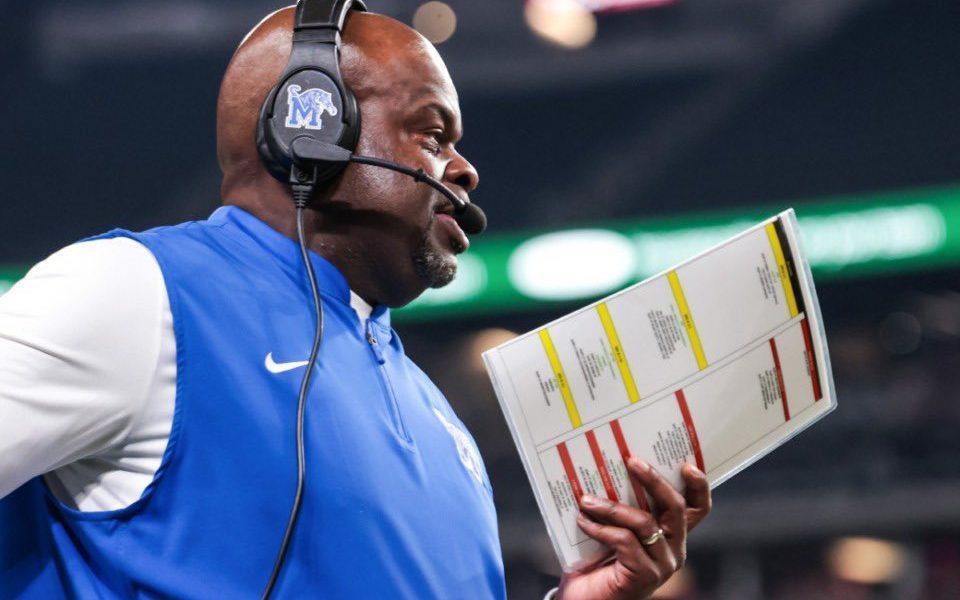
Huff became the first Memphis head coach in program history to win his road debut. That is a historic note. The context makes it more impressive. Memphis entered the season after a five-game losing streak to close 2025. Huff inherited a roster with 81 newcomers, including 61 transfers and 20 true freshmen. The Tigers returned only 27 players from last season, and only four returning players had started a game for Memphis in 2025.
Memphis was not a standard coaching transition. This was a program being rebuilt in real time. Huff brought 18 players with him from Southern Miss, including Carter, Kinsler, Ruffin, and Montgomery. Those players made critical impacts in the first game of the new era.
That is not accidental. A new coach needs players who know his expectations. He needs players who understand the standard when the game gets tight. He needs players who can help the locker room respond after a bad sequence.
Memphis did that in Las Vegas. The Tigers took the lead for the first time on Philippe Laforge’s 32-yard field goal in the final minute of the third quarter. Laforge then hit a 36-yarder early in the fourth quarter to make it 27–21.
Those six points mattered. Memphis won by six. Laforge entered the game with only two made field goals in his college career. In his Memphis debut, he went 2-for-2 under pressure. That is how a new program begins to find belief.
The Next Step Is Consistency
Memphis should celebrate the victory, but the Tigers also have a clear to-do list. They must improve on third down after going 3-for-11. They need to turn red-zone opportunities into touchdowns after settling for a field goal on their only red-zone trip.
They must protect the football after losing a fumble. They need to control the clock more effectively and avoid asking the defense to play 79 snaps. They also need to limit explosive plays after allowing UNLV touchdown passes of 38 and 22 yards. But those are correctable issues.
The Tigers have already shown the difficult things. Memphis can create explosive plays. They can run the football. The Tigers can rush the quarterback. They can make pressure kicks. They can fight through adversity. And they can win a close road game.
Arkansas State now comes to the newly renovated Simmons Bank Liberty Stadium on Sept. 5. Memphis will be seeking its 13th consecutive home-opening victory and looking to extend a 32–1 run in its last 33 home games against nonconference opponents.
The Tigers have made their first statement. They left UNLV all shook up. Now they have to prove Las Vegas was the beginning, not the peak.