
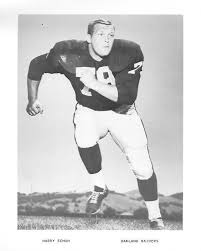
Retired jerseys usually go to the players people remember first. Quarterbacks. Running backs. Receivers. The men attached to the box score and the highlights. That is what makes Harry Schuh’s place in Memphis football history so important.
No. 79: Harry Schuh and the Strength Beneath the Story
No. 79 is a reminder that a program is not built only by the players who finish the play. It is built by the players who make the play possible in the first place.
That truth can get buried over time, especially in an era when football memory is often shaped through clips, fantasy numbers, and viral moments. Offensive linemen rarely get mythology in the same public way as skill-position stars. Their greatness lives in a different place. It lives in control, consistency, punishment, and trust. It lives in the feeling teammates have when they know the left side is secure, the edge is protected, and the run game has somewhere to begin.
Harry Schuh represented that kind of greatness for Memphis.
Building a Program Up Front
Even if casual fans know less about Schuh than they know about Isaac Bruce or DeAngelo Williams, the fact that Memphis retired his jersey says all you need to know about his standing inside the program. Schools do not put offensive linemen in that category out of sentiment. They do it because a player has become unavoidable in the telling of the program’s history.
Schuh’s era overlaps with one of the foundational stretches of Memphis football, the same broader period that produced Dave Casinelli and the undefeated 1963 team. That alone is enough to place him in an important chapter. Memphis was still becoming itself then. It had not yet accumulated decades of prestige or a modern brand identity. The program had to create a personality through the oldest football truths available: toughness, line play, and the ability to impose itself.
That is where a player like Schuh matters.
He was not there to decorate the offense. He was part of its architecture. If Casinelli represented the visible force of that era, Schuh represented the invisible one. For every great rushing season, there is a blocker whose name deserves to live beside it. For every identity built around physical football, there is a lineman whose work taught the team what that identity actually required. Retired No. 79 suggests that Memphis understood exactly that.
Why No. 79 Belongs
One of the most useful things a nostalgia series can do is restore balance to memory. It can remind fans that programs are not only shaped by stars with open-field brilliance. They are also shaped by the players who provided structure before style.
That is Harry Schuh’s place in Memphis football.
His retired jersey tells younger fans that Memphis’ history is not only one of speed and flash. It is also one of force. It is one of linemen who could define a team’s confidence snap after snap. It is one of players whose names might not dominate every modern conversation, but whose importance becomes clearer the deeper you dig into the program’s roots.
In that sense, No. 79 carries an almost instructional value. It teaches what Memphis chose to honor. The school could have built a retired-jersey group entirely out of stat-sheet stars. It did not. It left room for a player whose legacy reflects the belief that real football programs begin with physical standards, not branding campaigns.
That matters in 2026 as much as it mattered decades ago. Every time Memphis talks about wanting to be tougher, more consistent, more reliable in the trenches, it is echoing the same values a player like Schuh once embodied. His jersey remains out of circulation because the program decided that kind of excellence should not be diluted into ordinary use.
The No. 79 may not come with the same instant recognition as No. 20 or No. 83, but that is part of why it deserves this space. Some figures in a program’s history become famous. Others become foundational. Harry Schuh was foundational, and Memphis made sure the rafters would remember it.