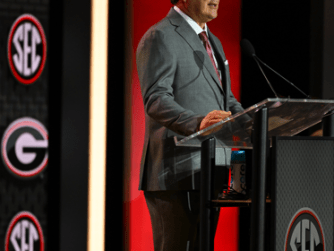

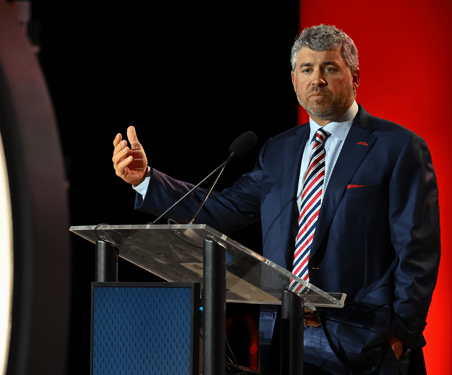
Pete Golding walked into Tampa and delivered a message that landed with a lot more force than a typical SEC Media Days appearance. The Ole Miss coach did not try to relive the Lane Kiffin era, dodge the obvious questions, or pretend the Rebels are starting from scratch. Instead, he spoke like a man who knows exactly where his program stands, exactly what the noise sounds like, and exactly how he wants Ole Miss to move forward.
Pete Golding’s Tampa Message Said Everything Ole Miss Fans Needed to Hear
That alone made his appearance interesting. Golding’s first major turn on the SEC Media Days stage as Ole Miss head coach carried the weight of everything that has happened since Kiffin’s departure, and he handled it with a calm edge that fit the moment. He did not overdo the emotion, but he also did not sugarcoat the reality. The Kiffin storyline is still alive, still unavoidable, and still part of the conversation around Ole Miss, but Golding made clear he is not going to let it define the Rebels’ future.
Golding Didn’t Run From The Kiffin Conversation
The biggest takeaway from Tampa was how direct Golding was when the subject turned to his predecessor. He essentially acknowledged what everybody already knows: Kiffin will remain part of the Ole Miss story for a long time, whether people like it or not. Golding referred to him as “the ex” who will always come up, but he did so without bitterness or theatrics, which only made the line hit harder.
That matters because this was never going to be a normal transition. Ole Miss was thrust into a high-pressure moment when Kiffin left for LSU, and Golding was suddenly asked to steady the program while the rest of the college football world watched closely. The easy thing would have been to lean into the drama, feed the rivalry, or make the moment about settling scores. Golding chose the opposite path.
That is part of what makes his approach so compelling. He has the kind of controlled confidence that suggests he understands the stakes without needing to announce them every five minutes. In Tampa, he came across as a coach who knows his program has already been forced to mature quickly. Ole Miss no longer has the luxury of acting surprised by the attention. The Rebels are in the spotlight, and Golding seems perfectly willing to stand in it.
His tone also reinforced an important message: Ole Miss is not interested in living off resentment. Golding said he had no ill will toward Kiffin, and that framing is smart for several reasons. It keeps the focus on the program rather than the departure. It also helps Golding establish his own identity instead of spending his entire tenure chasing someone else’s shadow. That is how coaches survive tough transitions — they absorb the noise, acknowledge the history, and move.
Why Tampa Felt Like A Turning Point
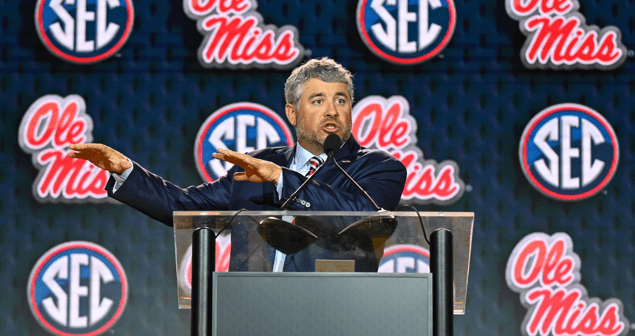
Golding’s Tampa appearance felt bigger than a standard media day because it represented the next stage of Ole Miss football. The Rebels already proved they could keep competing after Kiffin’s exit, and Golding’s leadership during the postseason gave the program enough proof to believe it can keep pushing forward. The coaching change could have created a long period of uncertainty. Instead, Ole Miss has entered a phase where expectations remain high, and patience is limited.
That is exactly why Golding’s message carried so much weight. He was not trying to sell a rebuild. He was selling continuity, resilience, and the idea that the Rebels can keep their edge even after one of the most chaotic coaching exits in recent memory. For fans, that is the kind of message that matters most. Nobody wants to hear that the program needs years to recover. They want to hear that the standard is still high and that the team is built to compete now.
Golding also touched on the broader realities of modern college football, including tampering concerns and the messy nature of roster movement in the portal era. That only added to the sense that he is not approaching the job like a coach stuck in nostalgia. He understands that the sport has changed, the pressure has changed, and the way programs are built has changed. Ole Miss cannot win by pretending otherwise.
What stood out most was how steady he sounded while talking about all of it. There was no panic. No awkward defensiveness. No attempt to turn himself into a sideshow. Golding looked like a coach intent on moving the conversation where he wants it to go: toward the future, toward the roster, toward the next season, and toward the idea that Ole Miss can remain relevant even after a massive coaching shakeup.
That is what made Tampa such a meaningful stop for him. It was not just another media session. It was a public declaration that he is not interested in serving as the caretaker of someone else’s legacy. He wants to build his own, and he wants Ole Miss fans to believe the Rebels are already doing that.
Golding did not need fireworks in Tampa. He only needed clarity, and he gave it. He acknowledged the past, rejected the drama, and pointed the program forward with a confidence that should resonate in Oxford. If the Rebels are going to keep climbing, this is the kind of voice they need leading the charge.