

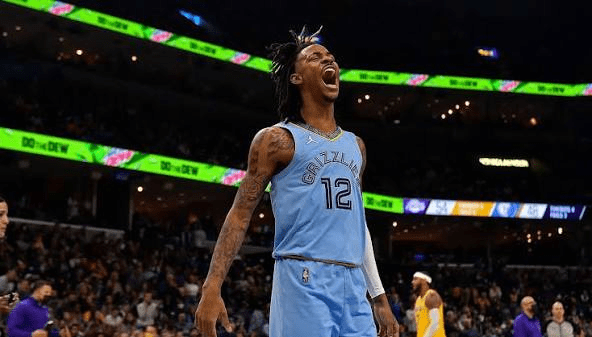
Ja Morant wasn’t traded because of “one mistake” or “bad luck with injuries” — he was moved because the Grizzlies spent three straight seasons paying a max contract to a star who was either suspended, hurt, or unavailable when it mattered most. Memphis watched their supposed franchise anchor suit up in only a fraction of their games, drag the organization into constant controversy, and stall out in critical parts of his development, all while consuming a massive slice of the salary cap. At some point, it stopped being about potential, highlights, and loyalty, and became a cold front-office calculation: the risk of keeping Ja outweighed the reward, and no amount of nostalgia for his rise could change that.
Ja Morant’s Costly Collapse: The REAL Reason Memphis Finally Cut Ties
In a small market like Memphis, you don’t get many chances at a true franchise player. When you decide to move off one, it’s never just about the last incident or the most recent injury report. It’s about a pattern, a trajectory, and a growing fear inside the organization that this version of Ja Morant was never going to be the dependable, scalable cornerstone they once believed they had. The trade to Portland wasn’t the beginning of the end — it was just the moment the rest of the world finally saw how far things had already fallen.
The Numbers That Broke Memphis
The box score tells a brutal truth: over a three-season stretch, Ja Morant appeared in only a fraction of Memphis’ possible games, suiting up for far fewer nights than a franchise player is expected to anchor. When you line up the seasons, the picture is damning: one year defined by a 25‑game suspension and a shoulder surgery that slashed his campaign down to single‑digit appearances, another where he hovered around a half-season of action thanks to lingering soft‑tissue issues, and a third where a serious elbow injury again brought things to a premature halt. In total, he was out more than he was in, and that ratio is lethal for any team trying to build continuity around him.

For the front office, those numbers weren’t just statistics; they were a verdict. Every missed game meant another night of “figure it out on the fly” for coaches and teammates, another lost chance to stabilize rotations and roles, another season where the organization never truly knew what it had with its full group on the floor. When your highest‑paid player is unavailable, you don’t just lose his production; you warp everything around him. Lineups, schemes, development plans — all of it gets built on a shaky foundation. Over time, Memphis wasn’t just tracking games missed; they were tallying lost seasons.
The problem was compounded by the nature of the absences. This wasn’t a single catastrophic injury you could rally around with a “he’ll be back” storyline. It was a mix of league suspensions, team-issued discipline, and recurring physical issues that continually interrupted any momentum he tried to build. That inconsistency made it nearly impossible for the franchise to trust that the next season would be any different from the last. When you’ve burned three years waiting for stability that never arrives, moving on stops feeling like a gamble and starts feeling like the only rational choice.
At the same time, the financial side of the ledger loomed over every decision. Maximum contracts are supposed to buy certainty — the peace of mind that the guy at the top of your payroll will be in the lineup, setting the tone, and carrying the load. With Morant, Memphis instead found itself paying for questions: Will he be cleared? Will he be healthy? Will he be locked in? No front office can live in that kind of ambiguity forever, especially not one whose margin for error is as slim as the Grizzlies’.
When the League’s Spotlight Becomes a Target
Morant’s saga stopped being a local story a long time ago. The gun incidents and the subsequent suspensions vaulted him into a different kind of spotlight, one where every move was judged not just as a player but as a symbol of league image and culture. Once the NBA office publicly hammered him with a lengthy suspension for conduct detrimental to the league, Memphis wasn’t just managing a talented but troubled star — they were managing a relationship with the league itself, under the watchful eye of a commissioner’s office that had clearly lost patience.
That kind of scrutiny changes the temperature inside a franchise. Coaches and executives know that every misstep could trigger another headline, another investigation, another round of questions about why the organization can’t rein in its best player. Teammates feel the weight too: they’re asked about it in every media scrum, they live through the stop‑start rhythm of seasons disrupted by non‑basketball issues, and they see how much energy gets spent putting out fires instead of building a winner. The Grizzlies didn’t just become a team with a problem; they became “that team with that problem.”
Internally, the trust fractures were just as significant. Reports of team-issued discipline and heated exchanges with the coaching staff pointed to a deeper issue: it wasn’t only about what Morant did in public, but how his actions and attitude were landing behind closed doors. When a star player openly bristles at accountability, or crosses internal lines badly enough to earn a suspension from his own franchise, it sends a message to everyone else in the locker room. Either the star is bigger than the standard, or the organization is willing to risk everything to enforce that standard. Memphis eventually chose the latter — but once you go down that road, the relationship rarely snaps back to what it was.
Culturally, the Grizzlies had spent years branding themselves as a gritty, blue‑collar, “we’re in this together” operation. Morant had been the face of that identity, the fearless, explosive guard who embodied everything they wanted to sell. When his off‑court choices started to undermine that image, the disconnect between the marketing and the reality became too wide to ignore. The organization found itself in a constant tug‑of‑war between protecting its star and preserving its culture. In the long run, choosing the culture meant choosing a future without him.
A Game That Stopped Evolving
On pure talent, Ja Morant is still one of the most electric guards of his generation. But talent alone doesn’t guarantee longevity, and that’s where the basketball story turned against him. His rise to stardom was built on violent rim pressure, downhill burst, and fearless attacks into the teeth of the defense. That style made him must‑see TV, but it also put enormous strain on his body and exposed a gap in his development: he never fully became the kind of consistent shooter or multi‑level scorer who can dial back the athleticism and still dominate.
As injuries mounted, that missing piece became more glaring. Every step he lost athletically, every night he couldn’t quite explode the same way, magnified the fact that defenses didn’t fear his jumper the way they fear other elite guards. In the modern NBA, where spacing and versatility are king, a max‑contract guard who lives mostly at the rim and doesn’t defend at a high level is a tougher puzzle to build around. Memphis had to ask itself: if this is who Ja is going to be physically and skill‑wise for the next five years, can we honestly expect to win big with him as the engine?
The answer, increasingly, was no. And once a franchise reaches that internal conclusion, everything else becomes a negotiation. The missed games, the suspensions, the tension with the league, the strain on the locker room — all of it stacks on top of a core basketball verdict: his game plateaued at a level that no longer offset the risk. Meanwhile, the rest of the supposed core was reshuffled, with key pieces moved in other deals, signaling that Memphis was already reimagining what its next era might look like without him.
In that context, the trade to Portland looks less like a shocking overreaction and more like the final domino. The Grizzlies chose to bet on a future where their culture, cap sheet, and on‑court identity were no longer tethered to a player they couldn’t trust to evolve or be available. The Blazers, in turn, are gambling that in a new environment — with different voices, expectations, and timelines — Morant can unlock the version of himself Memphis no longer believed in. One franchise saw too much risk; the other sees just enough upside to roll the dice.
In the end, this isn’t just a story about a star who got traded. It’s a cautionary tale about how fast belief can evaporate in the modern NBA. Ja Morant was once the unquestioned face of the Grizzlies, the symbol of their rise and their edge. But when the numbers stopped making sense, when the headlines wouldn’t go away, and when the growth on the floor stalled, Memphis made the harshest call a franchise can make: they stopped believing he could carry their future. And once that belief is gone, the breakup is inevitable — the only question is who’s willing to convince themselves they can fix what went wrong.