

The Rockies have spent years looking for players who can help them win. Now that Hunter Goodman has become one, the conversation has turned to what they might get for him. There is a baseball argument for listening. Colorado needs pitching, and a power-hitting catcher with three seasons of club control would give the front office leverage in a trade market where few teams are eager to part with young arms.
Why Would The Rockies Trade Hunter Goodman Instead Of Building Around Him?
Rival clubs reportedly believe the Rockies are more willing to discuss Goodman this winter than they were at the trade deadline. But there is a considerable distance between taking a phone call and making a sound baseball decision. Before the Rockies entertain moving Goodman, they ought to answer a more fundamental question: What, exactly, are they trying to build that does not have room for him?
The Production Colorado Would Have To Replace
Goodman hit 41 home runs in 2026 after hitting 31 the previous season. His latest campaign produced a .245/.310/.529 batting line, 88 RBIs, and an .839 OPS. He finished among the National League’s top four in home runs and slugging percentage.
That is an established source of major-league power, not a projection attached to a minor-league scouting report. Goodman has his shortcomings. His 30.5% strikeout rate in 2026 gave pitchers a clear avenue to attack him, and his .310 on-base percentage limits how much value he provides when the ball stays in the park. Defensive Runs Saved has also graded his catching slightly below average in each of the past three seasons.
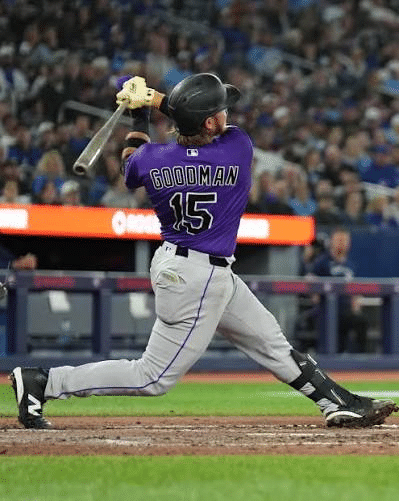
Those are reasons to be measured about his value. They are not, by themselves, reasons to trade him. The relevant question is what Colorado would gain after subtracting his production. Acquiring pitching would address an obvious need. Losing a middle-of-the-order hitter would create another. A deal has to be evaluated on both sides of that ledger.
This Is Not A Coors Field Illusion
Any discussion of a Rockies hitter eventually gets around to the ballpark. In Goodman’s case, the home-road splits strengthen the argument for keeping him. He hit 25 of his 41 home runs on the road in 2026. Away from Coors Field, he batted .255/.318/.564 with an .882 OPS. At home, he hit .235/.301/.490 with a .791 OPS. He received more plate appearances on the road, 302 to 272, but the advantage extended well beyond counting statistics.
One season’s splits should not be treated as a permanent forecast. They do, however, undercut the notion that Colorado should sell before another club discounts his production. Goodman did more damage outside Denver than he did in it. That matters to a contender considering a trade. It should matter just as much to the Rockies as they assess which parts of their lineup can anchor a better club.
Club Control Works Both Ways
Goodman is 27 and under team control through 2029. MLB Trade Rumors projects a $6.2 million salary in his first arbitration season, though that figure is not a finalized agreement. Those details explain why other teams would want him. They also explain why Colorado can afford to keep him.
This is not a pending free agent whose departure is forcing the front office to choose between a trade return and the possibility of losing him. Nor does his projected salary suggest an immediate financial squeeze. The Rockies have time to evaluate him, improve the roster around him, and explore whether a longer commitment makes sense.
There has at least been an opening for that last conversation. The Athletic previously reported that Goodman was receptive to an extension, although the Rockies had not approached him at the time. That report does not establish the current state of any discussions, but it makes his long-term fit something the organization can investigate rather than assume away.
If Colorado believes its next competitive team is too far off to include Goodman, that assessment deserves scrutiny, too. Three remaining seasons of control do not guarantee he will be around when the Rockies contend. But declaring that window insufficient would say something significant about the organization’s expectations for its own progress.
Pitching Is The Justification. The Return Must Prove It.
The strongest argument for a Goodman trade is also the most straightforward: The Rockies need arms, and he is one of their more attractive means of acquiring them. Colorado has emphasized adding pitchers capable of working multiple innings, while the difficulty of attracting starters to Coors Field complicates the free-agent route.
That is a legitimate roster-building problem. It does not make every pitching-centered offer a good solution. For a Goodman trade to make sense, the return should offer more than organizational depth and a handful of appealing scouting descriptions. It should provide a credible chance to improve the major-league staff enough to justify removing his bat from the lineup. There is an important distinction between acquiring young pitching and acquiring young pitching good enough to change a franchise’s direction.
The first is a transaction. The second could justify this one. Colorado should also resist treating the certainty of Goodman’s flaws differently from the uncertainty of a prospective return. His strikeouts and defensive limitations are visible because he has played in the majors. A prospect’s weaknesses can be easier to overlook when his best seasons still exist on paper.
That does not mean established players should never be traded for prospects. It means the unknown should not automatically be mistaken for the better option.
Keeping A Good Player Can Be Part Of The Rebuild
Rockies president of baseball operations Paul DePodesta has acknowledged the tension.
“Some of the position players we have, I think it will be much harder for us to trade because we feel like that’s a strength,” DePodesta told reporters at the general managers’ meetings. “So we want to be careful about not taking too much away from that. But I think we have to be open-minded.
That is a sensible position. Listen, establish a high price and make another club give Colorado a compelling reason to move. But the burden of proof should rest with the trade. Goodman has produced consecutive 30-homer seasons, shown that his power plays away from Coors Field, and reached this point with three years of club control remaining. There are legitimate questions about the rest of his game, but there is little mystery about what he contributes to a lineup.
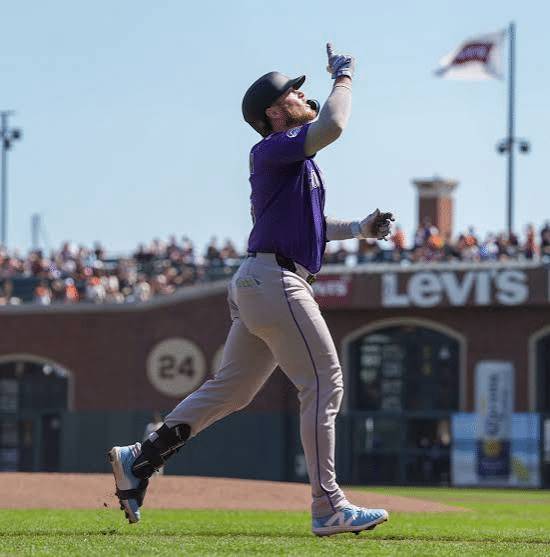
The Rockies do not need to make him untouchable. They do need to recognize that developing a productive player and retaining him is a valid outcome — particularly for an organization trying to establish a competitive foundation. Trading Goodman might bring back pieces of that foundation. Keeping him would mean acknowledging that one is already in place.