


Anthony Davis is still the answer for now.
The big man who turned Kentucky’s 2011-12 season into a 38-2, national-title coronation set a freshman bar almost no one has touched. Surrounded by future pros, he still led the Wildcats in scoring (14.2 points), rebounding (10.4 boards) and blocks (4.7 a night), all while shooting better than 62 percent from the field. He was the axis of a roster that never needed him to force offense to feel his presence.
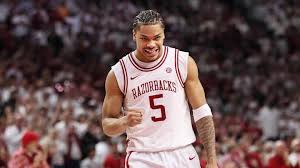
Now Darius Acuff Jr. is forcing that standard to be revisited. In Arkansas, he’s averaging 22.7 points, 6.4 assists, and shooting 49.4 percent from the floor, 44.3 percent from three, and nearly 80 percent at the line. He’s doing it while sharing the floor with one other double-figure scorer, guard Meleek Thomas at 15.1 points per game, on a team that leans on him for both creation and closing. When we at 4 Star Sports Media spoke with Fox Sports’ Mike DeCourcy, he called him “A spectacular player” who “Does so much right, so little wrong” and says he “Ranks among the best freshmen Cal has coached,” he’s reading the context as much as the box score.
Cal’s Blueprint and the Weight of Help
John Calipari’s freshman stars have rarely carried empty stat lines.
At Memphis in 2007-08, Derrick Rose shared the floor with Chris Douglas-Roberts, who led the team in scoring at 18.9 points per game, while Rose posted 17.0 points with 5.2 assists. Joey Dorsey and Robert Dozier vacuumed up rebounds, Dorsey at 9.7 boards per 36 minutes, Dozier at 7.9, handling the dirty work inside. Rose picked his spots because he had a veteran scorer and experienced bigs who managed volume and contact.
Next in the Bluff City was Tyreke Evans’ 2008-09 Memphis was similar but less star-heavy. He averaged 17.1 points, 5.4 rebounds, and 3.9 assists on a roster leaning on senior guard Antonio Anderson (10.2 points), versatile Dozier (11.1 points), and shooters like Doneal Mack (9.0 points). Evans carried primary-option responsibility, but his counting numbers reflected a balanced system spreading scoring across the rotation.
That’s the tension in these debates: how much did the supporting cast limit or inflate the numbers?
Rose and Evans: What the Rosters Allowed
Rose’s Tigers won 38 games because their top two scorers complemented each other perfectly. Douglas-Roberts was the wing bucket-getter; Rose was the driver and organizer. With Dorsey anchoring the glass and protecting the rim, Rose didn’t chase rebounds or over-extend defensively. His efficiency and assist numbers benefited from spacing by a proven college scorer and a front line cleaning up misses.
Evans walked into a Memphis program post-Rose and Douglas-Roberts, spiking his usage. Anderson, Dozier, and Mack averaged solid scoring but no true star volume, so Evans’ 17-plus points became the engine, with assists from drive-and-kick. His slightly lower efficiency makes sense; he created more late-clock looks than Rose ever did.
Rose shared with an alpha. Evans had to be that alpha.

Wall’s Kentucky: Talent Overload
After a move to Lexington, Kentucky, we witnessed the John Wall’s 2009-10 Kentucky team. Which truthfully, may be unfair for comparison.
Wall averaged 16.6 points, 6.5 assists and 4.3 rebounds on a 35-3 team where DeMarcus Cousins posted 15.1 points and 9.9 rebounds, Patrick Patterson 14.0 points and 7.2 boards, and Eric Bledsoe 11.3 points. Darius Miller and a long bench chipped in, five players at or above 9 points per game.
That depth capped Wall’s scoring. He didn’t need 22 a night because Cousins devoured block touches, Patterson stretched defenses, and Bledsoe attacked secondary actions. Wall led in points and assists while sharing with three future first-round picks.
Stack Wall’s 16.6 and 6.5 against Acuff’s 22.7 and 6.4? Rosters explain the gap. Wall ran a V12. Acuff is engine and chassis.
Davis and Towns: Big Men in Crowded Rooms
The 2011-12 Wildcats show how casts depress stats without killing impact.
The above-mentioned Davis’ 14.2 points and 10.4 rebounds came where Doron Lamb averaged 13.5 points,Terrence Jones 12.3 and 7.2, Michael Kidd-Gilchrist 11.6 and 7.4, and Marquis Teague 9.9 points with 4.8 assists. Six players between 9.9 and 14.2 points; Davis led them all plus 4.7 blocks. He was defensive centerpiece and efficient scorer, no 20-night chase needed.
Karl-Anthony Towns faced a crowded 2014-15 room. He averaged 10.3 points, 6.7 rebounds and 2.3 blocks in 21 minutes, platooned with Willie Cauley-Stein (9.5 points, 6.8 boards), and guards Devin Booker, Andrew and Aaron Harrison. Stretch Towns to 40 minutes: 19.6 points, 12.7 rebounds, 4.4 blocks, very Davis-like.
Roster truth: Towns shared everything. Davis shared touches and owned responsibility.

Acuff’s Arkansas: Burden of Creation
Acuff’s raw numbers scream loudest.
Arkansas’ 2025-26 sheet: Acuff 22.7 points, 6.4 assists in 34.9 minutes; Thomas 15.1 next; steep drop-off. He leads in scoring, playmaking, and efficiency: 49.4 percent from the field, 44.3 percent from three, 79.7 percent from the free throw line—those shine when he’s a scouting-report priority.
Wall deferred to Cousins. Davis let Lamb or Jones take possession. Acuff is Options A, B, C. Late clock, close game, he gets it. Predictability drags numbers. Acuff thrives.
DeCourcy’s quote lands: “Spectacular… so much right, so little wrong.” It nods to the assignment’s difficulty—no safety net like Davis, Wall, or Towns.
The Verdict, With Context
Who’s Calipari’s best freshman?
Accounting for casts, era, and responsibility: Anthony Davis holds the crown. Central to a title team loaded with double-figure scorers, most valuable on both ends.
Wall and Rose shaped deep programs. Towns dominated slices. Acuff matches poise, control, surpasses counting stats, sans help luxury.
Davis is No. 1. The chase below, especially the greatest guard, has a real contender. Acuff crashed the party.