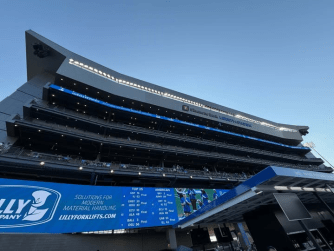

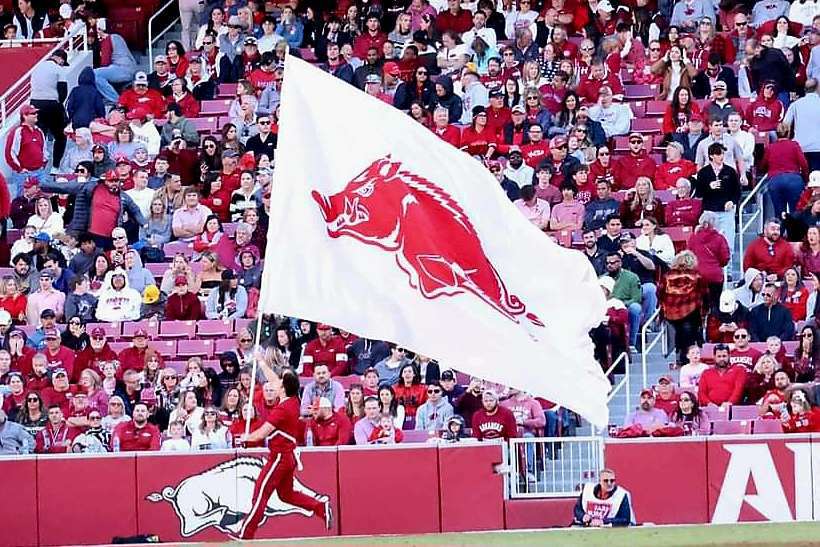
Arkansas went to Salt Lake City with a chance to make a statement. Instead, the Razorbacks walked out of Rice-Eccles Stadium with a 43-10 loss that exposed how far they still have to go.
Arkansas Got Embarrassed at Utah—and the Razorbacks Have No Time for Excuses
This was not a close road loss against a ranked opponent. It was not a game decided by one strange turnover, one questionable call, or one late mistake. Utah took control shortly after Arkansas grabbed an early 3-0 lead, scored 29 unanswered points before halftime and turned a nonconference opportunity into a full-scale reality check.
The Razorbacks entered the night hoping to prove they could compete with a ranked Power Four opponent on the road. They left with 61 net rushing yards, 305 total yards and a performance that raised more questions than the program can answer with a simple “turn the page” message.
Utah was better in every meaningful way. It was faster, more physical, more composed and more prepared for a game that became difficult almost immediately. Arkansas did not wake up Sunday with a bad loss. It woke up with a bad truth.
Utah Turned an Early Lead Into a Rout
Arkansas’ early field goal gave the Razorbacks a 3-0 lead and briefly created the appearance of a competitive night. That moment did not last.
Utah answered with 29 unanswered points before halftime. By the time the teams reached the locker room, the game had moved far beyond an early momentum swing. It had become a clear demonstration of the difference between a team that could impose its identity and a team that could not stop the opponent from imposing one.
Utah quarterback Devon Dampier was the center of it all. He completed 18 of 24 passes for 261 yards and two touchdowns while adding 50 rushing yards and two touchdowns on the ground. Arkansas knew Dampier’s mobility would be a problem entering the game. The Razorbacks still had no consistent answer for it.
Dampier punished Arkansas when the defense overcommitted to the run. He punished it when defenders lost contain. He punished it when the secondary left windows open in the passing game. Utah did not need to create chaos to move the ball. It simply used an athletic quarterback, an effective run game, and a well-designed offensive plan to make Arkansas defend every part of the field.
Wayshawn Parker added three touchdowns for Utah. He rushed for two scores and caught another while serving as another reminder that Arkansas was not dealing with a one-player offense. Tight end Noah Bennee added four catches for 113 yards and a touchdown, repeatedly making the Razorbacks pay when Utah attacked downfield.
Arkansas did not lose because Utah made several incredible plays. The Hogs lost because Utah made routine plays look easy.
The Razorbacks Lost the Physical Fight
The final score will be remembered, but the most concerning number might be 61. Arkansas finished with just 61 net rushing yards.
A football team can survive a rough passing night. It can survive a few stalled drives. But when a team cannot run the ball, it loses control of the game. It becomes predictable. It becomes easier to pressure. It becomes easier to defend on third down. It becomes dependent on perfect quarterback play and explosive moments to keep the offense alive. Arkansas never found that balance.
Utah controlled the line of scrimmage and forced the Razorbacks into a game they were not equipped to win. The Utes knew Arkansas could not consistently establish the run, and that allowed them to play aggressively against the pass.
The same problem showed up on the other side of the ball. Utah finished with 442 yards. The Utes did not need a late surge to inflate the statistics. They had command of the game early and kept building the lead. Arkansas struggled to get stops, struggled to limit damage after early defensive breakdowns and struggled to create the kind of negative plays that could have changed the momentum.
Every program talks about toughness before a major road game. Arkansas had the opportunity to prove it on one of college football’s more difficult stages.
Instead, Utah set the terms of the game from the beginning. The Utes were more physical when they ran the football. They were more disciplined when they defended it. They were more effective when they had to make an adjustment. And once the game turned, they never allowed Arkansas to regain control.
Now the Response Defines the Season
A 1-1 record does not end a season in September. Arkansas has games left to play, opportunities left to improve, and time to correct what went wrong in Salt Lake City. But the loss cannot be treated as an isolated event simply because Utah is a ranked team.
The concern is not that Arkansas lost. The concern is how Arkansas lost.
The Razorbacks looked overwhelmed when Utah’s offense found rhythm. They could not establish a run game. They did not have an answer for Dampier’s dual-threat ability. They did not appear capable of changing the game once Utah built momentum. That is the issue Arkansas must solve immediately.
The next opponent does not need to be Utah for these questions to matter. Every team on the schedule now has a clear picture of what worked against the Razorbacks. Stop the run. Pressure the offense into obvious passing situations. Force Arkansas to make long, sustained drives. Make the Razorbacks prove they can respond after adversity hits.
Arkansas has to prove it can. The program does not need another speech about toughness. It needs a performance that demonstrates toughness. It does not need to promise adjustments. It needs to show the adjustments in the running game, on early downs, and in the defensive front.
Utah did not just hand Arkansas its first loss. It exposed the standard Arkansas has to meet if it wants to be taken seriously. That is a brutal Monday Morning Hangover.