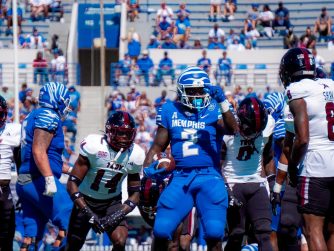

Spring in Memphis has turned the quarterback room into the most important stage on campus. The Tigers have designs on the College Football Playoff, or at least a serious run at the expanded postseason, and every rep between Marcus Stokes and Air Noland feels like another brushstroke on the canvas of the 2026 season. Two arms, one job, and a program trying to decide which style gives it the best shot at something historic.
Spring In Memphis, Two Arms, One Dream
When Memphis takes the field for spring practice, the first place eyes go is not to the shiny new offensive concepts or even the tempo. The focus locks on the two quarterbacks trading snaps, both wearing green no-contact jerseys, both carrying wildly different stories into the same competition.
Marcus Stokes steps into drills with the body language of someone who has already proved himself on Saturdays. His last season at West Florida was not just productive; it was dominant, a blur of three thousand passing yards, big play throws, and timely scrambles that turned him into a small school star. That experience matters. He knows what it feels like to be the center of the scouting report, the player that defensive coordinators stay up late trying to solve.
In this Memphis offense, that background gives him an immediate lane. Stokes is comfortable pushing the ball down the field, trusting his receivers to win in space, and living with the consequences of an aggressive decision. He does not play like someone worried about the last throw; he plays like someone already thinking about the next shot. For a staff that wants speed after the snap, that kind of confidence is almost priceless.
Air Noland brings a different kind of energy. Once one of the most talked about quarterbacks in his class, he has worn the labels that come with big-time recruiting, star ratings, and early expectations. His path through powerhouse programs sharpened his understanding of big-playbook football, even if it did not give him the volume of game reps he imagined when he first signed on the dotted line.
On the practice field, Noland looks like the prototype for a modern, pass-first quarterback. The ball leaves his hand with easy velocity, the left-handed spin giving every throw a distinctive look as it cuts through the air. When the script calls for rhythm passing, quick game concepts, and layered reads, he can glide from one progression to the next and keep the timing of the play intact. For an offense trying to live on tempo and precision, that smoothness has its own appeal.
Coaches Watching Every Throw, Teammates Watching Every Huddle
Officially, the staff talks about an even competition, a true battle that will extend through the heart of spring and probably into the early part of fall camp. Unofficially, every period becomes a kind of silent referendum. A missed read here, a late decision there, a brilliant, tight-window throw on the next rep, all of it gets folded into how the coaches feel when they meet behind closed doors.
For Stokes, the key question is translation. The throws he made at West Florida came against defenders who do not run quite as fast, disguise quite as well, or close quite as suddenly as they do at this level. The staff needs to see that his aggression can survive the jump, that he can trust what he sees without forcing balls into windows that no longer exist. If, as practices stack up, he continues to hit those deep shots and seam routes while protecting the ball, he begins to look like the safest bet for a team that wants to win right now.
Noland’s case rests more on projection. Coaches know what his arm can do; they have seen it in high school film and in flashes at his previous stops. What they need to see this spring is command. Can he get the offense out of a bad look before the snap? Can he handle a free rusher, slide in the pocket, and still deliver on time? Can he bounce back from a tipped interception without letting it bleed into the next series? When he stacks days of clean, efficient work, he looks like the long-term answer with the highest ceiling.
The players notice these things too. Teammates are not charting completion percentage in their heads, but they feel which quarterback makes the offense flow. They sense who settles the huddle on a hot, sloppy day, who owns a mistake instead of pointing fingers, who pulls a young receiver aside after practice to walk through a route one more time. Those are the intangibles that often tilt a coaching staff when the raw numbers look similar.
By the time the spring game arrives, the competition has taken on a life of its own. Fans will debate who looked sharper in public scrimmage periods, who hit the bigger throws, and who led the longer drives. Inside the building, the staff will weigh that against weeks of practice tape, meeting room habits, and how each quarterback responded when something went wrong. In a year where Memphis wants to be more than just a good story, the choice at quarterback cannot be made on a whim.
The Tigers do not need two good quarterbacks in September; they need one who commands the room. Stokes offers proven production and a fearless edge, the kind of profile that can jolt a program into a different gear if the jump in competition does not rattle him. Noland offers pedigree and polish, the feeling that if everything finally lines up, Memphis could be unlocking the best version of a talent people have believed in for years.
Whichever path the Tigers choose will say a lot about how they see themselves in 2026. Pick Stokes, and Memphis is betting that experience, grit, and a playmaker’s mentality can carry them straight into contention. Pick Noland, and Memphis is betting on upside, on the idea that a true number one arm in this system transforms the ceiling of what the offense can become. Either way, the story of the season will circle back to these spring practices, to the days when two very different quarterbacks fought for one job and, in the process, decided how far Memphis can really go.