
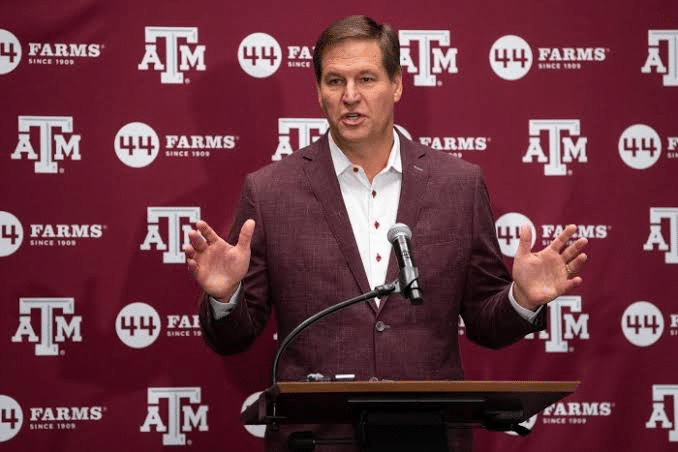
Somewhere in Ann Arbor, a very expensive background check is sitting on a desk. It’s a little late. Michigan is in the middle of one of the strangest athletic director searches in recent college sports memory. Trev Alberts, the Texas A&M athletic director, was widely reported as the man who would run the Wolverines.
Then he was told he wouldn’t. The search firm Michigan hired delivered the message, and the school’s own letter said his background check produced results that were “not acceptable” to the university. That would be a rough week for any athletic department. Michigan made it worse by what it apparently did before the background check came back.
The Paper Trail Is The Problem
Alberts and his lawyers have produced a memorandum of understanding that allegedly binds Michigan to the deal. If the deal dies, the school allegedly owes him $17.2 million. Depending on how the numbers shake out, the total exposure has been reported as high as $21 million, money that a little more thought could have avoided.
Read that again. The vetting didn’t come before the commitment. The commitment, by all appearances, came before the vetting. Every Michigan fan knows why that matters. This is the school of Robert Anderson, Sherrone Moore and Mark Schlissel. It should be the most paranoid hiring institution in the country. If any program should treat “What’s in this man’s past?” as the first question, it’s this one. It should be the first question, the second question, and the question you ask again at the end.
So Are Search Firms Worth It?
That’s the debate lighting up the Michigan message boards. The fan reaction is a mix of fury and genuine confusion over what a search firm is actually for. The frustration is understandable. Michigan is paying TurnkeyZRG $250,000 to help find its next athletic director. On the Michigan subreddit, fans are asking the obvious question.
If vetting is the firm’s job, how did a candidate get this far, and this deep into a contract, before the issue surfaced? There’s a second question, and it’s just as pointed. Why didn’t Michigan sit the candidate down and ask him these things directly? Some of this was apparently discoverable with a conversation. Those are fair questions. They’re also not the whole story.
The Defense Of The Firm
Some Michigan fans push back on pinning this entirely on the consultants. One argument is that the final decision belonged to the regents, not the search firm. Another is that it isn’t clear this outcome came from a firm mistake at all. There’s also a legal layer. Alberts is represented by Tom Mars, one of the better-known lawyers in sports, and commenters note that his public statements may be aimed at getting his client paid. Some say the matter is headed for court or arbitration.
Nobody outside the room knows yet who knew what, or when. There’s a simple way to look at this, too. A background check that flags a problem is a background check doing its job. The failure may be timing. The firm may have flagged it too late, or Michigan may have moved too fast. Or the school may have put its name on paper before it let the process finish.
THE REAL LESSON
A search firm is a tool. It isn’t a shield, and it isn’t a substitute for judgment. Industry guides will tell you executive search fees typically run 20 to 30 percent of a first-year salary. In return, you get a network, a vetting process, and a reduced chance of a catastrophic hire. That can be money well spent. It’s only well spent if the people paying actually let the process work.
A search firm can hand you a finalist. It can hand you a report. What it can’t do is make a university president, a board of regents or an athletic department slow down when everyone wants a press release. That’s the Michigan lesson, and it applies far beyond Ann Arbor. Smaller programs hire coaches and athletic directors under the same pressure. A donor wants a splash. A fan base wants a name. Somebody says, “Let’s lock this up before another school does.” That’s exactly when you need the boring part of the process most.
What Happens Next
Expect a messy few weeks. Michigan will have to answer who approved the memorandum of understanding and when the school saw the background results. The dollar figures will matter too, and so will whether any legal fight actually puts that money at risk. Michigan also still needs an athletic director. The next candidate will arrive knowing the school may have just burned through its credibility, and some of its cash, on the last one.
If Michigan wants a lesson from this, here it is. Hire the experts, and then listen to them. Don’t promise the job first and read the report later. For a program that built its modern brand on process, discipline, and doing things “the right way,” this one will sting for a while. The search firm may or may not deserve its share of the blame. But the school signed first, and that part can’t be blamed on anyone else.