


The CFP chairman does not have to convince America he has no conference loyalties. He has to explain the rankings well enough that those loyalties are not the story. Hunter Yurachek has two difficult audiences right now. One wants answers about Arkansas athletics. The other wants to understand why the College Football Playoff committee considers Alabama better than Miami. Neither audience is well served by a reminder that important people spent a long time discussing the problem.
Hunter Yurachek Needs a Better Answer Than “Trust the Room”
Yurachek’s leadership at Arkansas has drawn substantial criticism and scrutiny. That does not establish that his playoff judgments are wrong. But it makes the national assignment more demanding: he arrives as a chairman whose credibility is already being challenged in his own market.
The fair question is not whether every Razorback fan dislikes him. They do not speak with one voice. Nor is it whether he has become a national laughingstock. The question is whether Yurachek’s explanations make the committee easier to understand—or make an SEC athletic director sound like an SEC advocate. On Tuesday night, he provided evidence for both interpretations.

Alabama–Miami Was the Question He Needed to Answer
Asked why Alabama ranked sixth and Miami seventh, despite Miami’s cited advantages in record and its best victory, Yurachek offered this: “Yeah, I think in the committee room, we believe that Alabama is a better team than Miami.” He described the difference as “razor thin,” then repeated the conclusion.
That is not enough. It may be the correct order. A team with an additional loss can have a stronger full profile. Watching football should matter. But “better” is what the question asked him to explain. What does Alabama do more reliably? Which performances separate the teams? How much does schedule difficulty outweigh Miami’s advantages? A narrow comparison requires a precise explanation. Instead, the audience received the committee’s opinion twice.
The SEC Defense Creates Its Own Problem
In the next answer, Yurachek supplied useful evidence. Alabama, he said, ranked fourth in relative scoring offense and 22nd in relative scoring defense. Those are committee-reported measures that can become the starting point for a substantive comparison. Then came the familiar explanation. “The SEC has been a conference that’s beat up on each other,” he said.
That may be a relevant context. It does not establish Alabama’s superiority to Miami. When an SEC athletic director delivers that defense, the perception problem is obvious. Fans outside the league hear a system in which losses demonstrate schedule difficulty while victories against the same opponents demonstrate quality. That does not prove the committee reasoned in a circle. It makes the need for independent, team-specific evidence greater. Yurachek cannot eliminate his institutional background by declaring that he has changed roles. He can make that background less relevant by giving a better answer.
The Words Complicate the Bias Accusation
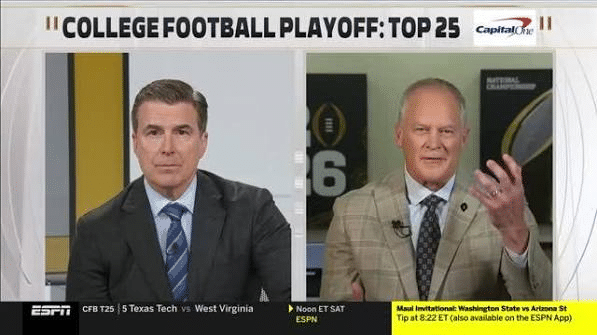
Anyone determined to portray the entire evening as SEC advocacy has to ignore an important exchange. Asked whether a conference-schedule metric demonstrated SEC superiority over the Big Ten, Yurachek rejected the premise. He explained that the measure compares schedules within each conference, not one conference against another. When pressed, he repeated the distinction. That was useful clarification.
His explanation for Texas was substantive, too. He cited four current top-25 victories, seven victories over opponents at .500 or better in the question-and-answer portion, and the committee’s No. 2 schedule-strength ranking. Those are claims an analyst can examine. That is the frustrating part. Yurachek can explain the evidence. The quality of the explanation changes too much from one comparison to another. Texas received a résumé argument. Alabama over Miami received a declaration.
The G6 Answer Left the Race Invisible
The same problem appeared when Yurachek was asked which other G6 teams were under consideration. He named none. He gave an uncertain count of the teams discussed and said Boise State’s advantage was shrinking. A narrowing race is news. The identity of the challengers is part of that news.
The committee does not need to disclose individual ballots to explain what separates the leading candidates. It can describe a strong victory, a schedule limitation or an important performance. Instead, the public was told the race was competitive without being given enough information to follow it. That is not proof of exclusion from consideration. It is a failure to explain the consideration taking place.
The Chairman Is Not the Entire Committee
Yurachek is not the SEC commissioner. He is not the sole author of the rankings. He speaks for a group. That distinction matters. An awkward answer does not prove a corrupt decision. Criticism of his Arkansas administration does not establish national misconduct. But being a spokesperson is not a ceremonial responsibility. Explaining the judgment is part of the job.
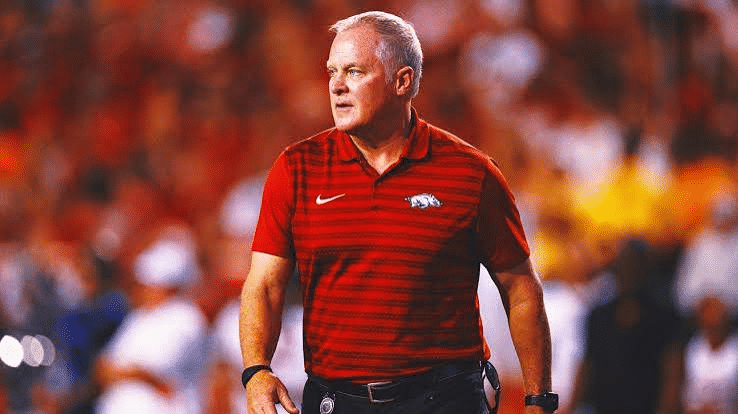
Yurachek’s strongest answers identify measurable distinctions. His weakest answers substitute the committee’s confidence for the audience’s understanding. He does not have to make America like him. He does have to make the argument carry its own weight. Until he does that consistently, the SEC hat will remain part of the picture—not because anyone has proved he refuses to remove it, but because too many answers ask the audience to take its removal on faith.