
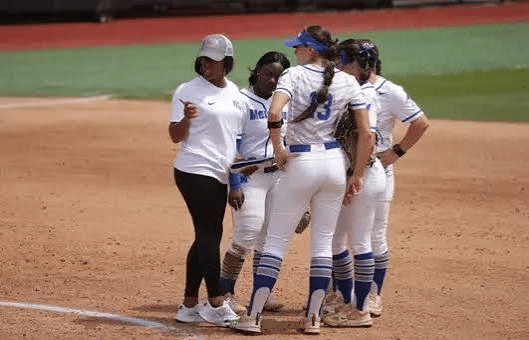
The Tigers’ reshaped staff faces a specific challenge in 2027: keeping pitching and defensive breakdowns from consuming the progress made by the offense. Memphis scored 16 runs against Bradley last February and needed almost every one of them. The Tigers committed eight errors and escaped with a 16–14 victory.
By season’s end, they had produced the highest slugging percentage in program history—and finished 18–39. Their pitchers issued 256 walks. Their defense committed 97 errors. That is the problem Trena Prater’s reshaped staff inherits heading into 2027. Memphis has developed an offense capable of winning games. Too often, the rest of the afternoon has required that offense to do more than should have been necessary.
Memphis Softball Improved at the Plate. Now Trena Prater Has to Make It Count.
The staff changes address that imbalance. Sierra Vanzant-Cheek takes over pitching, Bry Castro directs defense, and Cassady Brewer continues overseeing hitting. Bailey Honne manages the daily operation surrounding them. It will be the first spring for this combination, with Vanzant-Cheek, Castro and Honne joining during the summer.
The hires give Prater experience from different levels of college softball, including the Women’s College World Series, Division II championship teams, and junior-college head coaching. More important is how closely their assignments match the reasons Memphis has struggled. For a program trying to climb in the American Conference, the next step is not simply finding more productive players. It is getting more value from the production already there.
The Offense Has Moved. The Record Has Not.
An assessment of Prater’s tenure has to account for both sides. Memphis reached base more often and did more damage when it connected in her second season. Its on-base percentage rose from .344 to .370, while its slugging percentage climbed from .387 to a school-record .445. Ariel Davis hit .392 and reached base at a .489 rate. Faith Brown supplied nine home runs and 43 RBIs while batting .362. Those performances gave the Tigers legitimate threats in the lineup, not merely numbers accumulated in a struggling season.
Yet Memphis went from 19 victories in Prater’s first year to 18 in her second. Conference wins increased from five to six. The offensive gains were real, but they did not meaningfully change the team’s position. The run totals help explain why. Opponents outscored Memphis 404–251 in 2026. A better lineup could cover some difficult innings, but it could not consistently absorb that difference. That leaves Prater with a more specific task than a broad call for improvement. She needs the parts of the team that lagged behind the offense to catch up.
Vanzant-Cheek Inherits The Most Urgent Assignment
Memphis pitchers walked 256 batters and struck out 173 last season. Opponents reached base at a .425 rate, leaving the staff too often trying to escape trouble rather than prevent it. Vanzant-Cheek arrives from Queens, where she spent four seasons and became associate head coach for 2026. Her background includes work with Autumn Courtney, who posted a 1.58 ERA and 257 strikeouts at Queens in 2024 before transferring to Florida Atlantic and becoming the American’s pitcher of the year in 2025.
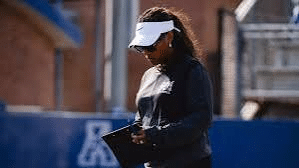
That history gives Memphis a relevant example of pitcher development. It does not establish how quickly the current staff can improve. The immediate work is less dramatic than the word “transformation” might suggest. Memphis needs pitchers who can locate reliably, recover after a difficult at-bat, and handle defined responsibilities without one baserunner changing the entire inning.
It also needs enough of them. An effective starter cannot cover every situation across a weekend. Prater needs choices when an opponent adjusts, when a game requires an early change, or when the next day’s pitching plan depends on getting through the current afternoon.
Last season showed that strong outings were possible. Memphis beat North Texas 1–0 during an April series victory. Two weeks later, Wichita State swept the Tigers while scoring 33 runs across three games. The useful measure for Vanzant-Cheek will be whether the distance between those performances narrows. Nobody should expect a staff to reproduce its best game every weekend. Memphis does need fewer games in which the pitching leaves almost no margin for anyone else.
Castro’s Work Begins With Finishing The Inning
The defense has to provide some of that margin. Memphis committed 97 errors in 2026, compared with 46 by its opponents. The Tigers finished with a .940 fielding percentage and allowed 89 unearned runs. Those figures do not assign responsibility for every run, but they show how often opponents received help. Castro takes over after coaching at Christian Brothers University in Memphis. A former Ole Miss infielder, she also worked at Sonoma State, where two conference championship teams fielded above .960. She now inherits a defense that needs more reliable execution across the field.
Her assignment goes beyond correcting the mistake that appears in the scorebook. Positioning can determine whether a ground ball becomes a manageable play. Footwork can make a throw easier on the player receiving it. Communication can settle a responsibility before two defenders are forced to make a late decision. Those details become especially important when pitching command is inconsistent. A walk followed by a defensive mistake asks everyone to operate with less room for error. Repeated often enough, the problem belongs to the entire team rather than one coach’s department.
Memphis had examples of the opposite last season. It played error-free defense in its 2–1 victory over East Carolina, its 5–3 win at UAB, and both victories in the North Texas series. Clean defense did not guarantee success, but those games demonstrated a more manageable way to compete. Castro’s impact will be visible if those performances become less exceptional. The Tigers do not need a highlight on every ball in play. They need to complete more of the opportunities they create.
Brewer Has Progress To Protect—And Gaps To Address
Brewer’s assignment is different because the offense already has a stronger foundation. She initially joined Prater’s staff as director of operations before becoming an assistant coach in January 2026. Her background includes three seasons on Florida’s staff, during which the Gators reached the 2022 Women’s College World Series, and a UCF playing career that produced a .437 on-base percentage and 121 walks.
At Memphis, the next offensive gain has to extend beyond asking the most productive hitters for bigger seasons. Davis and Brown gave the lineup dependable sources of production. A deeper offense would create more opportunities around them and remain difficult to navigate when an opponent limits their influence.
The 2026 results show why that distinction matters. Memphis won the opener at UAB 5–3, then scored one run in each of the next two games and lost the series. At Charlotte, 3–2 and 5–4 defeats contributed to another sweep. Those weekends complicate any explanation that places the entire season on pitching and defense. The offense improved over the full schedule. There were still games in which one more productive inning could have changed the outcome.
For Brewer, the challenge is helping more hitters contribute consistently enough to prevent those stretches. That could mean reaching base more often, making better decisions against a particular pitcher or adjusting before a difficult weekend carries into the next one. The season totals establish progress. The next question is how often that progress is available when Memphis needs it.
Prater Has Built The Balance Memphis Is Missing
Prater’s previous stop offers context for the approach. Her 2024 Campbell team led its conference in batting average, ERA, and fielding percentage while winning the regular-season championship. At Memphis, the offensive improvement has arrived before that balance. The competition and personnel are different, but Campbell establishes that her recent success was built across the game. Reproducing that with another roster is the challenge now.

Honne’s operations role supports the effort. A former head coach at Fort Hays Tech Northwest and pitching coach at Colby Community College, she oversees Memphis’ daily operations, travel, scheduling, and game-day logistics. Those are administrative responsibilities rather than a confirmed on-field coaching assignment, but they place someone with head-coaching experience in charge of much of the coordination surrounding the team.
Prater remains responsible for how the whole operation fits together. That means evaluating more than whether each coach can point to an improvement. A pitching plan has to work with the defense behind it. Lineup decisions have to account for both production and run prevention. Player development has to produce options the staff can trust during a conference series.
It also requires recognizing when an explanation is incomplete. A pitcher may have struggled after the defense missed an opportunity to end the inning. A low-scoring loss may involve a lineup that did not adjust. A better team total may conceal a weakness that keeps deciding close games. The head coach has to weigh all of it.
The Next Step Is Changing How Weekends End
Memphis won six conference games last season. A meaningful step forward will require more weekends in which its pitching, defense and offense contribute at the same time. The UAB series is a useful reference point: an opening victory, two quiet offensive games and a lost opportunity to take the weekend. Charlotte offers another, with two one-run defeats helping produce a sweep. Those results do not prove Memphis was one adjustment away from winning. They identify where a more complete team could begin changing its season.
For an audience beyond Memphis, that is the reason to watch this staff. The Tigers have measurable progress, specific weaknesses, and coaches assigned to address them. The next season will test how much those changes can alter the daily demands placed on the roster. The Bradley game showed how much the lineup could overcome. Prater’s reshaped staff has to make sure it is not asked to overcome so much.