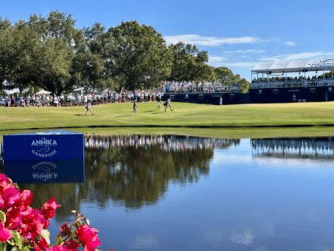


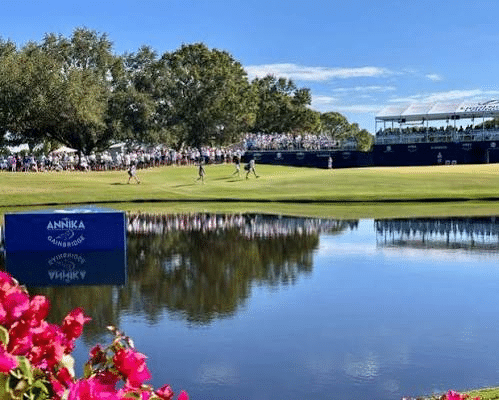
The ANNIKA began with record-matching scoring. It reaches Sunday with a different warning: producing birdies is only half the job. Keeping them can be harder. At Pelican Golf Club, Saturday exposed the distance between creating an opportunity and completing a round. Gaby López reached 12 under through 16 holes before dropping three strokes over the final two. Nelly Korda made four birdies but finished over par. Haeran Ryu, meanwhile, showed that a low score remained possible, shooting a bogey-free 65 in conditions that challenged much of the field.
One Round Left. Nothing Comes Easy at The ANNIKA.
Those performances frame the final round better than a simple promise of fireworks. Sunday will reward scoring, but it will also demand judgment, recovery and the ability to avoid letting one mistake become several. The trophy is still the destination. Saturday supplied a clearer picture of the work required to reach it.
Pelican Changes the Test
Thursday’s opening round produced 61s from Hye-Jin Choi and Minami Katsu, both matching the tournament’s 18-hole record. Lindy Duncan followed with 62, and Korda returned to competition with a bogey-free 63. The early benchmark was spectacular scoring.
By Saturday, the examination had changed. LPGA reporting described cooler temperatures, increased wind and firm, fast greens. Ryu said the combination made it difficult to hold approaches on the putting surfaces. Her answer was not to fight every condition, but to work with what the course allowed.
“This course is too hard because of the wind and the green is firm and fast,” Ryu said. She explained that her focus included finding manageable pars and giving herself realistic birdie opportunities. Her 65 moved her from 4 under to 9 under. That does not guarantee another low round Sunday, but it demonstrates that difficult conditions did not eliminate the possibility of gaining ground.
The distinction matters. A player shooting over par Saturday did not necessarily face an impossible course. Nor does Ryu’s score prove everyone else should have matched it. Different opportunities, decisions and execution produced different results. Sunday’s strongest explanation will connect the winner’s score to those details.
The Finish Can Rewrite the Round
López provided the clearest example of how quickly a promising day can change. She birdied Nos. 4, 8, 10, 14 and 16, reaching 12 under for the tournament. Then came a bogey at 17 and a double bogey at 18. Her five-birdie round became an even-par 70, leaving her at 9 under. The closing damage should not erase the quality of the opportunities she created. Equally, those opportunities cannot erase the significance of the finish. Both belong in an honest account.
Korda’s Saturday carried a related lesson. Four birdies were offset by three bogeys and a double bogey at No. 6. Her 71 left her at 7 under, despite hitting 13 of 14 fairways. Driving accuracy gave her a useful foundation, but the final score shows that the rest of the round still required execution. The available statistics do not identify the exact cause of every dropped shot.
For Sunday, the closing holes deserve attention without being treated as the only holes that matter. A double bogey early counts just as heavily. The pressure of the finish makes it memorable; the arithmetic makes every mistake consequential.
Sunday Needs a Complete Performance
The tournament has already offered several models of success: record scoring, sustained positioning, recovery after mistakes, and low rounds in tougher conditions. Choi and Duncan entered the weekend seeking their first LPGA victories, alongside experienced winner Carlota Ciganda in a three-way halfway tie. Their Friday totals established the opportunity, not the outcome.
Ryu adds another compelling thread. She has been managing a finger injury that forced her withdrawal from the Maybank Championship. Saturday, she said the hand was improving and that reduced pain allowed her to concentrate more freely on her golf. Her health remains part of the final-round story because she identified it as relevant—not because observers should speculate about it.
Sunday’s coverage should therefore resist a single predetermined narrative. A breakthrough, a comeback, or an established contender’s victory must first be earned. The most useful things to watch are specific: which approaches leave realistic chances, which missed greens demand difficult recoveries, and which players respond to a dropped shot without surrendering another.
For viewers, that makes the final round more interesting than a procession of totals. The leaderboard tells us who is ahead. The shots and decisions explain why. Pelican has already shown that five birdies can disappear into an even-par round, that accurate driving does not guarantee a low score, and that difficult conditions still permit a 65. Sunday will not be won by the best-looking moment in isolation. It will belong to the player whose strongest work survives the rest of the round—and, finally, the closing holes.