
Georgia does not need a reminder of how talented it is. The rest of college football does not need one, either. After a 27–24 home loss to Auburn, the Bulldogs need a more uncomfortable examination: Why did a team with championship expectations, a 14–0 lead and a late opportunity to finish the comeback repeatedly make the game harder than it needed to be?
Monday Hangover: Georgia’s Standard Means Nothing If Its Mistakes Keep Getting Excused
The answer cannot stop at saying Georgia beat itself. That phrase identifies responsibility without necessarily explaining it.
A Great Résumé Is Not a Postgame Defense
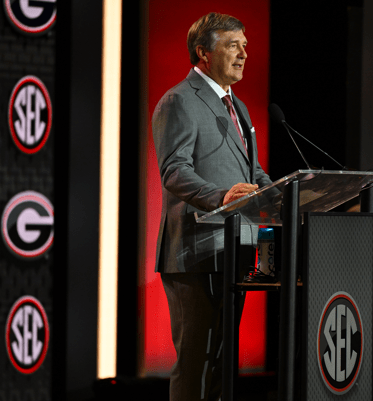
Kirby Smart has earned the respect that comes with his record. He has not earned an exemption from evaluating a bad Saturday. Neither have his players. Georgia committed three turnovers and forced none. Auburn blocked a field goal. The Bulldogs allowed 24 unanswered points after taking the opening 14-point lead.
Georgia recovered sufficiently to tie the game, then lost a late fumble that helped position Auburn for the winning field goal. This was not one unfortunate event overwhelming an otherwise clean performance. It was a collection of expensive failures. The problem with leaning on Georgia’s established standard is that a standard only matters when it governs behavior. It cannot function merely as a phrase summoned after the behavior falls short.
Accountability is not declaring the season finished. It is refusing to use the season’s remaining possibilities as an excuse to soften the assessment of what happened.
“We Beat Ourselves” Can Become a Convenient Escape
There is truth in identifying self-inflicted damage. There is also danger in allowing that explanation to become too comfortable. Auburn’s defense created takeaways. Its special teams blocked a kick. Brown challenged Georgia with 115 rushing yards and added 150 passing yards. The Tigers absorbed a disastrous opening and continued finding ways to contribute.
Georgia’s mistakes did not occur in a vacuum. Auburn applied the pressure under which they became decisive. Calling the loss self-inflicted can imply that the underlying answer is simply to return to normal. That is not enough. The Bulldogs must establish why the breakdowns happened and how their preparation will reduce the likelihood of another opponent exploiting them.
Otherwise, “we beat ourselves” becomes a way of protecting the favorite’s self-image while avoiding a complete evaluation of the winner.
Preparation Has to Survive the Game
Smart said Georgia had reviewed roughing-the-passer examples before the Auburn game. A costly roughing penalty still became part of the finish. That does not establish that the preparation itself was inadequate. It does establish that delivering the message was not the same as executing it.
A staff’s responsibility does not end when a topic appears in a meeting. The relevant question is whether the team carries the instruction into moments when restraint becomes difficult and consequences become expensive. The same applies to ball security. Every program discusses it. Every coach demands it. The distinction is what happens when a defender arrives, a possession becomes uncomfortable or the game reaches its highest-pressure stretch.
Georgia’s correction needs to become visible in those situations. A convincing explanation during the week will not substitute for cleaner football afterward.
The Standings Are an Opportunity, Not an Alibi
Georgia remained 4–1 in SEC play after the loss. The Bulldogs were still centrally involved in the conference race. That is important context, not a defense of the performance. Kentucky also stood at 4–1. Tennessee and Ole Miss were 3–1. Georgia no longer held an unbeaten conference record separating it from the teams trying to close the distance.
The correct response is neither panic nor reassurance. It is urgency. Auburn’s victory did not establish that Georgia cannot contend. It established that the Bulldogs cannot expect their ability to erase the cost of poor execution. The program’s reputation should increase the demand for specific answers, not reduce it. If Georgia expects to be judged by a championship standard, its mistakes cannot receive a reputation-based discount.