

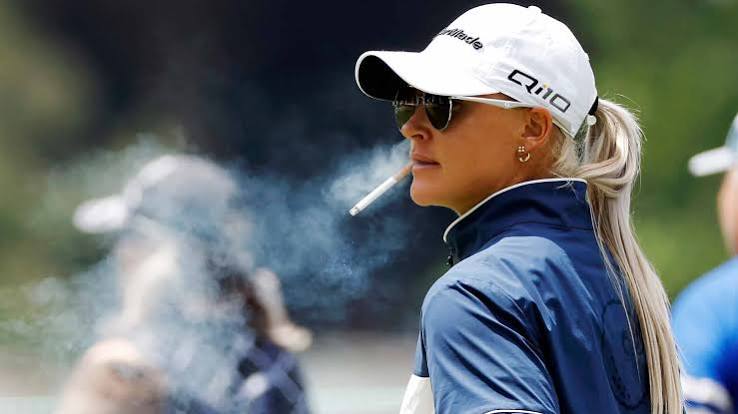
On Friday, Charley Hull’s 65 was a statement on the leaderboard. What followed in a small media room may have been an even more meaningful statement for the little girls who came to Pinnacle Country Club to watch.
In Rogers, Little Girls Saw What Golf Can Be
Long after a little girl leaves Pinnacle Country Club, she may not remember every number from Charley Hull’s Friday scorecard.
She may not remember that Hull opened on the 10th hole. She may not remember the exact sequence of birdies, or that a bogey came at No. 12 before Hull gathered herself and went on a charge. Maybe, years from now, she will remember there was a 65.
But more likely, she will remember what that 65 looked like.
She will remember a woman with a golf bag walking through the Arkansas heat, hitting towering shots and making birdies while standing among the best golfers in the world. She will remember the quiet just before a putt and the sound of a gallery coming alive when it fell.
And if she was close enough to the post-round media room — or if someone later told her the story — she may remember something even more important.
She may remember that the women she watched on television, the golfers whose names she saw on leaderboards and autographs, were allowed to be brilliant and funny at the same time. They were allowed to be fierce competitors and still be friends.
That was the real Friday moment in Rogers.
The Score Was Only Part of It
Hull’s 6-under-par 65 was an exceptional round. She began on the back nine with pars at Nos. 10 and 11, then made bogey at the par-4 12th. It would have been easy for that moment to become the story of her morning. On a course where so many players are making birdies, an early mistake can make a golfer feel as if she is being left behind.
Hull did not let it. She birdied the 13th, then the par-5 14th. She added another birdie at the 16th and reached the turn at 2 under. On the front nine, she kept going: birdies at Nos. 1 and 2, another at No. 4 and one more at the par-3 sixth.
Seven birdies. One bogey. A 65. Her card showed a player in command: nine fairways hit, 14 greens in regulation, 26 putts and one successful sand save. Her 256-yard average driving distance helped her create chances. Her response after the bogey showed why golf is never only about how far a player hits it.
For a girl watching from outside the ropes, that may be the first lesson. Even the golfers they admire make mistakes.
The difference is not that they never struggle. The difference is that they keep walking. They steady themselves. They find the next birdie.
Hull was near the top of the leaderboard through much of Friday morning and afternoon because she did exactly that. But then came the moment that made the day bigger than a leaderboard.
Megan Khang Brings the Laughter
After Hull finished, she walked into her post-round media session to discuss a round that had put her among the day’s leaders. Then Megan Khang entered. Not with a scoring question. Not with a formal reporter’s notebook.
Khang came in with the confidence of a friend who knew exactly how to make Hull laugh. “Charley, did playing me in singles really have like a huge impact in your round today?” Khang asked.
Hull asked her to say it again. “Playing me in singles, like you beating me in singles at Solheim Cup, did it give you that confidence you needed to shoot 6-under?” Khang said.
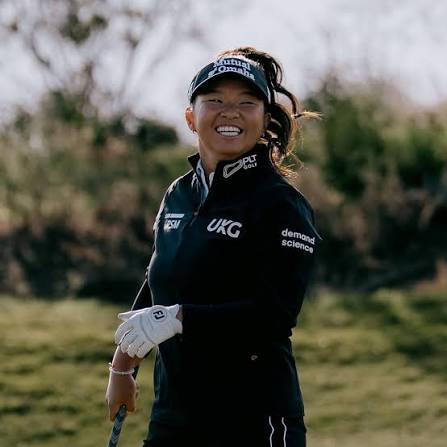
For anyone who understands the intensity of Solheim Cup golf, the question carried the perfect kind of competitive friendship. Those matches matter. The pressure is real. The pride is real. But the memory can still become a joke between two players sharing an LPGA week in Northwest Arkansas.
Hull did not miss her chance.
“Yeah, it made me very, very confident knowing that I beat you, Megan,” Hull said. “It made me feel really confident as well that you was in front of me, comfortable as well knowing that my friend was in front of me as well.”
Then she added, “Even though he held me up on a couple holes.”
There it was: the laugh, the teasing, the reminder that even inside a world governed by scorecards and cut lines, these women have relationships that stretch beyond the next tee shot. Khang had one more question. “I see you had a bogey on 12,” she said.
Hull’s answer was immediate. “No,” she said. “I don’t want to talk about it.” The room laughed. It was a small exchange. It lasted just minutes. It may have meant everything.
What the Girls in Rogers Saw
At the Walmart NW Arkansas Championship, young girls do not have to imagine what an elite woman athlete looks like. She is right in front of them. She walks down the fairway with purpose. She talks with her caddie. She chooses a club. She hits a shot into the green. She signs an autograph. She may wave at a child standing behind the rope with a visor too big for her head and a golf ball clutched in her hand.
On Friday, those girls had another chance to see themselves. They saw Hull respond to a bogey rather than surrender to it. They saw her make seven birdies and post 65. They saw her play a sport that demands concentration, strength, imagination and nerve. But they also saw the humanity behind all of it.
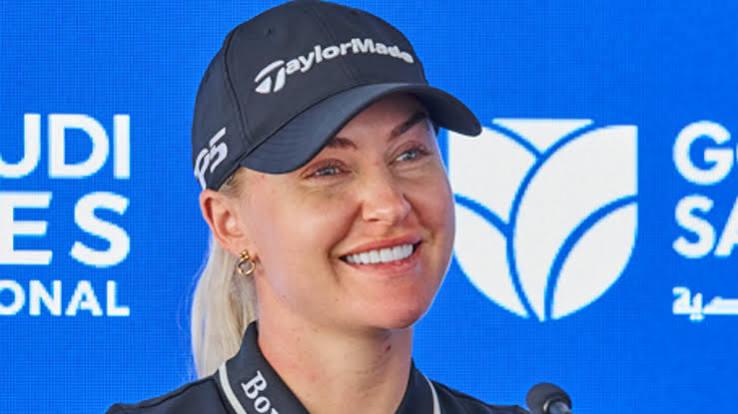
Khang’s playful interruption reminded everyone that being great does not require a young woman to be distant or humorless. It does not require her to compete without warmth. It does not require her to become someone else to belong in professional sports.
Girls can be serious about their dreams and still laugh loudly. They can chase trophies and still cheer for their friends. They can lose, learn, return and refuse to let one bad hole define them. They can be Charley Hull, walking off a bogey at No. 12 and finding seven birdies before the day is over. They can be Megan Khang, showing up for a friend with a joke at exactly the right moment.
That is what Rogers got to witness Friday. Not only a 65. Not only a leaderboard. Not only a tournament round at a beautiful course in Northwest Arkansas.
The girls in attendance saw women being powerful without giving up their joy. They saw competitors who could carry the weight of a Solheim Cup memory, a packed leaderboard and the expectations of a professional sport — then laugh about a bogey in front of a room full of people.
There will be another leaderboard tomorrow. Another round. More birdies, more pressure and more names moving up and down the board.
But there were little girls at Pinnacle Country Club on Friday who may go home and putt on the carpet, swing a plastic club in the backyard or ask their parents when they can play again. And somewhere in that motion will be the memory of two LPGA players who showed them not just how to be golfers.
They showed them how to be themselves.