
Charlotte Football has no excuse for what happened against The Citadel. There are season-opening losses that sting. Some losses expose problems. Then some losses become a Monday morning hangover before a team has even had time to wash the game tape from its hands.
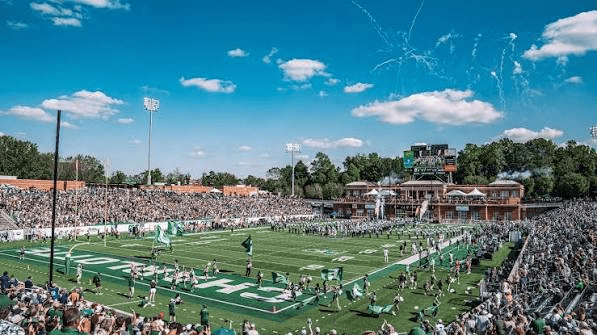
Charlotte’s 43-41, triple-overtime loss to The Citadel is all of that. The 49ers did not lose to an American Athletic Conference rival. They did not get caught in a back-and-forth shootout against a Power Four opponent. They lost at home to an FCS opponent after allowing The Citadel to walk into Jerry Richardson Stadium, run for 311 yards, and leave with one of the most stunning results of college football’s opening weekend.
There is no elegant way to dress this up. Charlotte had an opportunity to start a new season with momentum. Instead, the 49ers opened with a loss that immediately places pressure on the program, the coaching staff, and every player who took the field Saturday night.
This is not about disrespecting The Citadel. The Bulldogs earned the win. They played through a weather delay. They made plays in regulation. They answered in overtime. And when Charlotte had opportunities to end the game, The Citadel proved tougher, steadier, and more prepared in the moments that mattered most. That is precisely why this loss should hurt so much.
An FCS Loss Changes the Conversation
Every college football team can have a bad Saturday. The sport is too volatile and too dependent on execution for anyone to be immune from an upset. But context matters. Charlotte is an FBS program competing in the American Athletic Conference. The Citadel is an FCS program from the Southern Conference. The 49ers were playing at home. This was supposed to be the kind of opener that allows a program to establish its identity, build confidence, and carry positive energy into the weeks ahead.
Instead, Charlotte will spend Monday answering the questions that come after an FCS loss. How did the defense allow The Citadel to control the game on the ground? Why was there no meaningful separation before overtime? Why did Charlotte fail to finish, repeatedly, with the game available to win? And perhaps the most painful question: What does this say about where the program really is?
The Citadel did not simply steal the game on one fluke play. The Bulldogs earned it possession by possession. Their ground game consistently created an edge, and Charlotte never discovered a reliable answer. Charlotte knew what was coming. It still could not consistently stop it. That is not bad luck. That is a breakdown.
The Defense Could Not Deliver
The final score will show 43 points allowed. Overtime can inflate a number, but it does not erase the uncomfortable truth behind it. The Citadel found a running game. Charlotte did not find a response. Allowing 311 rushing yards at home is not simply an ugly statistic. It is a warning sign. It is an identity problem.
A defense cannot expect to compete in the American if it cannot establish control against the run. It cannot expect to protect home field if it gives an opponent the freedom to dictate tempo, stay ahead of the chains, and turn every fourth-quarter possession into a test of toughness.
The 49ers allowed The Citadel to make this a physical game. Then they allowed the Bulldogs to keep it there long enough for doubt to spread across the stadium. That is how upsets happen. The underdog does not need to dominate from the opening whistle. It only needs to stay close long enough for the favorite to tighten up. Charlotte gave The Citadel that chance.
Credit the Bulldogs, Then Fix the Problem
The Citadel deserves every bit of credit for its performance. The Bulldogs are now 2-0 all-time against Charlotte, and both victories have come in overtime. Saturday’s 43-41 triple-overtime victory was not merely an upset. It was another painful chapter in a strange matchup history for the 49ers.
But Charlotte cannot afford to treat this as simply one of those weird September outcomes. The 49ers must respond immediately. Not with clichés about learning from adversity. Not with empty promises about correcting mistakes. They need tangible improvement: better tackling, greater defensive discipline, more control at the line of scrimmage, and a team capable of finishing games before desperation becomes its only plan.
A season is not over after one game. Charlotte has time to recover. It has time to correct the flaws Saturday exposed. It has time to prove this was an awful opener rather than a warning sign. But the first Monday of the season belongs to The Citadel. Charlotte owns the headache.