

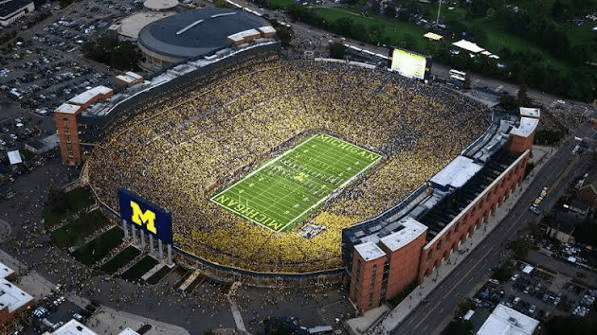
For a few chaotic minutes in Ann Arbor, college football had its latest officiating outrage packaged and ready for social media: Michigan appeared to receive a second chance after time expired, Western Michigan appeared to be robbed, and the Big Ten appeared to be protecting one of its flagship brands.
The Big Ten Got It Right in Ann Arbor, Even If Nobody Wanted to Hear It
That is the easy version of the story. It is also not the accurate one.
The Big Ten’s decision to restore one second in Michigan’s 13-12 win over Western Michigan was correct. Not convenient. Not emotionally satisfying for Western Michigan. Not helped by the way the network broadcast presented the final sequence. But correct under the rulebook and, more importantly, correct based on the replay evidence officials were charged with using.
A play does not become wrong simply because it produces a result people dislike. Michigan received one more snap. Bryce Underwood threw a 47-yard touchdown pass to JJ Buchanan. The Wolverines escaped. Western Michigan suffered a crushing loss.
None of that changes the decisive question: Was there one second remaining when Western Michigan’s defender, having left his feet from an out-of-bounds position, touched the ball? According to the Big Ten, there was. And if there was, officials had no discretion. They had to stop the clock and give Michigan the final play.
The Rule Is Clear
The foundation of the ruling is not complicated, even if the ending was. The Big Ten stated that Western Michigan’s No. 18 “started his jump from an established out-of-bounds position (left foot) and made contact with the ball with one second remaining on the clock.”
That is not vague language. It identifies the player’s status, the relevant contact, and the exact time remaining. The central fact is not whether the defender caught the ball or landed out of bounds. The central fact is that he touched a loose ball while legally considered out of bounds.
The conference then cited NCAA Football Rule 4-2-3-a: “A ball not in player control, other than a kick that scores a field goal, is out of bounds when it touches the ground, a player, a game official or anything else that is out-of-bound, or that is on or outside a boundary line.”
The rule’s consequence is unmistakable. A loose ball that touches an out-of-bounds player becomes dead immediately. As the Big Ten concluded, “and thus the clock is stopped.”
Western Michigan’s defender did not need possession. He did not need to complete a catch. He did not need to land before the clock expired. Once he touched the ball after starting his jump from an established out-of-bounds position, the ball was out of bounds. If the video showed one second remaining at the point of contact, that second belonged on the clock. This was not an invented exception for Michigan. It was the rule applied as written.
The Broadcast Was Not the Evidence
The public frustration is understandable because television viewers saw the NBC clock reach zero as the first Hail Mary played out. In a decisive moment, the broadcast image becomes the evidence fans trust most. But it is not necessarily the same evidence available to replay officials.
The Big Ten explained that its decision came from “a side-by-side view of the play and the game clock, using a direct shot of the game clock in the stadium.” That distinction matters. Officials were not simply estimating the remaining time from an on-screen network graphic. They were using an actual stadium-clock shot aligned with the replay video.
The conference also addressed the concern that camera feeds and clocks might not match. “Eighty-five minutes prior to the game,” the Big Ten said, “all broadcast cameras used for the replay system, including the camera on the game clock, are synced using a strobe system to ensure all cameras are aligned.”
That sentence is the heart of the league’s explanation. The Big Ten is saying its replay process uses synchronized video—not a guess, not a delayed network graphic, and not a postgame attempt to rationalize a controversial result. The officials had a direct look at the stadium clock and the ball contact on aligned cameras. Their review showed one second.
Could the conference have communicated that faster? Yes. Did the visual disconnect between the broadcast and the ruling invite suspicion? Absolutely. But a poor rollout of a correct explanation does not make the ruling wrong.
Results Do Not Set the Standard
The noise around this ending is louder because Michigan won. Had replay restored one second for Western Michigan, and the Broncos used it to stun Michigan in the Big House, much of the country would have called it an unforgettable finish. That does not invalidate Western Michigan’s disappointment, but it does expose how often outrage begins with the name on the jersey and ends with the scoreboard.
Michigan did not receive a free timeout. The Wolverines did not get a phantom penalty. They did not receive a special rule because the game was in Ann Arbor. They received what the replay review determined was still available: one second.
Western Michigan deserves empathy. The Broncos were seconds from a defining program victory. Losing on a 47-yard touchdown after believing the game had ended is crushing. But pain is not the same as unjust.
The Big Ten should be held accountable for transparency whenever an officiating decision changes a game’s outcome. Still, transparency cannot become a demand that officials ignore synchronized replay evidence because the conclusion is unpopular.
The conference explained its ruling. It cited the exact contact, the exact timing, the actual rule, and the replay process used to reach the decision. Michigan won because it made the play that was still legally available. Western Michigan lost because one second—however agonizingly small—was still one second. In football, the clock does not care about outrage. On Saturday night in Ann Arbor, neither did the rulebook.