

For most of modern sports history, access to the game was universal. If you had a television, you could watch. It didn’t matter your age, your technical ability, or your familiarity with emerging platforms. The experience was consistent. That consistency is disappearing.
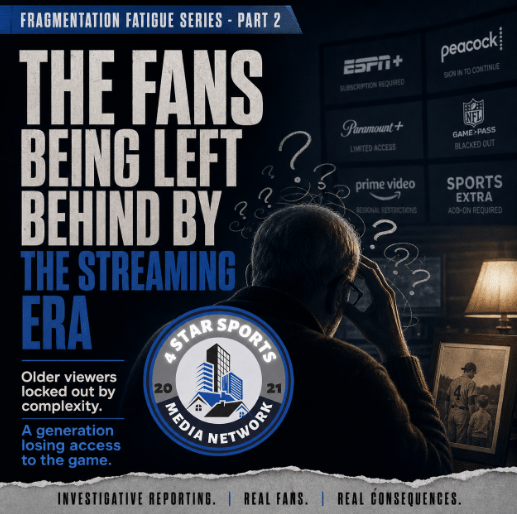
The Fans Being Left Behind by the Streaming Era
As sports have moved deeper into the streaming era, accessibility has become uneven. While some fans have adapted quickly to the shift, others have found themselves navigating a system that feels increasingly complex and unfamiliar. Among those most affected are older viewers.
This is not a question of willingness. It is a question of usability.
Streaming platforms are built around assumptions—multiple logins, app navigation, subscription management, and device compatibility. For users who have grown up with that environment, those steps are routine. For others, they can be barriers.
The challenge is compounded by fragmentation. A single team’s games may be spread across several services, each with its own requirements. One game may appear on a traditional broadcast, another on a streaming-exclusive platform, and another behind a subscription that requires additional setup. What was once a routine has become a process.
For older fans, that process can be enough to disrupt engagement. It is not uncommon for viewers to miss games not because they lack interest, but because they are unable to locate or access them in time. This shift carries broader implications.
Older audiences have long been among the most consistent consumers of sports. Their viewing habits are established, their allegiances stable, and their engagement reliable. They represent continuity within the fan base, connecting past eras of the sport to the present.
When that group begins to disengage, even gradually, the impact is felt over time.
Sports culture is built on shared experience. It is passed down through families, reinforced through routine, and sustained through accessibility. When access becomes uneven, that continuity weakens.
There is also a structural concern. The current streaming model prioritizes flexibility and revenue diversification, but it does not always prioritize simplicity. Interfaces change, platforms update, and access points shift. For users comfortable with constant adaptation, this is manageable. For others, it introduces uncertainty. In the end, uncertainty creates distance.
The industry has framed this transition as progress, and in many ways, it is. Streaming offers convenience, portability, and expanded options. But progress is only effective when it remains inclusive.
At present, inclusivity is not evenly distributed.
Some steps could address this imbalance. Simplifying user interfaces, consolidating access points, and improving clarity around scheduling would reduce friction. Providing alternative viewing options that do not rely on complex navigation would help maintain accessibility for a broader audience.
These are not technological challenges. They are strategic priorities.
The long-term success of any sports league depends on maintaining engagement across generations. Younger audiences represent future growth, but older audiences represent stability. Losing either creates an imbalance.
Right now, the balance is shifting. The risk is not immediate. It rarely is. Fans do not disappear overnight. They drift, gradually, as the experience becomes less accessible and less intuitive. For older viewers, that drift is already underway. Furthermore, if the industry is not careful, it will not just lose a segment of its audience.
It will lose a generation that helped define the experience of watching the game.