

There is a subtle shift happening in how sports are consumed, and it is not being driven by the games themselves. It is being driven by everything around them.
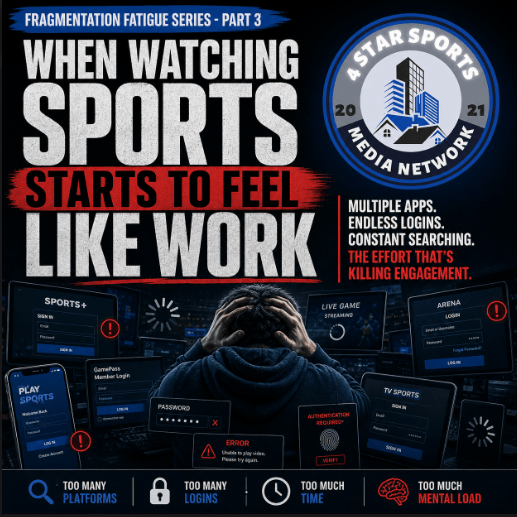
When Watching Sports Starts to Feel Like Work
Watching sports, once a passive and predictable experience, now requires effort. Not in the sense of emotional investment or attention, but in the logistics of access. The act of finding a game has become part of the process, and in many cases, the most frustrating part.
Fans are being asked to do more than watch. They are being asked to manage.
Multiple subscriptions, varying schedules, platform exclusivity, and inconsistent availability have turned what used to be routine into something closer to a task. It is not uncommon for fans to check multiple apps, search online listings, and navigate login systems before they even reach the broadcast. That effort accumulates.
Individually, each step is minor. Together, they create friction. And friction changes behavior.
Sports have historically thrived on ease. The easier it is to watch, the more likely fans are to engage regularly. That consistency builds connection, and that connection sustains interest. When the process becomes complicated, that consistency is disrupted.
The current streaming model prioritizes distribution across multiple platforms. From a revenue standpoint, it is effective. Rights are sold in segments, maximizing value and expanding partnerships. But from a user experience standpoint, it introduces fragmentation.
Fragmentation reduces clarity. Fans are no longer certain where games will appear, and that uncertainty affects engagement.
There is also a psychological component. When accessing content feels like work, the perceived value of that content changes. What was once effortless entertainment begins to feel conditional.
Sports compete for attention in an environment saturated with alternatives. If watching becomes inconvenient, other forms of entertainment—often more accessible—fill the gap.
This is particularly relevant for younger audiences, who are less inclined to navigate complexity. But it applies broadly. Even dedicated fans can reach a point where the effort outweighs the reward. The industry has not fully accounted for this shift.
Revenue models assume that demand will remain constant, even as access becomes more complex. That assumption may hold in the short term, but over time, behavior adapts.
Fans streamline their habits. They watch fewer games. They rely more on highlights. They disengage from live viewing. Each of those changes reduces the value of the product. There is a balance to be found between maximizing distribution and maintaining usability. At present, that balance leans heavily toward the former.
The question is how long that imbalance can persist before it begins to affect the latter. Because when watching sports starts to feel like work, the issue is not with the fans. It is with the system they are being asked to navigate.