

Streaming was introduced as a solution.
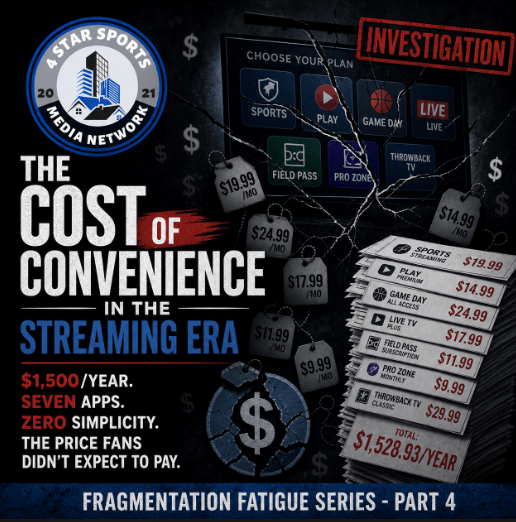
It promised flexibility, convenience, and control. Fans could watch from anywhere, on any device, without being tied to a traditional cable package. The model was positioned as an upgrade—more options, more access, more freedom.
In many ways, it delivered. But as the system has evolved, so has its cost. Not just financially, but structurally.
The convenience of streaming has been offset by fragmentation. Instead of one centralized platform, fans now navigate a network of services, each offering a portion of the overall product. The result is a system that is flexible in theory but complicated in practice.
Convenience has become conditional. Access depends on subscriptions. Subscriptions depend on awareness. And awareness depends on constantly shifting schedules and platform agreements. This layered structure creates a different kind of cost—one measured not only in dollars, but in time and attention.
Financially, the burden is clear. Maintaining access across multiple platforms can rival or exceed the cost of traditional cable. What was once a single monthly bill has become several, each tied to a specific segment of content.
Structurally, the burden is less visible but equally significant.
Fans must track where games are being broadcast, manage multiple accounts, and adapt to different user interfaces. The experience varies from platform to platform, reducing consistency and increasing friction. The original promise of streaming was simplicity. What has emerged is something more complex.
This complexity affects different audiences in different ways. Tech-savvy users may adapt quickly, but even they encounter frustration when content is difficult to locate. For others, particularly those less familiar with digital ecosystems, the barriers are more pronounced. The broader impact is gradual but measurable.
When access becomes inconsistent, engagement becomes inconsistent. Fans watch when it is easy, and they disengage when it is not. Over time, that pattern reshapes viewing habits. Live sports, once defined by their immediacy, become something that fans consume selectively rather than routinely.
That shift carries implications for leagues, broadcasters, and advertisers alike. The value of sports media rights has always been tied to consistent viewership. If that consistency erodes, even slightly, the long-term value proposition changes. There is still time to adjust.
Consolidation, improved discoverability, and more transparent scheduling could restore some of the simplicity that defined earlier eras of sports consumption. The technology exists to create a more unified experience.
The question is whether the industry prioritizes that experience. Because the current model, while profitable, is not without consequence. Convenience was the selling point of streaming. If it is no longer convenient, the system will need to evolve.
If not, the audience will.