
There was a time when following your team required little more than habit. You knew the channel. You knew the time. You turned on the television, and the game was there.
The Night the Game Became Hard to Find
That simplicity is gone.
Today, watching sports has become a fragmented experience, one that requires planning, multiple subscriptions, and often, a fair amount of guesswork. The modern fan is no longer just a viewer but a navigator, moving between platforms in search of something that used to be easily accessible.
A single team’s schedule can now be split across as many as six or seven platforms. National broadcasts might appear on one service, exclusive games on another, and local matchups on a regional network that may or may not still exist in its traditional form. Add in blackout restrictions, and even paying customers can find themselves unable to watch games in their own market.
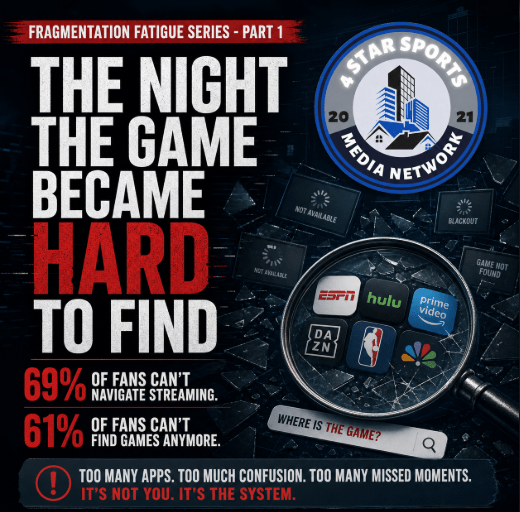
The result is a growing sense of frustration. Nearly 70 percent of fans now say managing multiple streaming services is a hassle, and more than 60 percent report difficulty simply finding where games are being broadcast. That is not a minor inconvenience. It is a signal.
Sports have always depended on accessibility. The ability to watch regularly, without friction, is what builds a habit. And habit is what builds fandom. When that process becomes complicated, the foundation begins to shift.
From a business perspective, the current model makes sense. Leagues have maximized revenue by distributing media rights across multiple partners. Instead of one network paying a premium for exclusivity, several platforms now pay for pieces of the schedule. The NFL, NBA, and MLB have all benefited from this approach, securing long-term deals worth billions.
But the cost of that strategy is being absorbed by the fan.
Where once there was a single point of entry, there are now several. Each requires a subscription, a login, and familiarity with a different interface. For some, that complexity is manageable. For others, it is enough to disrupt the viewing experience entirely.
Time is another factor. Finding a game can take minutes, sometimes longer, especially when schedules shift or exclusivity deals change week to week. That may not seem significant on its own, but it adds friction to what was once effortless.
And friction, over time, reduces engagement.
Younger audiences, in particular, are less tolerant of that friction. Raised in an environment where content is immediate and abundant, they are less likely to search extensively for a game. If access is not straightforward, they move on.
That shift has implications beyond viewership numbers. Live sports have long been one of the few remaining forms of real-time, shared media consumption. If fans begin to disengage from live broadcasts, the value of those rights deals—so carefully negotiated—could be affected.
There is also the question of cost. Maintaining access across multiple platforms can exceed $1,000 annually, depending on the sport and market. For households following more than one league, the number rises quickly.
That changes the equation. Watching sports becomes a financial decision, not just a habitual one. Leagues have, in many ways, traded simplicity for scale. The revenue gains are undeniable. But the long-term impact on fan behavior is less certain.
At its core, sports consumption has always been about ease. The easier it is to watch, the more people watch. The more people watch, the stronger the connection becomes. Right now, that ease is being tested.
And if the current trajectory continues, the industry may find that maximizing access points has come at the expense of accessibility itself. Because for many fans, the issue is no longer whether they want to watch.
It’s whether they can find the game at all.