
The Kentucky Derby has lasted because it delivers something modern sports rarely offer anymore: a shared national moment built on history, ritual, and scarcity. It lasts roughly two minutes, but the race carries more than 150 years of accumulated symbolism, from its 1875 debut in Louisville to its present role as the first jewel of the Triple Crown and one of the most recognizable events on the American sports calendar. For one Saturday every spring, Churchill Downs becomes part horse race, part fashion showcase, part civic festival, and part television spectacle, all of it wrapped around a field of 3‑year‑old Thoroughbreds trying to survive the most chaotic trip in racing.
Run for the Roses: How the Kentucky Derby Became America’s Spring Ritual
The Derby began as an imported idea with an American accent. Meriwether Lewis Clark Jr. traveled through Europe in the 1870s, studied major races such as England’s Epsom Derby and France’s Grand Prix de Paris, and returned home determined to build a race that could anchor Louisville on the sporting map. The result was the Louisville Jockey Club and the track later known as Churchill Downs, where the first Kentucky Derby was run in 1875 and won by Aristides over 1.5 miles. That inaugural race announced Kentucky as a serious center of American horse culture at a time when the nation was still defining its post‑Civil War identity.
The race changed in 1896 when the distance was shortened to 1 1/4 miles, the measurement that still defines the Derby today. That adjustment mattered because it better fit the developing American style of racing, which favored a sharper blend of speed and stamina rather than a European‑style grind. It also helped create the modern Derby drama: a break from the gate that matters instantly, a middle stretch that punishes impatience, and a final run home that can turn triumph into collapse within seconds. The present‑day Derby feels eternal, but much of what fans now consider timeless was refined through decades of adaptation.
That ability to evolve without surrendering its identity is the reason the event became more than a race. As radio and then television expanded the Derby’s audience, Churchill Downs learned how to package spectacle. The track’s grandstand, completed in 1895 and crowned with twin spires, became a visual shorthand for elegance and anticipation, and the race itself turned into a gateway for casual viewers who might not follow another horse event all year. Once the Triple Crown format hardened in the public imagination, the Derby gained even more significance because it stopped being just a destination and became the opening act of an even larger pursuit. Win in Louisville, and a horse is no longer merely a Derby champion; it is suddenly carrying the possibility of sporting immortality.
No figure illustrates the Derby’s power as a national stage better than Secretariat. His 1973 victory in 1:59 2/5 remains the fastest Kentucky Derby ever run and one of the most famous performances in American racing history. The time still functions as a kind of impossible standard, a number invoked every spring whenever a new contender appears dominant in prep races or posts a dazzling workout. Secretariat mattered not just because he won, but because he gave television and racing fans an image of perfection that still shapes how greatness is discussed at Churchill Downs.
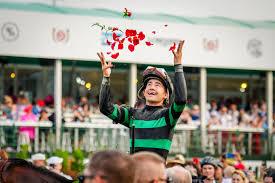
Yet the Derby’s hold on the culture has never depended solely on horsepower. Tradition gives the event its emotional weight. The winner receives a blanket of red roses, the origin of the phrase “Run for the Roses,” after red roses became the race’s emblem and the presentation of the floral garland was formalized in the early 20th century. The crowd sings “My Old Kentucky Home” as the horses come onto the track, a ritual that has endured since the 1930s and remains one of the defining sounds of Derby day. Mint juleps flow by the tens of thousands in souvenir glasses, joining the roses and the song as symbols that matter almost as much as the race itself.
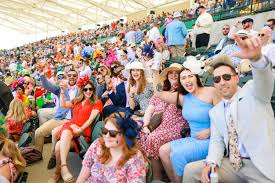
Then there is the visual theater. Derby fashion has become one of the event’s main attractions, with elaborate hats, floral prints, bold color palettes, and spring formalwear helping turn attendance into a performance in its own right. The grandstand presents one version of the Derby, refined and curated for cameras, while the infield offers another, louder and less restrained, shaped by tailgate energy, packed crowds, and a college‑football‑meets‑music‑festival mood. Those parallel experiences are part of what makes the Derby such a durable American spectacle: it can still sell prestige and revelry at the same time.
That dual identity also creates tension. In the modern era, the Kentucky Derby is both a heritage institution and a contemporary sports business. Corporate sponsorships, luxury hospitality, wagering partnerships, and broadcast rights have helped turn Derby week into an economic engine, while controversies over medication, disqualifications, and horse safety have forced racing to answer harder questions about its future. The 2021 victory by Medina Spirit, for example, was later vacated after a medication case, a reminder that even the race’s most luminous moments now live alongside scrutiny and distrust. The Derby’s romance remains real, but it now operates in constant conversation with accountability.
Even so, the first Saturday in May still feels different from other major sporting dates. The race is short enough to attract casual viewers, historic enough to satisfy traditionalists, glamorous enough to pull in lifestyle coverage, and unpredictable enough to feed bettors and analysts for weeks. In an era when sports audiences are fragmented across streams, alerts, and clips, the Kentucky Derby still creates a singular appointment. For two minutes, the country looks in the same direction.